Health
In Search of Wisdom

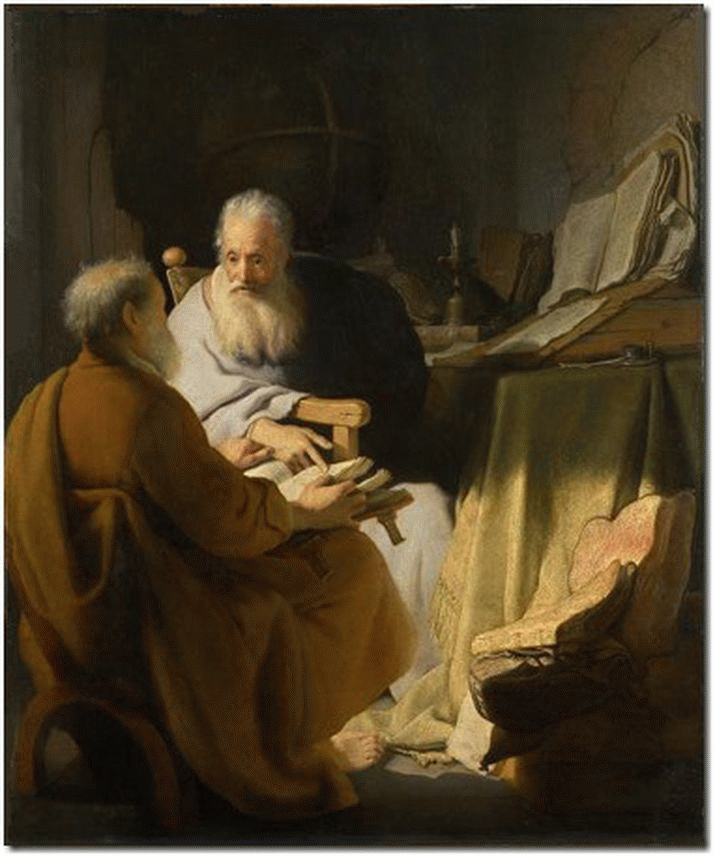

The getting and begetting of wisdom – so revered in the past as a practical and spiritual necessity for both individuals and societies – seems to be sadly out of fashion in our present age. The very idea that we should seek, love and promote wisdom is likely to be met with incredulity or derision, to be dismissed as yet another form of stuffy intellectual or moral pretentiousness. Perhaps it is a case of: Where ignorance is bliss, ’tis folly to be wise!
So it is refreshing to discover Alain de Botton’s wonderful new and very user-friendly alternative news service: www.thephilosophersmail.com It is unashamedly dedicated to re-invigorating the concept of wisdom as an unending adventure in the better understanding of ourselves, our world, what we most need to know, what we should value and how we could live more decently and happily in the face of all of life’s many difficulties.
This complements his new School of Life project which operates in cities around the world, including Melbourne, where the National Gallery of Victoria is currently also hosting his and philosopher John Armstrong’s Art as Therapy program.
Among the many cultural treasures held by the gallery, and part of that program, is one of my favourite works of art – a wonderful early masterpiece by Rembrandt: Two Old Men Disputing. (Above) It is a painting about the getting of wisdom, not material possessions. The enlightened elders are passionately engaged in the collaborative endeavour of getting to the true meaning of the work at hand. Reflection and good conversation are at the heart of such an enterprise. The luminous text – representing the crucial role of culture in helping discern their highest aspirations to Truth, Goodness, Beauty and Justice – is the source of their inspiration. Rembrandt’s engagement is equally passionate and in the same tradition. His treatment is reverential. Clearly, for him, wisdom is golden. But can such an image still speak to us?
While there are as many paths to wisdom as there are people looking for it, I wonder what these wise elders would say were the most important lessons they have learned from all their reading, thinking and arguing. I imagine they might include the following:
1. Know thyself
This inscription above the entrance to the Greek Oracle of Delphi is the starting point. Each of us possesses a unique consciousness and perspective on the world. It is a precious gift that carries with it a call to self-reflection and awareness. This is the ethical imperative, essential if we are to avoid individual and collective madness, as Shakespeare’s King Lear tragically reveals. It challenges us to look at ourselves with unflinching honesty, as in Rembrandt’s many astonishing self-portraits.
Philosophers remind us of the need to constantly re-examine what we really think and the soundness of our reasoning. We must challenge our intellectual prejudices and the taken-for-granted ideologies that pervade our opinions. Thinking about how one thinks can be hard work, as philosophers like Raimond Gaita and Ronald Dworkin demonstrate. Alain de Botton’s and John Armstrong’s initiatives are to be welcomed as more accessible points of entry. (Sites such as the ABC and YouTube have many of these thinkers’ best talks, as well as the wonderful Justice Harvard lectures of inspirational Harvard Professor, Michael Sandel.)
Therapists remind us of the need to become more aware of what we feel and its relationship to what we think, to recognise what unconscious processes run our habitual responses to life and what emotional barriers need to be overcome to lead healthier, saner lives. This can also be hard work. It requires even more courage to address painful feelings than prejudicial thoughts – something therapist M. Scott Peck acknowledges in his book The Road Less Travelled, which many have found helpful.
Of course, to know yourself involves much more than the intellectual and the emotional. We are more than our thoughts and our feelings. The depths of our inner lives – our ‘souls’ if you like – know no limits. There is a great undiscovered world within and to not explore it is to fail to rise to our essential humanity. As Socrates concluded: The unexamined life is not worthy of a human being.
2. Get to know the best that has been thought and said in the world
Of course, we cannot know ourselves fully on our own. We need more than our own personal resources. We need guidance from significant others.
My mother was my first best guide. One of her great gifts as a parent was to impart her wisdom simply by talking to me about everything, reading the traditional stories and providing me with carefully chosen books. Apart from a children’s Encyclopedia which I explored for years, I particularly remember Oscar Wilde’s beautiful children’s stories The Happy Prince and The Selfish Giant. These are much more than delightful moral fables. Their language, when read aloud by a parent in the spirit of love, evokes a profound sense of wonder and awe – confirming the essential goodness of life, while sensitising us to what can destroy it. And the illustrations – particularly Walter Crane’s marvelous woodcut in the original publication of The Selfish Giant – demonstrate the power of art to convey what words cannot.
Our inherited culture is the great repository of wisdom. It is overflowing with the most important books, works of art and (importantly for me) music, produced by the best minds of each generation and preserved as the most worthy of passing on to the next. But what is inherited, and the wisdom it contains, is only kept alive by our passionate creative and critical engagement with it. Only then have we standards by which to judge the value of our present culture, including our popular culture. Sociologist John Carroll is a wonderful guide here.
The critical function of culture, according to Matthew Arnold in Culture and Anarchy, involves:
… getting to know, on all the matters which most concern us, the best which has been thought and said in the world; and through this knowledge, turning a stream of fresh and free thought upon our stock notions and habits, which we now follow staunchly but mechanically, vainly imagining that there is a virtue in following them staunchly which makes up for the mischief of following them mechanically.
I will always be grateful to my English teachers at Sydney University in the mid 1960s for introducing me to Matthew Arnold and ‘the great tradition’ of English literature under the influence of FR Leavis. They passionately advocated ‘the common pursuit of true judgment’ in all our intellectual endeavours, with the primary function of culture and criticism being to help us to live better, more fulfilling lives and to contribute to building a better society.
In so many ways, our future depends on drawing wisdom from our culture. Therefore, the goal of every serious endeavour should be to learn all we can from the best examples available to us, to add our own unique contribution and then share it with others.
3. Think it possible you may be mistaken in whatever you think or do
One of my intellectual heroes is Jacob Bronowski, whose BBC television documentary and book The Ascent of Man is surely one of the greatest cultural achievements of the twentieth century. It is a treasure trove of wisdom from a genius communicator who understood deeply the unity and value of both scientific and artistic endeavour.
Even more than this, however, his greatest contribution, I believe, was to remind us of the human limits of even our best understandings and to warn us against the dangers of hubris and arrogance.
There is no absolute knowledge and those who claim it, whether they are scientists or dogmatists, open the door to tragedy. All information is imperfect. We have to treat it with humility. That is the human condition …
All knowledge, all information between human beings can only be exchanged within a play of tolerance. And that is true whether the exchange is in science, or in literature, or in religion, or in politics …
We are always at the brink of the known, we always feel forward for what is to be hoped. Every judgment in science [and, one could add, religion, morality or politics] stands on the edge of error, and is personal …
Knowledge is not a loose-leaf ragbag of facts. Above all, it is a responsibility for the integrity of what we are, primarily of what we are as ethical creatures.
Bronowski believed passionately in the power of the human imagination, in the unity of knowledge across all domains and in ethical integrity. Dworkin, in his last monumental work Justice for Hedgehogs, is equally passionate about the unity of value across all domains: “The truth about living well and being good and what is wonderful is not only coherent but mutually supporting: what we think about any one of these must stand up, eventually, to any argument we find compelling about the rest.”
4. Judge all things conscientiously but try never to judge anyone personally
If we can have no certainty in our scientific knowledge of the material world, then we can have even less certainty in the correctness of our judgments in the moral domain. We must, therefore, be less dogmatic and more ‘tolerant’ (in Bronowski’s sense of the word) in the many ethical and moral judgments we are required to make.
Whether and how we communicate such judgments requires even more care because of the profound impact our judgments can have on others. Fools rush in where angels fear to tread! (A wise friend of mine once said that if you have a harsh truth to tell someone make sure you “hold their hand” while you do so.)
No matter how severe our judgments may be about a person’s behaviour, we should always remember that a person is infinitely more than his or her conduct. A person is a subject not an object, a being totally beyond our human reckoning and a mystery beyond all comprehension, let alone judgment.
It is crucial to keep in mind this distinction between judging the moral significance of behaviour, while at the same time acknowledging the full intrinsic value of the person whose behaviour we are judging. It requires, characteristically, the wisdom of mothers and saints, whose intuitive immediate response to the person is kindness and a non-condescending pity, in full recognition that “There, but for the Grace of God go I.” In the words of narrative therapist Michael White, whose wonderful work exemplified such wisdom: “Think it possible that you might not be doing as well as your clients if you were fully in their shoes.” The whole thrust of his therapy was to separate problems, behaviours and judgments from the person.
Given that our culture has become increasingly moralistic and condescending, Raimond Gaita has done us a great service in helping us to think about this issue more clearly.
In Romulus, My Father he pays moving tribute to the wisdom he learned, long before he studied philosophy, from his father. For Romulus, nothing was more important than to live decently. He was often severe in his moral judgments of other people’s moral failings but remarkably never looked down on them as somehow inferior, or judged them as persons unworthy of love, because of those failings. In After Romulus Gaita says:
“I learned from my father that we could, to a morally important degree, detach moral responsibility from the conditions of culpability and think of it, essentially, as a serious, lucid responsiveness to the moral significance of what we have done.”
The only purpose of moral judgment should be as an invitation to moral responsibility. It should never be a statement about the value of a person as a human being.
As Gaita beautifully concludes:
“No-one is underserving of love, not because everyone is really deserving of it, but because, unlike admiration or esteem, real love, deeper than both, has nothing to do with merit or desert.”
Christian doctrine – often abused, confused or reversed in practice – emphasises forgiving the person while condemning their wrongdoing. (Our great religious texts are full of practical wisdom which, when read in the right way, can still help us to live better in our secular world. My early guide was existentialist theologian Paul Tillich’s profound meditations on the human condition: The Shaking of the Foundations. John Carroll’s reading of our rich Christian heritage, emphasising the importance of story and imagination to religious experience, is also insightful and provocative.)
The difficulties of living out this wisdom in everyday life are many and varied. Our struggle with blame, forgiveness and reconciliation is the subject of some of our greatest literature, from Shakespeare’s last plays to Pulitzer Prize-winning novelist Marilynne Robinson’s recent novels about ‘normal’, intimate, troubled family relationships, Gilead and Home – extraordinary works of profound wisdom, insight and wondrous love.
5. Love more and allow yourself to be loved
Wisdom does not only flow in one direction. In a popular song made famous by Nat King Cole, it is the “very wise’ Nature Boy – for me it is the ‘very wise’ Girl – who teaches the older man the most important lesson of all: “The greatest thing you’ll ever learn, is just to love and be loved in return.” We all know this to be true. But we need reminding.
Cartoonist Michael Leunig says: “Love one another. It is as simple and as difficult as that. There is no other way.”
Love is the great Mystery. It grounds all of our most important values, meaningful relationships and passionate endeavours. It, more than cleverness, is the true source of our greatest achievements, as Mozart recognised:
“Neither a lofty degree of intelligence nor imagination nor both together go to the making of genius. Love, love, love, that is the soul of genius.”
Love is the source of our greatest happiness. But our failure to love ourselves, others and our world appropriately can also be the cause of our greatest sorrows. So we need to work at it. Love is more than a feeling; it is a call to action, which requires effort and discipline. According to Scott Peck it involves: “The will to extend one’s self for the purpose of nurturing one’s own or another’s spiritual growth.” This involves a commitment to honesty and integrity.
There is an old saying: “Love is a bird with two wings: one is compassion, the other is wisdom. If either is broken, the bird cannot fly.”
There can be no wisdom without love. Knowledge is not enough. Only wisdom acquired through love can inspire a meaningful personal life, as well as a culture in which individuals and society can flourish.
We need more of both.
( For my daughter, in the spirit of Plato: “We should leave our children a legacy rich, not in gold but in reverence.” )