Coroner & Legal
Down Memory Lane

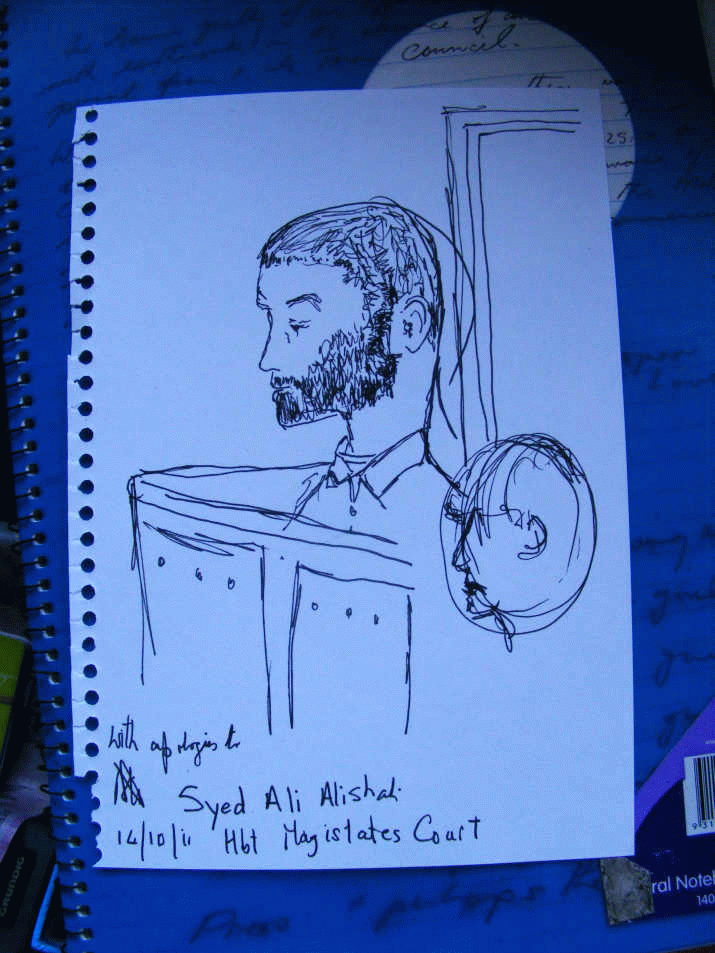

*Pic: Sketch which was done when Ali fronted the court and got sent down …
Walking down memory lane is not all nostalgia. It’s not all fuzzy photos, the memory of dear times and so forth. Sometimes it’s a can of worms. One such case, ‘Tasmanian logger escapes conviction for punching forestry protester’ [Here] which tells of a man remembering a face and punching it, is just such a thing.
For it firstly involves a magistrate who was innocently at the centre of a corruption controversy some years ago. The Justinian ‘Court in the Act’ [Here]reminds us how Magistrate Simon Cooper was once the Executive Commissioner of the then RPDC, that body which had found the Gunns Pulp Mill application to be ‘critically non-compliant’.
So the story goes, Cooper had been offered a magistrate’s job to promote him out of the job (and thus remove a source of opposition to the pulp-mill). It had even got as far as an advisory letter to Cabinet being prepared for Steve Kons, then Deputy Premier and Attorney General. It would advise that Simon Cooper was to appointed as a magistrate. Kons put his signature to it.
At the eleventh hour, Linda Hornsey (then head of DPAC) contacted him, so the story goes, and demanded that the offer be withdrawn and the letter be destroyed. News of the offer had, so one version of the story goes, been leaked to Sue Neales, then chief reporter for the Mercury. The appointment could not go ahead (lest the reasons for it be published by Neales).
Our then Attorney General Kons, once he put down the phone, shredded the document. This did not go unnoticed by his staffer, Nigel Burch, who later collected the shreddings – actually, as I recall, to protect his boss (Kons) from any future possible ‘friendly fire’ maladvent – yet later (when Kons denied on the floor of the Parliament that the document had ever existed) Burch decided to give the shreddings to Greens MLA Kim Booth.
When having denied in the Parliament that the document had ever existed, at the sight of Booth holding up the reconstituted document for all to see, Kons turned a ‘whiter shade of pale’ (do yourself and listen to this classic song [Here] while you read on). Our then Deputy Premier walked the Parliamentary plank and the Lennon Government lurched on.
Cooper didn’t get the appointment, took another job and eventually was quietly given a magistrate’s job some five years later, in March of last year, 2013, in the last year of the Labor Government’s reign. There had been a Legislative Council inquiry, which had made certain recommendations, the new Integrity Commission Tasmania had then considered this matter, as well as other complaints associated with the pulp mill saga, and the ICT had dismissed them one and all.
In fairness to Cooper, it must be said that he told the Leg Co inquiry that the suggestion that his proposed appointment to promote him out of the RPDCA in order to circumvent opposition to the mill was ridiculous. He rejected it, saying that he was actually only acting in the position and was doing so reluctantly, while in another full-time position. He was trying to get out of his acting RPDC role.
However, he also told the inquiry that he did not accept as true/valid the reasons (e.g. possible perceptions of Labor cronyism) given to him by Linda Hornsey for intervening in the process and stopping his appointment. He had met Hornsey in a Sandy Bay coffee shop to discuss the non-appointment. It had earlier been indicated to him (by Steve Kons) that he (Kons) and ‘Paul’ (Lennon) were the only ones who were aware of the proposed appointment. At the coffee shop, Cooper said that Hornsey had berated him about his earlier letter to the Minister (i.e. Premier Paul Lennon) which had detailed problems with the pulp mill assessment process which had been before the RPDC. Before the inquiry cleared the public from the room, so that it could continue ‘in camera’, Cooper also stated that Hornsey had reassured him that he would be offered the next magistrate’s position.
Mr HALL – At that meeting, Simon, did she then, I suppose, offer you anything down the track?
Mr COOPER – Oh yes; she told me that I could have the next one.
Mr HALL – The next magistracy?
Mr COOPER – Correct; and I pointed out to her that it was not hers to give and that that was completely inappropriate. I was – well, I don’t know if surprised is the right word because I wasn’t surprised by anything much then – but I indicated to her that it was completely improper; that it wasn’t hers to give even though it may be that it was; that it was inappropriate – who was to say who would be in the next field of candidates.
Mr HALL – What was her reaction to that? Was she –
Mr COOPER – Oh no, no; you can have the next one. Sort of – yes, once or twice.
Mr HALL – So she brushed it off – your opinion –
CHAIR – But not this one because of Labor cronyism; interesting.
Mr COOPER – Yes, well, that’s a matter for you.
Read Simon Cooper’s evidence:
[Here]
(if this link has decayed, try at the Parliament of Tasmania’s Archived Committees … 2011 … Legislative Council – Public Sector Executive Appointments): http://www.parliament.tas.gov.au/ctee/Council/psea.htm
The Legislative Council (Interim Report) recommended that
The Committee recommends that, pursuant to s14(1) of the State Service Act 2000, the Premier should direct the State Service Commissioner to delegate his powers of investigation, under s18(1) of that Act, to an independent judicial officer for the purposes of examining the conduct of Ms Linda Hornsey disclosed in this Report, in order to determine if her conduct so disclosed constituted a breach of the State Service Code of Conduct
She and three others, Hutton, (Justice Dept), Lennon and Kons were also recommended to front the L.C. Privileges Committee.
As I saunter down this pathway of memory, I pause at that of Ali Alishah. I see him in my mind’s eye, collecting funds at the highway turnoff for use in opposing the pulp mill. We others were actually inside the Long Reach property, conducting a legal protest against the mill, police were in attendance, no arrests were made because it was glasnost time and Greg L’Estrange was allowing us inside the gates.
A short while later, at the time when the Permit expired, Gunns began moving in equipment to begin illegal construction works. Ali was arrested for trying to stop the equipment entering the mill. He was then bailed, provided that he not re-enter the property. When subsequently arrested outside the property for trying to prevent another ‘illegal’ truck from entering, he was wrongly put into Risdon jail for some months, until police dropped the charges, after it was shown that he had not breached his bail conditions.
And now to Jamie McMahon, whom the Court found had punched Ali in the face, having recognised him as someone who had protested against logging in an area which SWST had discovered was beginning to be logged, despite being protected under the ’round table talks’ moratorium and the subsequent TFA … and which had been nominated for inclusion into the WHA.
Here, clearly, the loggers were in breach of the Agreement. This area was Butlers Gorge and under the terms of the moratorium that was part of the roundtable agreement, was not to be logged. Yet with the Tasmanian Forests Agreement Bill already passed the Lower House, and while languishing in an Upper House Inquiry… the loggers moved in. Forestry Tasmania itself had committed not to log such areas. But as was discovered, “There’s many a slip ‘twixt the cup and lip”. And then we got Bryan Green who misrepresented the protection given to this and other areas:
But Mr Green said the protests deserved condemnation.
“The nomination of these areas includes a small number of coupes where existing harvesting operations are being completed to meet contractual wood supply requirements,” he said.
“This is consistent with the Signatories’ agreement which recognises the need for a transitional period involving short-term logging in some proposed reserve areas, to allow wood supply requirements to be met until logging schedules can be re-directed to alternative areas.”
In fact, under the forest agreement/moratorium, loggers were to be compensated if they could not be provided with coupes outside the nominated HCV – not given access to log within it. See ‘Protest Seeks to Stop Logging’
[Here]
Jamie McMahon expressed no regret to the court for his assault on Ali Alishah. There is no record of his apologising to Ali for his assault. Here are excerpts from an ABC article:
A magistrate has decided not to record a conviction against a Tasmanian forestry worker who punched a man in the street after recognising him as a protester.
Jamie McMahon, 28, told the Magistrates Court in Hobart he punched Ali Alishah in the face in a New Norfolk street in March last year after he recognised him as one of the Butlers Gorge forest protesters.
McMahon, a third-generation forestry worker, said frustration got the better of him because he had lost wages because of the actions of protesters.
“I jumped out of the vehicle to get the last $100 out of the bank, and as I looked across at him sitting on the bench … I knew there wasn’t going to be $750 in the bank next week, so I got a tad upset,” he said.
McMahon said he had been pushed to the limit.
“I’ve got two kids at home to feed and a partner, and when I’ve got to go home and say to them, ‘Look, we’re $800 down this week, I don’t know how we’re going to make the car repayment or any loan repayment this week’ … it gets beyond a joke.”
[…]Magistrate Simon Cooper told McMahon that he understood his frustration but also cautioned him.
“It’s still not right to punch a person in the street, whatever your motivation or frustration,” he said.
He recorded no conviction on the condition McMahon exhibited good behaviour for nine months.
Under new proposed laws people who disrupt workplaces face $10,000 spot fines, with three-month mandatory jail sentences for repeat offenders.
The legislation has passed the Lower House. It is still being considered by the independent-dominated Upper House.
Contrast this with the case of a Kye Langdon who in Hobart, after a fight with his girl friend, punched a man who was waiting for a taxi. Sentence? Three months jail. Conviction? Too bloody right. So the difference? Well, there’s a few. But the salient point must surely be that the Hobart man was an innocent stranger, and that Ali Alishah is a forest defender. If you belong to the group known as loggers, and if you in in financially straitened circumstances, then the law will excuse you if you punch a forest defender in the face. The law will tell you that you shouldn’t have done it, but the law will let you walk free, and will not record a conviction. Victims of Crime? Don’t hold your breath, Ali.
So the Magistrate, Simon Cooper, who failed to record a conviction for the assault on Ali, is the same Simon Cooper who was at the centre of the appointments enquiry those several years ago. I stress that it has not been suggested that Cooper himself was party to any of the untoward goings-on. He is just a part of my ‘Down Memory Lane’. The Examiner posted the following article (by Rosemary Bolger) recently. Given its title,‘Harsher Penalties no Deterrent’, it provides much food for thought… [Here] or in the following text:
A Tasmanian best known for spending the most time behind bars for anti-logging protests, Ali Alishah says protecting forests was not his primary motivation.
“Funnily enough it wasn’t really the environment that first caught my eye, it was the poor policy procedures,” he said.
“I came at it more from a social justice background, rather than environmental focus.”
Mr Alishah has been arrested more than 20 times. He was one of the Triabunna 13 sued by Gunns after halting business at a woodchip mill for seven hours.
He spent Mothers Day in 2009 in a stand off with police in the Upper Florentine Valley.
In 2012, he was sentenced to three months jail after he breached a suspended sentence by locking himself to the undercarriage of a truck entering the proposed pulp mill site at Bell Bay.
If the Liberal government has its way, more protesters are likely to find themselves behind bars, with first time offenders copping $2000 fines and three month mandatory sentences for subsequent crimes.
In 2011, the 29-year-old had been remanded in custody for almost six weeks. Afterwards, his lawyer said jail time had had a “sobering effect” on his client.
But yesterday, Mr Alishah said it had not dampened his resolve and he would not hesitate to take similar action.
In July last year, he led a group of university students into Ta Ann’s Huon Valley timber veneer mill who chained themselves to gates and machinery.
The softly-spoken, articulate man is hardly the typical image of a feral greenie on the frontline of Tasmania’s forestry wars.
He was born in Tasmania after his father moved from Pakistan to complete a PhD in epidemiology at the University of Tasmania.
He spent some of his childhood in Pakistan before returning to Tasmania in 2003.
For the former Clarence High School student, he speaks of his actions as if they are a duty.
“I have always felt that if you have received an education, especially one that is facilitated by a public institution, you owe the public, you owe the people.”
Inspired by mass demonstrations against the Iraq war and WorkChoices he said he felt a “responsibility to engage”.
His attention was drawn to the management of Tasmania’s public forests.
“It was obvious to me that there was a great amount of wastage. Seeing the public institutions and managers facilitating that was was really got to me.
“I could see people hurting. For me it was a massive wholistic problem.”
His concern might be hard to swallow for community members that lay some of the blame for their struggling communities on Greens and protesters.
Forest Industries Association of Tasmania, of which Ta Ann Tasmania is a member, has backed the crackdown.
FIAT chief executive Terry Edwards says illegal protests are not victimless crimes.
“There are real and potential consequences for contractors, employees, companies and customers and therefore a reasonable deterrent is warranted,” Mr Edwards said.
The Workplaces (Protection from Protesters) Bill passed the lower house late on Thursday night after the government used its numbers to cut off debate.
Opening debate on the Bill, Resources Minister Paul Harriss told Parliament the tough penalties were aimed at stopping “disruptive and irresponsible extremist protest groups”.
Mr Harriss has defended the Bill as protecting the right to free speech but also the rights of businesses.