Economy
Mother Mountain: The Symphony of Birdsong (22)


A flock of black-headed honeyeaters huddled out of the bitterly cold winds in the shelter of a silver wattle at the Springs as a group of people hoping to shape the future of the mountain made their way to the summit.
The wind blew sleet, hail and snow horizontally, the temperature was 2C and the view was lost in cloud, as the newly formed Mount Wellington Taskforce gathered for a hot drink at a specially hired mobile coffee station.
As the Mercury reported, they were seeking “cold comfort” along with hundreds of tourists making their way to the summit.
“Unlike on other days, at least for an hour or so, a coffee van was parked at the top, offering a free cuppa to anyone who could reach it without being blown over,” said the newspaper, pointing out the task force was hoping to drive home the message that Tasmania needed to offer mountain visitors more.
The chief executive of the Tourism Industry Council of Tasmania, Luke Martin, said 300,000 people a year visited Mount Wellington, making it the state’s second most popular attraction, after MONA.
He said it had almost three times more visitors than Cradle Mountain, with far less to cater for their needs.
“We don’t want to wreck it, but we don’t want to keep dishing out this sort of experience,” said Ben Targett, chief executive of a new regional tourism group Destination Southern Tasmania.
Another member of the task force, Hobart City Council Alderman Sue Hickey, said the council had built a basic shelter in 1988, and was about to open new public toilets but there should be more.
“We’ve got hundreds of people up here braving the elements,” she said.
The push for development on the summit came at the Wellington Trust Management Authority was due in the coming month to finish its review of the management plan, which prohibited development at the summit. The new task force said it did not back any specific development, but wanted that ban lifted.
Cable car campaigner Adrian Bold told the Mercury if the Wellington Trust Management Authority again did not allow for development ideas, it should be abolished.
Next day, a yellow-throated honeyeater scouted trees for insects and this time it was joined by an eastern spinebill flitting through the wet forest at the start of the Lenah Valley track at the Springs.
Spinebills usually migrate to lower ground at the end of summer and it was interesting to see them on mountain in winter. The mountain was bathed in sun when I arrived, more like a summer’s day, but the clouds closed in later in afternoon.
I had learned the best time to visit Mother Mountain was in the morning, just as the early morning mist had lifted and before clouds gathered early to late afternoon. Best to seize the moment, that window of opportunity, before mist descends. On this day mist swirled over Sphinx Rock earlier than usual and a blast of cold air drove me from the rockface.
It was mid-July, mid-winter, but a hint of spring was in the air. Daffodils sprouted in my garden in the Waterworks Valley and green rosellas were dashing about the bottlebrushes, chirping and chasing each other in a courtship frenzy.
Native-hens had started their rhythmic mating cries and I noticed that the exotic, introduced oven’s wattles were showing russet-red new growth to the leaves.
Winter, however, was a long way from surrender. In coming days the Mercury carried a picture of a snowman on the mountain and then a grim story about the mountain’s dangers. A hiker was lost, and later found dead. He was not the first and no doubt would not be the last to die on the peak. The Mother Mountain is unforgiving of those who do not observe the basic rules of safety, who take risks, even inadvertently. Mother Mountain’s rules do not just apply to humans, of course. The black cockatoo, and black currawong and raven, ignoring the dangers of mist, flying through cloud, slam into trees, fracturing fragile wings. And the unwary swallow, leaving it too late to depart for warming climes over Bass Strait where insects are plentiful all year runs the risk of starving to death.
The death of unwary bird or animal does not make the news rolling off the Mercury presses far down in the city below the mountain. Humans do. The headlines started in September, 1903, when runners George Radford and J.M. Richards died on the way down Mount Wellington during the “Go-as-you-please’’ return race between Hobart and the Pinnacle.
The first death was recorded in 1841 when an early visitor to the mountain died while trying to climb to the summit. His body was never found.
The weather turned warmer during the next few days. On the lower slopes, the skulkers and lurkers, the little brown birds that hide in the bush, had emerged from the shadows, as they often do on warmer days when the sun is free of cloud, and melts the snowmen at higher elevations. The snowmelt swelled mountain watercourses and one afternoon I came across a Tasmanian thornbill bathing in a rockpool. For once I could study the bird closely and determine all the subtle field marks that separate this endemic species from the closely related brown thornbill. The chief difference is a cluster of white, downy feathers under the Tasmanian thornbill’s rump, described by Tasmanian birdwatchers as its “trousers”.
Clearly the bird I was watching was the endemic species, and just to confirm the sighting the bird let out its distinctive “wop, wop” at the end of its musical song.
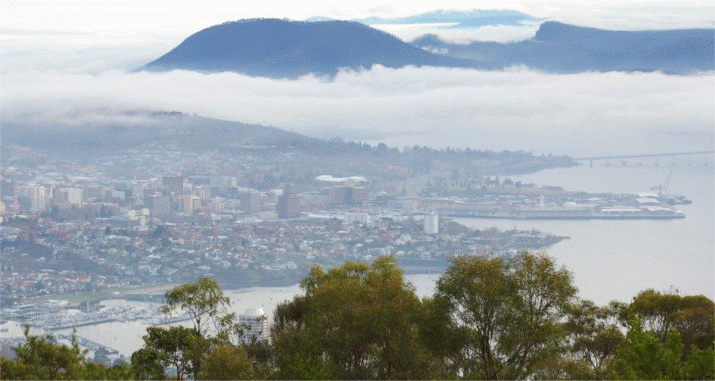
The songs of the mountain spur my visits there, but there are distractions. In winter one is the Bridgewater Jerry, a mist which drifts from the upper Derwent Valley and floods the Derwent Estuary. The winter phenomenon forms as cold air drifting from the high country meets warm air coming in from the ocean. It’s best viewed from the mountain, and after seeing the Jerry spread out at the lower end of the Waterworks Valley, I hurried to a viewing point at the peak, along the Pinnacle Road just above Sphinx Rock. A pure white snake, writhing and bending around point, inlet and bay moved in slow-motion towards the sea. As the sun rose, the snake became pink and then yellow on the folds of its skin and suddenly it was gone, vanishing as if into thin air, a magical trick which left golden ripples of sparkling ocean in its wake, like a magician’s illusion.
No one knows how the Bridgewater Jerry received its name, only that Bridgewater at the point where seagrass divides river and estuary is at its heart. The Jerry is a winter talking point among the rushing commuters hurrying to work in the Hobart city centre, as insistent as the phrase to denote a cold day, “There’s snow on the mountain”.