Economy
Mother Mountain: The Symphony of Birdsong (19)


The “Respect the Mountain” forum ( here, here, and here ) at the Hobart Town Hall earlier this year prompted Don Knowler to return to a diary he compiled after daily rambles on Mt Wellington during the previous year. In what promises to be a momentous year in the modern history of Kunanyi, the weekly diary gives the mountain and its wildlife its own voice. All Don’s Mother Mountain columns – and much more by this superb writer – can be found under the Category, Don Knowler, here
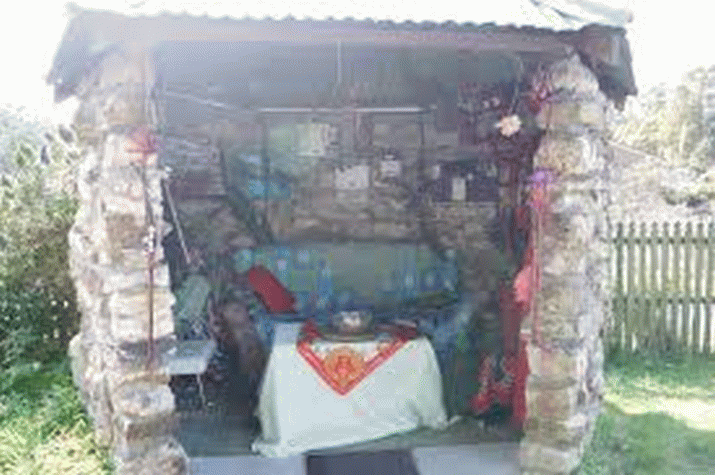
A bus shelter fashioned like a mountain cabin stands as a gateway to Mount Wellington, just as vitally as the winding, steep road that climbs through the Springs and on to the summit.
It is not so surprising then, that when the citizens of Fern Tree should organised their annual photographic exhibition on the first day of July it would feature a picture of the bus stop, or more precisely a girl sitting in it with a torn black stocking.
The shelter means much to the people of Fern Tree, not just as a place to shelter in blizzard and downpour while waiting for the bus. The people of Fern Tree choose to be different in their forested, and cold fastness, a habitat divorced from the comfort of the suburbs closer to town, which have supermarkets and bottle stores and fast-food restaurants.
Fern Tree only has a general store and a pub. It has a bus stop, however, like no other, the main feature of the solid dolerite and sandstone structure beyond the bright yellow Metro timetable being a worn couch.
As expected, some of the keen amateur photographers had wandered the slopes of the mountain to record it for posterity, but someone had also found beauty and eccentricity in the bus stop – no 2042 on the Metro Hobart map. Along with the sofa with a faded floral pattern, the bust stop sports a basket of dried flowers, Buddhist prayer flags and a few pictures of gum trees. And clearly on some days, the girl in the torn black stocking.
It had rained early but the skies cleared as I drove along the Huon Road to view the photographic exhibition in the Fern Tree Community Hall. I was looking for pictures of the mountain in all its guises, in all weather, in all seasons, but there were not many pictures of the mountain at all. Instead the exhibition was largely given over to other vistas: Cradle Mountain in the north, Russell Falls in the Mount Field National Park, plus ocean and breaching whales.
The mountain above me was beautiful this fine morning. A white cloud nestled on the summit, and just below it I could see fingers of snow reaching down in crevice and gully. It cried out for a picture but for once the people of Fern Tree, crowding their photographic exhibition, seemed to be ignoring it. Perhaps that’s the way it is when you live just under the mountain. It seems familiar and commonplace and for your photographic kicks you must venture further afield.
The picture of the whale proved prescient. On my way home I bought the Sunday Tasmanian which reported the biggest number of whales since the end of the whaling industry in the 1800s had been seen in southern Tasmanian waters in June.
There was another talking point generated by the press in the first weeks of July. It was reported that moves to establish a cable car on the mountain were gathering pace. On the front page of the Mercury there was a picture of a possible cable car station at the summit, and readers were directed to a website with designs of cable cars from other cities worldwide. Cape Town was there, and Cairns and Rio de Janeiro, with readers invited to comment on whether they liked specific designs.
A flock of yellow-tailed black cockatoos – 17 of them – passed before me as I stood on Sphinx Rock a few days later. I had heard them long before I could see them, which is often the case but these were well off the mountain. By the time I caught sight of them they were about two kilometres distant, heading away north-east with the city as a backdrop. It had been a great day for birds, with a golden whistler added to my checklist. This was after I had followed a grey shrike-thrush flying ahead of me along the track to the rock. It paused several times, and I paused with it, giving it space, as it flew from tree to tree, ripping at the bark to reveal hidden, sleeping grubs.
I checked the track to Sphinx Rock several times to see what else might be revealed, the first good look at an olive whistler perhaps – the other whistler species found in Tasmania which is more often found in dense rainforest. I had to be content with the golden bird and a little later I followed the black cockatoos’ path to the city, just after sunset as thin, horizontal wisps of cloud hung over the mountain. The clouds were back-lit in fiery yellow and then pink, the sky thinly painted in stripes of purple-black and soft pink as night descended.
The mountain is often wreathed in cloud, the “south-westerly sit” referred to my mariners both ancient and modern. Wreathed might be the wrong description because the cloud generally does not descend far below the summit, warm air possibly rising from the lowlands and suburbs, holding it in place.
The “sit” has its own quality, pointed out to me one day by a walker I encountered on the Cascades trail. The cloud spread across the summit obscures the manmade structures and appears to return the mountain to nature. Here she can be seen as the Aborigines and the first Europeans to visit Van Demon’s Land viewed her, untouched by the hand of man.