Economy
More than 25 years after ‘the clever country’ little has changed

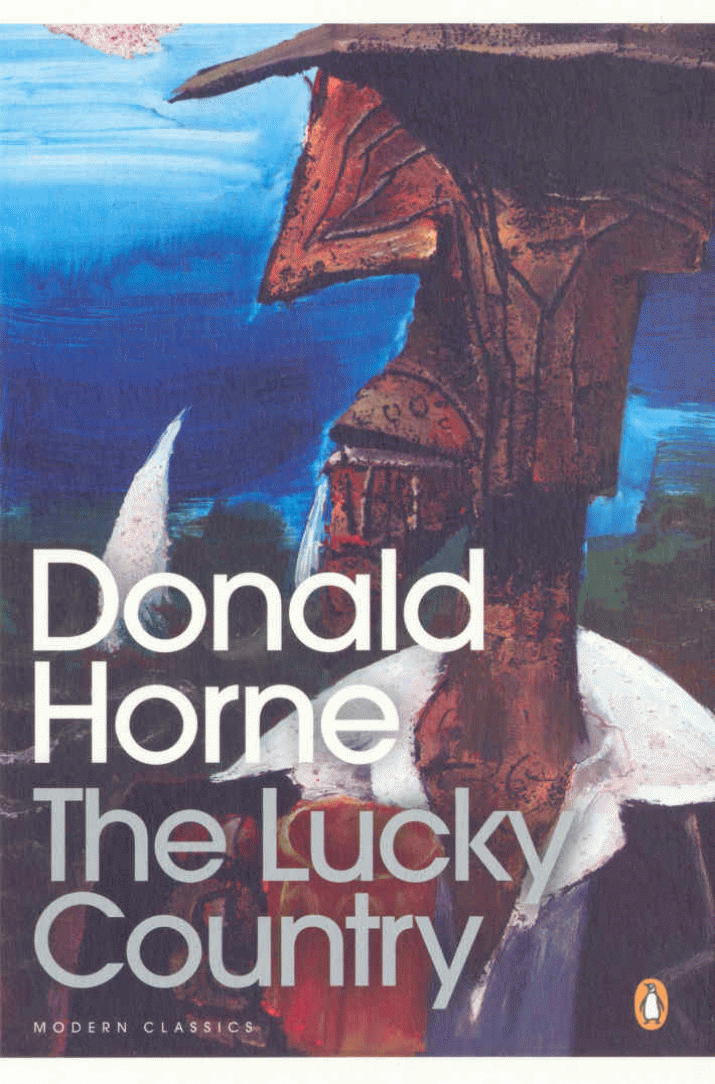

In 1964 Australian social commentator Donald Horne published a book, The Lucky Country. At the time, most people were aware that Horne was using the phrase ‘the lucky country’ ironically.
Australia, he argued, developed as a nation at a time when we could reap the benefits of technological, economic, social and political innovations that were developed in other countries. Those countries were clever: Australia was simply lucky.
In 1988, then Prime Minister Bob Hawke was cornered at the opening of a science facility in Canberra by a bunch of scientists who had been laid off in the latest round of budget cuts. Under serious pressure and clearly rattled by this out-of-character behaviour, Hawke agreed that Australia needed to become ‘the clever country’.
At the time, Donald Horne said: “I think we should realise that ‘the lucky country’ provides a descriptive phrase, condemning Australia for what it was, whereas the clever country is a prescriptive phrase, suggesting to Australia what it might become.”
Ten years later, another eminent social commentator, Professor Ian Lowe, delivered a paper, The Clever Country. Lowe said that “international studies confirm that brain-based industries, as Hawke’s science minister Barry Jones called them, are of ever-increasing economic significance”.
He argued that, as international competition was increasingly based on product performance rather than price, investment in education and research and development would become increasingly significant.
Give that man a medal. Sixteen years on, nothing has changed – other than the fact that we’re not actually even having any meaningful discussion this time round.
Government policies over recent years have argued that education is a private benefit rather than a community investment in the future. As a result, more and more cost burden has been placed on young people as they work to secure an education.
Under the deregulation of university fees proposed in the recent federal budget, it is estimated the cost of a degree will rise by at least 40 per cent. Added to that, rural students coming to study in the city will now have their relocation costs, currently tax-free, added to their HECS bill.
Australia’s chief scientist Ian Chubb says agriculture will be one of the areas worst hit by these measures, and this at a time when Australia cannot meet the demand for agricultural graduates. Experts say we need 4000 new scientists alone each year if the industry is to grow, but we are producing only 800.
The University of Melbourne estimates that, after the proposed fee increases, it will cost $97,000 to $112,000 for the three years of its agriculture degree, while staying on campus.
The Weekly Times reported recently that Lincoln University in NZ (where many of today’s leading Tasmanian farmers studied) charges about $60,000 for the same degree, also staying on campus. You’d be up for $80,000 at the University of Alberta in Canada; and the University of Kentucky in the US offers the same course for less than $100,000.
Even taking into consideration the availability of HECS, education experts say it would be cheaper for parents of Australian rural students to take out commercial bank loans to send their children overseas for the duration of their tertiary studies than for them to study here.
It just does not make sense.
Australia desperately needs the skills of agricultural scientists, with food security the new focus of international attention. So why would we charge them more to do a degree that’s so critically important to our national welfare?
In 1988, Professor Lowe said:
“There are two options for our future. Either we continue our current economic strategies (the ‘steady as she sinks’ approach), or we could try seriously to become ‘the clever country’ by investing in our own future.
“If we adopt the ‘steady as she sinks’ approach, we will continue to run down our capacity for science and innovation, driving our best talent overseas or into unproductive activity and remaining an unattractive option for the scientists and engineers of other developed nations…
“We will become a bleak backwater, eking out a poor living from our declining commodities and the willingness of tourists to enjoy what remains of our natural heritage.”
He said that we could try seriously to become ‘the clever country’ by investing in our own future. As a relatively small economy, we would need to concentrate our efforts on areas that are based on our natural advantages: our resources, our skills, our scientific expertise.
“We could become one of the success stories of the twenty-first century,” he said, “ noted for our hybrid vigour and our dynamism. The choice is ours.”
That’s wise advice for us as a nation. Even more importantly, imagine what we could achieve if we took that advice to heart here in Tasmania.