Economy
Bryan Green’s Asbestos Mine


Labor and Liberal governments love to trumpet how friendly they are to development. The truth is that the impediments they put in the way of development, prevent many projects from proceeding, and lumbers those that do proceed with a huge burden of compliance expenses.
If all the red tape served a purpose, such as ensuring that projects were well planned and met good environmental standards, then it would have some justification. However the truth is that the regulatory burden usually impedes projects without any significant public benefit.
One project that the Labor government was trumpeting as a $70 million example of progress under their administration was Proto Resources NL’s proposed nickel/iron mine for the West Tamar. Now that the company has been placed into involuntary administration, I can publicly comment on the project. If I had done so before now, and the company subsequently collapsed as I had expected it would, I am sure that both Labor and Liberal would have blamed me.
Proto’s exploration area covers a large part of the old Asbestos Range, part of which is now renamed Narawntapu. Way back in 1805 Australia’s first discoveries of both iron ore and asbestos were made there by Lt-Colonel Paterson, who led the expedition to settle northern Tasmania. Asbestos was mined on the West Tamar during the First World War, when supplies from Canada were cut off. When better quality asbestos became available again, both from Canada and from Gundagai in NSW, the mines on the West Tamar closed.
Tasmania is well-endowed with asbestos, if such a pejorative term may be used to describe such dangerous material. There are substantial deposits at Ulverstone, for example, and on the West Coast. I suspect that current and recent mines have often come across the mineral, and kept very quiet about it. Left alone, the deposits are not a problem, particularly as most are chrysotile, or white asbestos, rather than the very dangerous varieties. I do know of one deposit of the bad stuff, but it is probably best to allow it to remain lost and forgotten.
The last investigation of Tasmania’s asbestos resources, with a view to potential mining, was done by the mines department in 1955. It is the Taylor Report, and is available on the Mineral Resources Tasmania website. It contains a number of maps of the asbestos resources of Tasmania, the most significant of which is the map of the asbestos field on the West Tamar, which I produce herewith.


Prior to 2011, Proto had a large exploration licence over the Asbestos Range area. In 2011 they decided to convert part of this exploration licence into a mining lease, with the intention of commencing mining as soon as possible. I have taken their published mining lease boundaries, and overlaid them on the Mines Department’s 1955 map of the asbestos field on the West Tamar.


Proto’s stated intention was to mine for nickel and iron. However it can be clearly seen from published reports, that their mine plan involved digging up an asbestos deposit in order to get to the nickel below it. Similarly, their infrastructure would be built over the asbestos, and foundation works would involve digging up asbestos. Similarly, their mine dam would involve digging up asbestos. Workers on the site would be exposed to the asbestos dust, and the prevailing winds would cause that asbestos dust to fall onto Beaconsfield and other settled areas.
On July 21st 2011, Bryan Green held a ceremony at Parliament House to present Proto with their lease to (effectively) mine asbestos on the West Tamar.
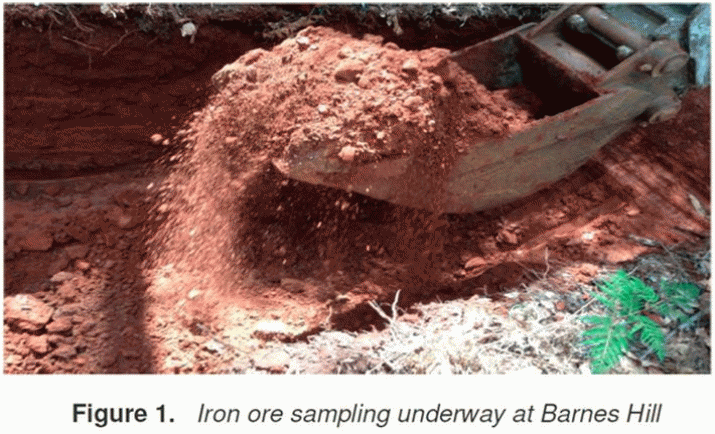
Now granting a mining lease alone does not give the go-ahead to mine, as EPA approval, for example, is still required. However it does give the right to do bulk sampling – and Proto has been doing this for three years, digging up the place and sending tons of material off to NSW for testing. They have been releasing photos to the Stock Exchange, such as these:


For many years I have been Treasurer of the Tasmanian Lapidary & Mineral Association, and in such capacity I arrange insurance. Our insurers have made it clear to me, that if we even enter areas of past asbestos mining, we void our insurance. Yet in 2011 Bryan Green gave a mining lease to Proto for Tasmania’s largest asbestos field, and held a ceremony over it. I would be very surprised if Proto’s insurers knew the nature of the material being dug up, and I am sure that the workers doing the bulk sampling were not told, as they were not wearing any protection.
Had Proto not failed as a company, there were two possible outcomes to these absurd proceedings. Either they went on to the mining phase, dug up the asbestos in order to get at the iron and nickel, and just piled up the asbestos dirt to blow away in the wind. If so, this would quickly have become public, as the existence of the asbestos is widely known, and the government would have been forced to shut them down.
More likely though, is that the environmental approval would not have been granted. The government would thus have allowed the company to proceed, granted them a mining lease and allowed bulk sampling, allowed them to raise money from the public, allowed them to pointlessly spend heaps of that money – the government themselves spruiking the project as $70 million investment for the West Tamar – while all along knowing that they would have to pull the rug out from under the company at the last stage. If this scenario sounds as familiar to you as it does to me, I think it is because we have heard of real estate and tourist developments that have suffered the same fate.
I am a miner and a mining historian. I love digging holes. However I also believe that mining must be regulated in the public interest – but regulated in a way that does not impede and burden developments unnecessarily, and that achieves a purpose rather than being an exercise that merely gives employment to consultants and public servants. It seems that it is often environmental groups that have to ensure project compliance, due to regulatory failure by governments. To allow an asbestos mine to proceed to the point that it did, and even spruik it, is simply extraordinary. Both Labor and Liberal governments make it extraordinarily hard for mines to get up, supposedly managing them in the interests of the state, but all the regulation fails to achieve its purpose. Projects should be easier to get up, but at the same time be better and more intelligently regulated.
Instead, the present government just wants to get rid of environmental groups. I suppose this is easier than fixing the regulatory framework and administration.
All about Nigel Burch: During the period 2005-2008 I was an adviser to Deputy Premier Steve Kons and also his electorate officer. Immediately prior to that I had been a director of the Tasmanian Farmers & Graziers. In the 1990s I was Managing Director of a listed gold mining company and later assisted the Bosnian government with problems in their state steel industry at the end of the war. I was honoured by the Australian Shareholders Assocation in1991 with a medal for services to small shareholders and assisted ABC 4-Corners with an award-winning documentary “Other People’s Money”. He has been also a national director of the RSPCA.
• Bryan Green: Mt Lindsay mining news welcomed
• Scott Jordan: Minister in error in granting Mt Lindsay Mine Lease
• Paul Harriss: Mt Lindsay mine approval follows robust assessment