Economy
Mother Mountain: The Symphony of Birdsong (18)


The “Respect the Mountain” forum ( here, here, and here ) at the Hobart Town Hall earlier this year prompted Don Knowler to return to a diary he compiled after daily rambles on Mt Wellington during the previous year. In what promises to be a momentous year in the modern history of Kunanyi, the weekly diary gives the mountain and its wildlife its own voice. All Don’s Mother Mountain columns – and much more by this superb writer – can be found under the Category, Don Knowler, here
I looked for something to brighten my day on the mountain, but after an hour or so decided there were better places to be. The Fern Tree Tavern sprung to mind, advertising a log fire and hot lunch with a sign near where I had parked the car.
It was definitely time to call it a day, to shake a rain-sodden coat, wipe the mist from my binoculars, have one last check for leeches on my socks.
I had just reached the final flight of stone steps at the start of the Fern Glade Track, leading to the road that leads to the pub, when a dark shape flitted across the trail right in front of me. I focused binoculars on the dark shape half hidden by foliage and in the half-light was not prepared for what lie before me – the shimmering hues of a male pink robin magnifying every faint ray of light penetrating the latticework of leaves above it. Pink robins are not in fact pink. Everyone who studies them knows that they are the colour of magenta on the breast, with a sooty black back and a hood of the same colour.
Like the other birds of forest, the pink robin was determined to maintain its silence.
It has a sweet song sung in a rhythm punctuated by short pauses, but it was not to utter it, to shed a little light on a dismal day.
A month into my project and my enthusiasm for the mountain was mounting.
I thought I might grow tired of the visits there – “beware getting what you wish for” as one of my friends had warned – but the mountain was becoming an obsession. I had become a mountain tragic.
In truth, I had another motive for my mountain forays. After writing the On the Wing column on bird-watching for the Mercury for a decade or so, part of the motivation to explore the mountain on a regular basis was to provide material on high country species I had neglected in the past. I had not realised, though, that the mountain and its wider environment would become bigger than the birds themselves.
On the very last day of June, with snow lingering on the higher peaks, I was lured there again, again on my familiar lowland walk of the Fern Glade Track picking up the Silver Falls Track which crosses it. It was bitterly cold with night coming down, and I was disappointed that I had not found any birds of note. I was beginning to wonder why I had even bothered to take off for the mountain at all, so late and on such a drab, dull-grey day, when something remarkable happened, an event and its memory that that will stay with me for the rest of my life.
To capture the beauty and wonder of the wild world I sometimes I find myself lapsing into the poetic and lyrical instead of my usual direct style of writing honed from five decades in the newspaper business.
There are times, though, when what I see and experience in the wild defies deft words of any kind and it is better to merely tell it like it is, to use the parlance of my trade.
So straight out of my notebook, this is what happened on the slopes Mt Wellington on the afternoon of June 30, 2012.
Eventually giving up on birds for the day, I had decided to return to my car parked near the Fern Tree Tavern and, maybe, just maybe, settle for a pint of Cascade pale ale around a roaring log fire.
I sought out a fast and direct route down to the pub but was distracted by two grey currawongs flying along the Silver Falls Track and, for reasons I will never be able to explain, decided to follow them, even though a detour to the Silver Falls would delay my arrival at that log fire at the pub, and that pint.
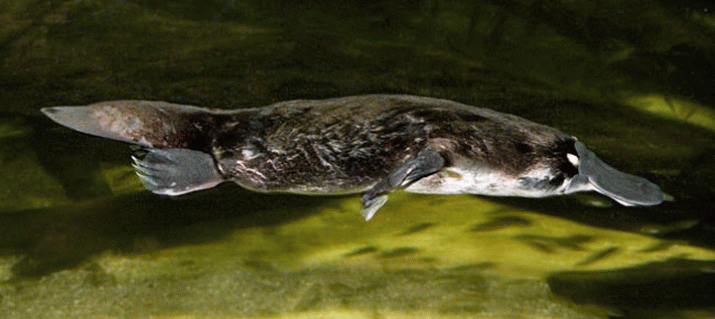
The currawongs soon veered from the tunnel the track made through the tight and dense wet forest near the falls but I kept going, stopping only for a brief moment to view the beautiful cascade of water, framed by fern fronds. The chill air indicated snow was about to fall and I quickened my pace in anticipation of getting to the pub. Just at that moment, however, I spotted something on the stream bank, half in and half out of the water. I could see it was not a bird, but an animal of some kind, and then came the realisation – I was looking at a duck-billed platypus.
In that magic moment all my assumptions about platypus were swept aside. I thought they were nocturnal for a start, and only frequented billabongs, just the place I had once previously seen a platypus, at dusk on the Atherton Tablelands in Queensland – ripples, rings and bubbles as the sun set on a muddy pool. But here was a platypus in broad daylight, in a rocky brook that at times was merely a series of deep puddles, busily making its way upstream, thrusting its beak in crevices and cracks in rocks, shifting stream-bed gravel as it went.
I watched it for half an hour, travelling about 20 metres back along the stream towards the falls. Sometimes it left the watercourse when mini-waterfalls impeded its progress and it then made its way through leaf and fallen bark.
On land it paused sometimes to bury its head and beak into wet leaf-litter before continuing its journey, sometimes raising its head to check the course ahead. At this point the bill was clearly visible, like an appendage that appeared to have been stuck on this mole-like creature as an afterthought. I noticed that the platypus also had a tail like a beaver’s which, as with the bill, seemed to have been added at some late stage.
The appearance explains why, when skins of platypus first arrived in London with the discovery and exploration of the new land of Australia, many naturalists there didn’t believe the animal was real, that it was a hoax, a creature fashioned from parts of both animal and bird.
That thought occurred to me when I returned home and set out excitedly to explain to my wife what my latest bird column would be about.
“But a platypus is an animal,” my wife said.
“Ah, but it’s got a beak . . . ” I replied.