As the boom ends, poor oversight and lax bonds leave governments stuck with an enormous bill for mining’s clean-up.
Back in the good old days, there was no green tape for miners to worry about. Dig it up, ship it out, leave the mess behind.
Consider Mount Morgan, near Rockhampton in Queensland, at one time the largest goldmine in the world.
In the 100 years to 1981 it produced about 262 tonnes of gold, 37 tonnes of silver and 387,000 tonnes of copper, as well as 134 million tonnes of waste rock and overburden.
Then the price of gold fell and the price of the cyanide used to extract the gold rose, and the mine’s then-operators walked away, leaving behind the old pit, flooded with billions of litres of acidic water and elevated levels of 18 elements, including lead, cobalt, cadmium, copper, manganese.
And there it has stayed – a cocktail of heavy metals in a giant bath of sulfuric acid – with minimal rehabilitation, gradually leaching pollutants.
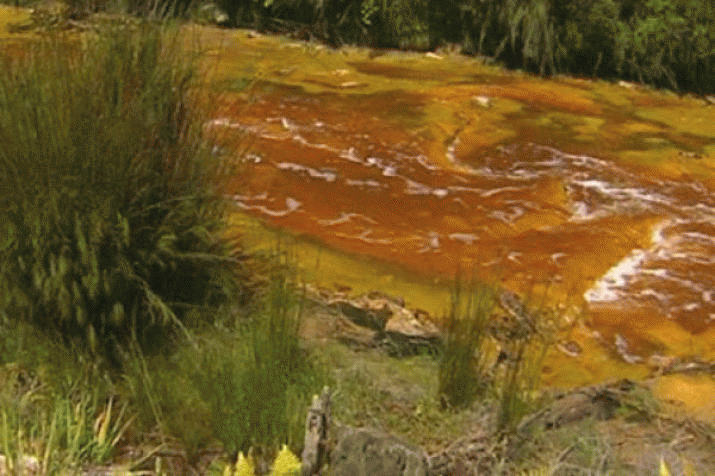
Decades later, long stretches of the nearby Dee River remain highly toxic. And in the big wet of January 2013, when the pit overflowed, there were “impacts”, as the Queensland mines department blandly put it, for 50 kilometres downstream. That is to say, the Dee River turned bright turquoise, killing fish and other wildlife, and leaving behind a poisonous sludge on the streambed.
The Queensland government has spent more than $50 million since 1992 mitigating the worst of the problems posed by the abandoned site at Mount Morgan. Some of the seepage has been intercepted and pumped back into the pit, the acidity has been lowered by adding lime to the water, giant fans have been used to evaporate pit water, and there have been periodic “controlled releases” from the pit into the river. But, as the departmental website makes clear, there is no “practical” (read: affordable) solution to the Mount Morgan environmental problem, such as emptying the pit of its toxic contents and filling it with the overburden.
Estimates of the cost of such a complete fix range into the hundreds of millions of dollars. It’s simply not going to happen. What we have at Mount Morgan is an ongoing ecological disaster, extending indefinitely into the future.
This is what happens when you have inadequate monitoring and regulation of mining activity, or “green tape”, to use the pejorative term of some of our politicians – notably Prime Minister Tony Abbott and Queensland Premier Campbell Newman.
Indeed, within a month of Abbott winning office last year, he and Newman staged a media stunt in Brisbane to sign a memorandum of understanding, devolving sole power to the state to make environmental approvals and promising this “cut to green tape” would make things quicker and easier for miners.
…
David Brereton, the deputy director for research integration at the Sustainable Minerals Institute at the University of Queensland and a colleague of Corinne Unger, underlines the urgency of it.
“I think there will be a very large number of mines closing in Australia over the next 20 or 30 years – I don’t think there’s any argument about that – just because they will run out of resources.
“Collectively, I think, probably industry and government have significantly underestimated what’s going to be required to really do proper closure on all of those mines.”
Clearly now is the time to get the systems in place to stop mining companies from “externalising” their costs by pushing them onto the rest of us; privatising the profits and socialising the losses.
Like all those other three-word slogans, “Cutting green tape” is simplistically appealing. Until you realise the slogan’s cost could be measured in more Mount Morgans, more environmental destruction and threats to health and billions upon billions of dollars.
ON TT
• Tour Tasmania’s mining legacies from the past and in the making
• Mines contaminate 40 Tasmanian rivers