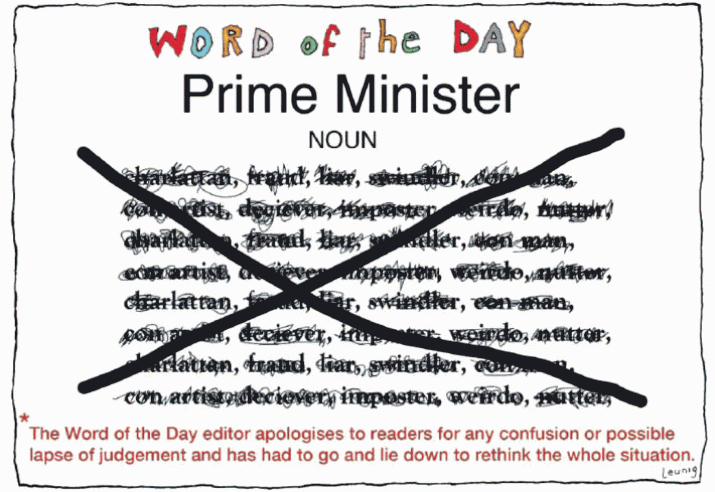
Leunig, with permission http://www.leunig.com.au/
Once upon a time in ancient Sparta there was a Council of Elders, called the Gerousia. This was a body of 30 men, acclaimed by the assembly, which consisted of the two Spartan kings plus 28 elders, all were elected for life, and all (excepting the kings) had to be over the age of sixty. This body originated and vetted all legislation that was to be brought before the assembly. Further this body could veto any “crooked” legislation. Among other roles, the Gerousia had authority for any trial involving a capital crime, or exile.
Of course Spartans were not the only ones to think up the idea of the Council of Elders, nor even the first, but I was reading about Sparta recently. Indeed the Spartan idea of a Gerousia may have come from Crete. This gerontocracy is often considered a reward for a virtuous life.
More powerful in Sparta then in Crete, this style of government suited the static laconic culture; a culture of religiousness and superstition, a culture founded on slavery and militarism, a culture that shunned money and material possession. “Therefore,” remarked Plato, describing his laconophilic republic (412c), “the old men are to govern, and the young are to be governed.”
At once fortunate and unfortunate, we live in a very different culture; in many ways different, in many ways alike. For while our culture is a curious mix of religiousness and superstition, our daily life is built by science on a scale never before attempted. We love freedom, yet our fabulous wealth is created by slavery, genocide, and militarism. A static culture that craves novelty, a culture of constant change, a sort of permanent revolution.
As Marx and Engels described in the Communist Manifesto “The bourgeoisie cannot exist without constantly revolutionising the instruments of production, and thereby the relations of production, and with them the whole relations of society.”
Events have moved on, we can not emulate the Spartans. To understand this constant revolution, to take full advantage of the new, we can become reverse laconisers. We must make a council that can oversee all legislation; with our galloping change we must create a body of the young; people under 35 years of age. This body of youngsters can imitate the role of ancient elders. Our council of youngsters will rule society. In this way we can face up to the current urgencies in a proper fashion. It seems to me to be abundantly clear that our current crop of people over 40 who currently control the reins have failed miserably.
Moreover, with their moribund selfishness, with their short sightedness, they have failed the future. The almost sixty year old Malcolm Turnbull has no need for fast networks. His work is all but finished. The fifty-six year old Tony Abbott — who benefited from free university and universal health care — has no ability to change the status quo. To keep the country doing what it did in the past is all he and his party can envision. To keep Australia as it was, in some fantastic golden age, is all that he can imagine. To win and to keep power, helping his friends and hurting his enemies along the way is the limit of his politics.
It is the young ones who will swim or drown in the flowing change. It is the young who will be able to see the results of change. Decisions made now will create changes over the next twenty years. In twenty years time Turnbull will be 79, Abbott 76, and it will be a different world. Twenty years ago was 1994. In 1994 Google did not exist, Al Gore coined the term information superhighway, Microsoft released Windows 3.11.
Now I am sure many will say that this Council of Youth is as silly the Fountain of Youth. This is an idea that will not work. They may be right. I am sure they will be right. But when I look about at the world, I have to say things are not working. Potential harm as against present harm? Status quo, or a new course?