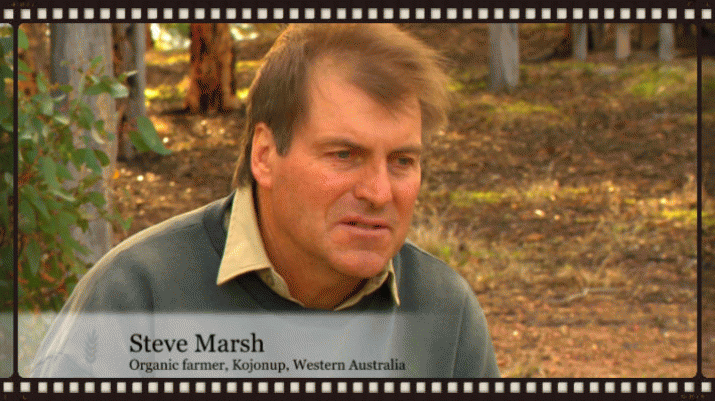
The verdict in the controversial Western Australian Supreme Court case between neighbouring farmers Michael Baxter and Steve Marsh was handed down earlier this week. Justice Martin found in favour of the GM canola grower in this landmark decision on genetically modified (GM) canola and property rights.
Steve Marsh was suing former friend Michael Baxter, claiming he lost organic certification for more than half of his farm after GM canola drifted onto his land from Mr Baxter’s property.
In 2010, Mr Marsh’s mixed farming property south of Perth was certified organic by the National Association for Sustainable Agriculture Australia. But he alleged GM canola blew 1.5 kilometres inside his fence, which caused him to lose his certification.
Mr Baxter claimed that, when he planted the GM canola, he followed all regulations on buffer zones and notified his neighbours.
The three-week hearing earlier this year was believed to be the first of its kind in the world.
In a 150-page judgment, the court gave the following for this decision:
• For private nuisance, the judge assessed that it had not been shown that there had been any unreasonable interference by Mr Baxter in the Marshes’ use and enjoyment of their property.
• Mr Baxter was not to be held responsible as a broadacre farmer merely for growing a lawful GM crop and choosing to adopt a harvest methodology which was entirely orthodox in its implementation.
• Nor could Mr Baxter be held responsible, in law, for the reactions to the incursion of Marshes’ organic certification body, NASAA, which in the circumstances presented to be an unjustifiable reaction to what occurred.
• The judge also rejected the Marshes’ cause of action in common law negligence. The Marshes’ action for exclusively a financial loss, was without precedent. No basis in legal principle was presented to the Court to extend the law to the events in this case.
• Mr Baxter had not been shown to have acted negligently, either by growing or then by swathing the lawfully grown GM canola in 2010.
The verdict in this case is a victory for commonsense.
It confirms the long-standing tradition of different farming production systems existing side-by-side in Australia. It also reaffirms the importance of allowing farmers the ability to choose the crops and production systems that best suits their needs and desired markets – which is so critical to their competitiveness.
Importantly, the outcome should focus attention on the standards required for organic certification in Australia. Unlike other countries, there is a zero tolerance threshold here for GM contamination in broadacre crops. There is an urgent need for the Australian organic industry to move to bring these rules in line with the rest of the world. As well, the federal government needs to take urgent action to prevent future unnecessary conflict caused by these flawed standards.
It is clear that Australian farmers must continue to have access to all of the available tools that can help them meet the demanding weed and pest challenges that they often face. To ensure that farmers can innovate to meet the growing demand for food and fibre, we need different parts of agriculture working together to avoid disputes such as this.
The opportunities available for Australian agriculture this century will be wasted if farmers do not have the right to choose which crops they grow on their land, and which production system they use to grow those crops.
We need to make it easier for farmers to get on and do what they do best. That means doing everything we can to ensure that all Australian farmers have access to the same safe, effective tools and technologies as their international competitors; and that they can access a variety of markets for high quality produce.
This case has pitted farmer against farmer – and that is something no-one wants to see. All involved in the agricultural industry need to work together to avoid similar disputes in the future.
Let’s hope these farmers are now able to put this case behind them and return to farming, side-by-side.
TT EARLIER • The future of organic and non GM food in Australia is uncertain …