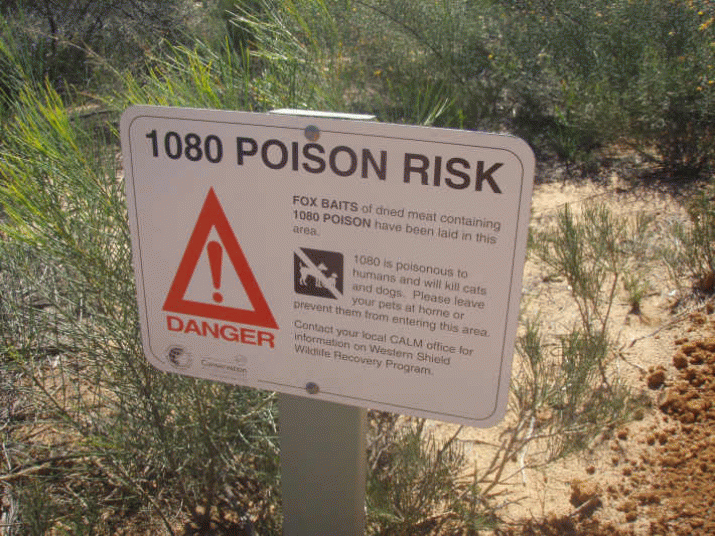
The Tasmanian Government had made a sensible and pragmatic decision in allowing landowners to continue to use 1080 for control of browsing animals, the Tasmanian Farmers and Graziers Association said today.
Chief executive Jan Davis said that wildlife browsing on agricultural land was causing massive problems across the state, including the Bass Strait islands. Despite the best will in the world, 1080 had to remain part of the solution because no alternative had proven itself.
The federally-funded Alternatives to 1080 Program report in 2011 confirmed there was no one easy solution to browsing management. The experts who undertook this research acknowledged that farmers needed an arsenal of tools to keep browsing at bay: shooting, fencing and the ability to use poison in a responsible manner. The report also concluded that, at this stage, there was no alternative to replace 1080 as part of a diversified management strategy.
“This study identified that Tasmanian farms suffer an overall 22 per cent productivity loss on our farms because of browsing by native animals. Far greater impacts – sometimes as high as 80 per cent – were experienced in areas where the land bounds the bush,” Ms Davis said.
“This means farmers on average lose a quarter of their income each year to the impacts of browsing animals. In reality, the impact is greater, as this does not recognise the costs in establishing crops and getting them ready to harvest. Nor does it factor in the considerable expenditure farmers already make in managing wildlife.
“Animal rights campaigners have suggested fencing is the solution. However, it is enormously expensive and, in many areas, physically impractical. Furthermore, fencing out wildlife is not a solution in itself: it simply condenses the population and pushes it in to another area.
“Not only does that simply pass the problem onto neighbouring land; but increased population density can lead to starvation and overgrazing of endangered grassland or other species.”
According to Ms Davis, the problem has been exacerbated by the fact that so much of the state’s area is owned by government, and they have invested little in wildlife control or fencing. In effect, this meant that farmers are growing crops to feed wildlife that comes onto their land from neighbouring state-owned properties. Farmers in other states have relatively easy access to 1080 for controlling browsing and feral animals even though impacts may be less severe than is the case here. Increasing the regulatory burden and red tape costs on Tasmanian farmers makes them even less competitive.
“Effective wildlife management on farmland can only be achieved through ensuring farmers have access to a comprehensive tool kit. There is no single silver bullet,” she said.
“At this stage, there is no viable replacement for 1080. Until there is, it must remain as part of the farmer’s tool kit.”