Environment
Mother Mountain: The Symphony of Birdsong (7)


The “Respect the Mountain” forum ( here, here, and here ) at the Hobart Town Hall last month prompted Don Knowler to return to a diary he compiled after daily rambles on Mt Wellington during the previous year. In what promises to be a momentous year in the modern history of Kunanyi, the weekly diary gives the mountain and its wildlife its own voice. All Don’s Mother Mountain columns – and much more by this superb writer – can be found under the Category, Don Knowler, here
A Morris Minor parked in the Springs car park carried a bumper sticker reading “Mount Wellington – Naturally”. I was more interested in the car than the sign. It was shiny, immaculate, as though fresh out of the box, but it must have been at least 60 years’ old. Who would own a Morris Minor, in freshly polished green livery with a sign extolling the mountain’s natural values on the bumper?
I immediately thought of the elderly gentleman I had seen hiking on the mountain a month previously. The vintage of the car more or less matched the gear he was wearing, canvas backpack with leather straps, and stout hiking boots, in leather again, without a hint of Velcro.
I lingered, hoping to catch a glimpse of the owner, to remark on the car and discover its history. I was also keen to discover the history of the hiker, and his memories of the mountain from before my time in Hobart, if the car was indeed owned by him.
The owner failed to show and after half an hour or so it was time for me to move on if I was to complete a walk … before nightfall drove me off the mountain.
The time spent at the Springs was not wasted. As I sat on a large rock overlooking a stretch of mown grass that forms a play and picnic area, I watched a party of superb fairywrens scurrying across the open ground, a male still in summer plumage and his harem of four females and a handful of juvenile males. Older males, possibly from six years of age, retain their blue finery, unlike younger birds which moult to a brown plumage resembling the female, and I speculated on the age of the male I watched at the Springs. Even six years must be a fairly old age for such a small fragile bird and I wondered how many summers, and winters, the male had in him before a young suitor for the females took over.
He looked sprightly enough, though, scampering across the lawn and chasing his females. The clan of fairywrens presented an image of one big happy family.
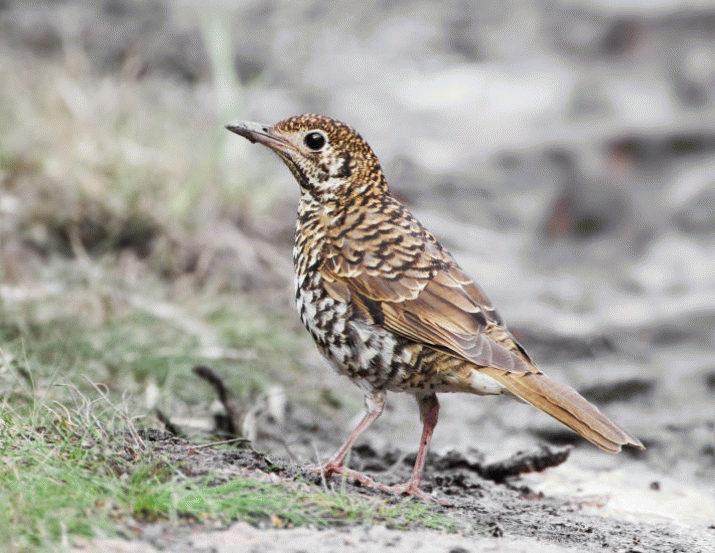
The fairywren might be one of the showcase bird species of the mountain in terms of sheer stunning beauty – the flame and scarlet robins are the others – but at the Springs I look for birds of subtle beauty, the bassian thrushes.
This day I was lucky enough to find one poking the ground for worms at the start of the short walk that links the lower Springs car park with the site of the Springs hotel a little distance away.
The bassian thrushes are the only true thrushes found in Tasmania, apart from the introduced blackbird, and they can often be found with a little patience on tracks and in clearings in the forest. They generally keep hidden, relying on camouflage for safety, with a plumage that blends perfectly with their forest floor habitat. The birds – the size of blackbirds – are coloured warm brown on their backs and on the undersides their beige feathers are flecked with brown. If disturbed they tend not to fly, but walk through the undergrowth to a safer location.
The mountain – even in summer – is often brushed with freezing rain but now the first snows of winter were about to arrive. By the second week of April were warnings on the radio of snow above 800 metres in the Tasmanian high country and a blizzard was soon to envelope Mount Wellington, swirling down from the summit to dress the eucalypts around the Springs in coat of snow.
Next day the Mercury heralded the winter months, although they were still officially six weeks away, with pictures of children and their parents frolicking in the snow of the summit. And cars coming down the Pinnacle Road had snowmen on their bonnets, the ice sculptures swaying and sliding as vehicles negotiated the hairpin bends. It was not until South Hobart that the snowmen were to slide to mushy deaths on the tarmac of suburban streets.
I went to the mountain for the sight of birds in the snow, but found not a bird at first but a pademelon, bemused and confused. It looked a young animal, born last summer, and would never have seen snow before. Gently, the pademelon nosed its way through the carpet, thrusting snout into drifts to chew on lush vegetation hidden beneath it. Every now and again, the pademelon raised its head to sniff the breeze for danger, then scanned the landscape with alert eyes. At times it shook a hind leg, rigorously, to remove the clinging snow.
Birds that rely on camouflage to stay safe and well in the forests now were exposed and vulnerable.
The mottled plumage of the bassian thrush stood out starkly against the pure white snow, but the bird I had seen in previous days at the Springs seemed oblivious of the danger. It strutted, and stopped and strutted again to finally plunge its head into the snow to retrieve a worm or other invertebrate. With each hop the thrush would pause, and cock its head to listen. It could hear the movement of a potential meal under the snowy blanket.
The snow also served to highlight the beauty of the more flashy bird species that make the mountain their home. That was the reason I went to the mountain on a day I knew would be crowded with tourists wanting to build the first snowman of the year.
I walked to Sphinx Rock, as I often do, and instead of snow the city below me was coated in a soft winter light, snow clouds lingering to the north of the mountain blunting the sun’s intensity.
Winter might have arrived on Mount Wellington but the city was still under the spell of autumn. The deciduous, European trees that grace its parks and avenues were still very much in autumn leaf, in the colours of gold and bronze and brass.
The square of the ancient St David’s Park was marked out by poplars, standing tall and erect above the other trees, and instead of the subtle colours of precious metal, the dying leaves were in bright yellow.
And something else in the city said autumn had arrived. The metallic “egypt, egypt” call of the crescent honeyeaters coming down from the mountain could now be heard in the suburbs, the song of autumn.
I soon turned my attention back to the mountain, however, gazing up at the Organ Pipes above me, the long lines of snow frozen in the upright pipes of dolorite heightening their effect. I wondered what they would look like from afar, from over the river. The mountain from a distance would have been stunning that morning, like the pictures of it you see in the tourist shops when it wears a beret of snow, contrasted against a brilliant blue sky. By now the snow clouds had drifted further north and the whole mountain and city below it were swept by the rays of strong, penetrating sunlight.
My search for mountain knowledge had seen me book for various tours as part of the Hobart City Council’s Bush Adventures programs. I had studied bats, eucalypts, mountain shrubs and fungi. As I was about to set off for a Pinnacle Discovery walk to learn of geology and alpine nature I received a phone call. The Pinnacle Road was blocked by snow and had been closed for the day.