Economy
Mother Mountain: The Symphony of Birdsong (6)

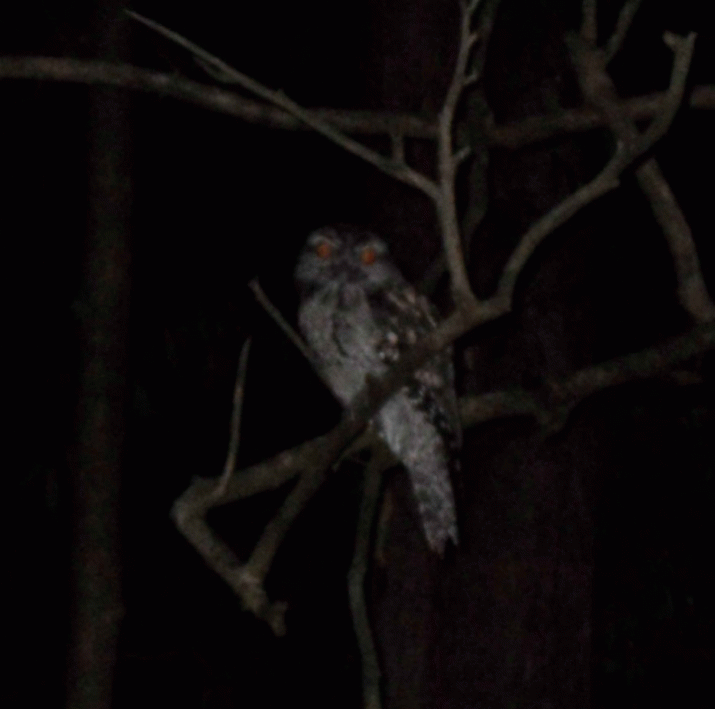

Image from here: http://foxgully.wordpress.com/tag/environment/page/3/
The “Respect the Mountain” forum ( here, here, and here ) at the Hobart Town Hall last month prompted Don Knowler to return to a diary he compiled after daily rambles on Mt Wellington during the previous year. In what promises to be a momentous year in the modern history of Kunanyi, the weekly diary gives the mountain and its wildlife its own voice.
Daylight saving arrived and I forgot to put my clock back. So there I was up on the mountain, late afternoon, with night suddenly closing in.
The sky was clear, no hint of the thick, heavy snow clouds that can cut an hour off daylight and I looked at my watch. It should still be light, the sun should still be up I was thinking, before I realised I had lost 60 minutes of daylight without the weather intervening.
Although I had in recent weeks found roosting tawny frogmouths, I had never seen frogmouths hunting. I took the unexpected approach of night as an omen. Would this be the night to see my frogmouths in flight and I hurried along the trail I was walking, the Ice House Track, to head towards Sphinx Rock where I had discovered the family of frogmouths. I estimated I had about 20 minutes to walk part of the way to Sphinx Rock before I could return to my car at the Springs car park before total darkness fell.
Time, of course, is a human invention; measured time that is, not the natural division of day and night when the sun sets and rises again to create a new day.
When it comes to the natural world, we humans seem determined to put our stamp, or hands, on everything. We want to shape the natural world to conform with ours, as with time and the 24-hour clock neatly divided into hours. Frogmouths couldn’t hope to understand time’s concept, and its context; when to work and when to play, when to eat and when to drink, and sleep. To a frogmouth the sun, not a clock, is all important. Their day starts just after it sets behind the mountain, and ends with its rise over the Eastern Shore.
Night was closing in rapidly, and hungry frogmouths along the track were being given a signal that it was time to feed. Impatient and sparking into life after slumbers on bough and branch, shaded from the hot day’s sun, the frogmouths would have to wait for moths and other flying insects to take flight.
In tree hollow and cave crack, bats were also getting ready to roll, and twist and turn, chasing the very same food that the frogmouths would hunt closer to the ground, using echo location instead of sight. The eyes of owls, boobooks and masked, were opening too, focusing, but it would be the ears that would lead them to fur and feather in the hours of darkness.
I wish I had packed a torch with me, it would have allowed me to stay out longer, easier to navigate the path back to the Springs. I did not need one, however. Just a short way along the Lenah Valley Track towards the Sphinx Rock lookout I found one of the frogmouths in the family. In fact I didn’t find the tawny, it sort of found me.
I had been looking into the low branches of yellow gums and white peppermints – places where I have found frogmouths in the past – and had never thought that they might sometimes perch in the closed foliage of native cherry and mountain needlebush.
The tawny opened one sleepy eye to view me, a beautiful orange colour framed by a spiky eyelid, before it closed it again. Darkness might be falling but this tawny was not ready for its night-time adventures, and I left it in peace.
The first morning after the clocks go back is really the signal of winter. Although the southern calendar might list March 1 as the start of the slow drift to cold and snow, it’s hard to believe at the start of autumn, with temperatures still hot and humid, and these can often continue well into April. Nights closing in, sunset at six o’clock tells another story.
The days to follow were cold and rainy. Mist settled on the mountain, and south-easterly winds and updrafts from the Hobart suburbs brought the smell of woodsmoke to the lower slopes again. Distant forest burns also put ash into the air and at times the mountain was shrouded in a blue haze, not unlike the eucalypt oil haze of the hottest days in summer.
Another sign of winter is the flight of birds to lower altitudes. I could still see and hear fantails, silvereyes, spinebills and crescent honeyeaters, but in lesser numbers.
Now that flame robins had gone for winter, I would have to concentrate on birds that make the mountain their home all year. And there were plenty of these fossicking on tracks and in open spaces, including Bassian thrushes and Tasmanian scrubwrens.
Soon I’d see them set against a background of snow.