History
Lest We Forget indeed!

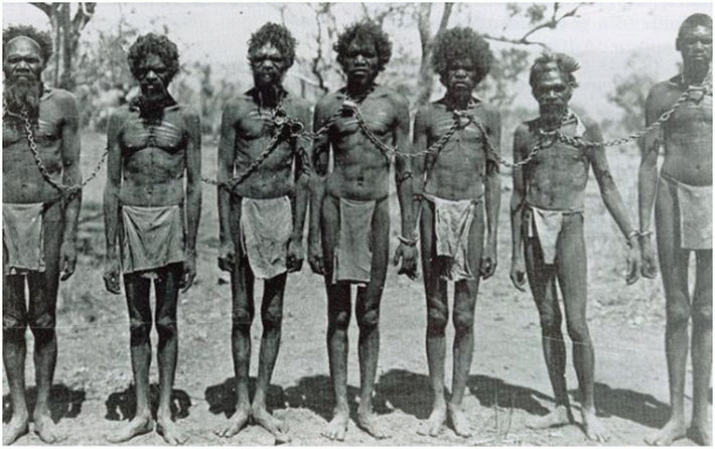

Only 8 years before the ANZAC’s set off for Gallipoli, these Aboriginals were in Police Custody, 1906. Their crime was fighting against invaders.
Michael Mansell argues that ANZAC Day, like Australia Day, is another step by white Australia in promoting its pioneer image while ignoring its ill-treatment of Aboriginal people.
The essence of ANZAC remembrance is the honoring of those who made the ultimate sacrifice for the rest of us. The ANZAC’s did not fight for Aborigines – they fought for whites.
Those Aborigines slaughtered in the quest by white invaders for our lands are who should be remembered and honoured, yet there are no monuments, and no holidays for the fallen victims of that war.
Australia turns a convenient blind-eye to this genocide because the facts do not sit well with a country that celebrates all that is white, glossing over the shocking harm metered out to Aborigines.
Like Australia Day promotions that spins a racist event into a national day of celebration, ANZAC Day has its roots in the belief in white supremacy.
The war in Turkey was not for the benefit of Aboriginals; the whites had taken our lands already, so what were we defending?
Australia sent an army to help mother-England, not Aborigines.
Aborigines who went to Gallipoli went for different reasons to their white comrades: so severe was the racism and discrimination against Aboriginal people within Australia that Aborigines were hoping to be accepted by joining a fight they otherwise had no interest in.
When they returned to Australia they were once again discriminated against.
In the same way that Australia Day highlights participation of some Aboriginals ANZAC celebrations incorporates our involvement by focusing on the few Aboriginal soldiers virtually forced by circumstance to enlist.
The focus on Aboriginal soldiers ignores why they had to join up and is using black soldiers as pure propaganda.
Australia’s promotion of ANZAC Day helps to ignore the ultimate sacrifice paid by Aborigines in the way of a ruthless and violent white settlement.
Australia reveres its fallen warriors at Gallipoli 100 years ago with monuments and public holidays, yet Australian history is blind to the massacres of tens, if not hundreds of thousands of Aborigines massacred in the quest for our lands.
There is a growing view that the seizing on an event across the other side of the world is a good diversion from having to acknowledge genocide and slaughter within Australia.
In Tasmania, bridges and streets are named in honour of the killers of Aboriginal families.
After slaughtering several Aborigines near Ben Lomond while they slept, John Batman later killed a wounded Aboriginal man just because he could no longer keep up.
The Batman Bridge is named after John Batman. An estimated 30 men, women and children were run off the cliff at Cape Grim by Edward Curr and his VDL men. The Bowen Bridge is named after Lt Bowen whose men slaughtered a tribe a Risdon Cove in 1804.
Other examples are the Myall Creek massacre in NSW, the Fremantle hunt for Aborigines who killed some chooks in the 1830’s; between 60 and 200 Gunditjmara were massacred at Portland over a beached whale carcass; between 8 and 50 Kamilaroi were killed on Australia Day, January 26th at Waterloo Creek, and the 1867 Goulbolba Hill Massacre, in Central Queensland where 300 Aboriginal people, including all the women and children, were shot dead or killed by being herded into the nearby lake for drowning.
They are forgotten.
Let us not forget that ANZAC Day was initiated in the same era in which Aborigines were excluded from the Australian constitution.
It was thought that after the genocide and dispossession, and sheer domination by whites, that Aborigines would die out.
It is one thing for a nation to honour its dead, but quite another to turn a blind eye to those killed because they were of a different race or that the slaughter does not fit the image Australia wishes to project of itself.
If Australia is to fairly deal with the warriors who made the ultimate sacrifice then make a national day for the Aboriginal dead.
Lest We Forget indeed.
• “Lest We Forget” – West Papua
• The Conversation: Tasmania’s Black War; A tragic case of Lest We Remember?