• Drunk in charge of a State is OK
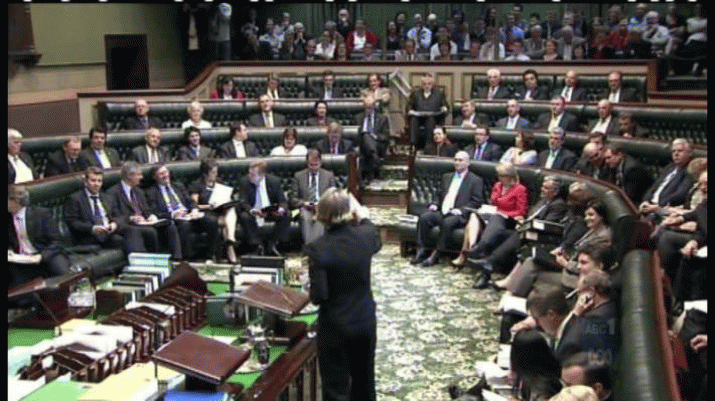
NSW politicians have narrowly escaped a ban on consuming alcohol when parliament is sitting. A parliamentary committee was asked to consider regulating how much politicians can drink after former Finance Minister Greg Pearce admitted to being affected by alcohol during a late night session.
The 12-member Upper House committee baulked at a total clampdown. Instead MPs have been warned they could face disciplinary action for becoming intoxicated. Drunk in charge of a vehicle is an offence: drunk in charge of a State is apparently not an offence, Civil Liberties Australia commented. – NSW Parl report.
• Horsing around in parliament
The independent Senator Nick Xenophon, respected as an effective and sensible swing vote in the federal upper house, offers the (Senate) newcomers this thought: “Avoid horse trading because you might get a donkey, and worse yet you might end up looking like an ass,” Peter Hartcher reported in the SMH.
ON THE SUBJECT OF HORSES: With PM Abbott having found a new predilection for Sir-cumcising people, we are fortunate that he does not have a horse, so he will be unable to appoint one Consul. However, given his chosen method of mobility, he could appoint a bicycle to a position of authority. Arise, Sir Malvern, what a Star!
• Spooks and police want even more secret access to your data
Intelligence and police agencies are turning reality on its head: they claim the Snowden leaks prove authorities need more laws forcing Australian telecommunications companies to store customers’ data.
Some agencies want everything you say on the phone, and do on the internet, stored for two years, according to their papers to a parliamentary inquiry into potential changes to telecommunications laws
ASIO, NT Police, Victoria Police, Australian Federal Police, Australian Crime Commission and Australian Commission for Law Enforcement Integrity all support a data-retention regime. Although storing “content” data is ruled out under a retention scheme, the NT Police and Victoria Police want web-browsing histories stored, Fairfax has reported.
ASIO is arguing that the more people encrypt their web communications after revelations made by US intelligence contractor Edward Snowden about widespread data collection programs by governments, the more agencies need greater surveillance powers.
In other words, because of Snowden, who revealed how the spooks and police cheated, there’s a hastened need to force providers to keep all customers’ “metadata” for a prescribed period, ASIO says.
Metadata stored about a phone call could include the parties to the call, location, duration and time of the call, but not what was said. Metadata stored about an internet activity could include your assigned IP address and the IP addresses of web servers you visit, or uniform resource locators (URLs) you visit and the time they were visited, while email metadata might include addresses, times, and the subject.
In the Sue Neill-Fraser murder case in Tasmania in 2009, metadata was wrongly used by police to claim she had accessed a particular website for nefarious reasons: only after she was convicted and jailed was it revealed it had been her daughter accessing the site, using her mother’s computer as a “guest”…looking up information to help a young child cope with the death of a grandparent! Neill-Fraser is still, wrongly, in jail with 18 ½ years to serve, Civil Liberties Australia believes
Secret and non-secret agencies in Australia accessed metadata 330,640 times during criminal and financial investigations in 2012-13. Access to such data, if it is currently stored by a provider, is able to be retrieved by many state and federal agencies, local councils, as well as the RSPCA, Australia Post and the Tax Office, without a warrant.
– from CLArion, Civil Liberties Australia newsletter, April 2014
For more articles from Civil Liberties Australia go to their website: http://www.cla.asn.au/
AND,
• The Stringer: Australia’s suicide crisis should not be played down – the media must highlight it