Economy
Tasman National Park Goes Under The Knife

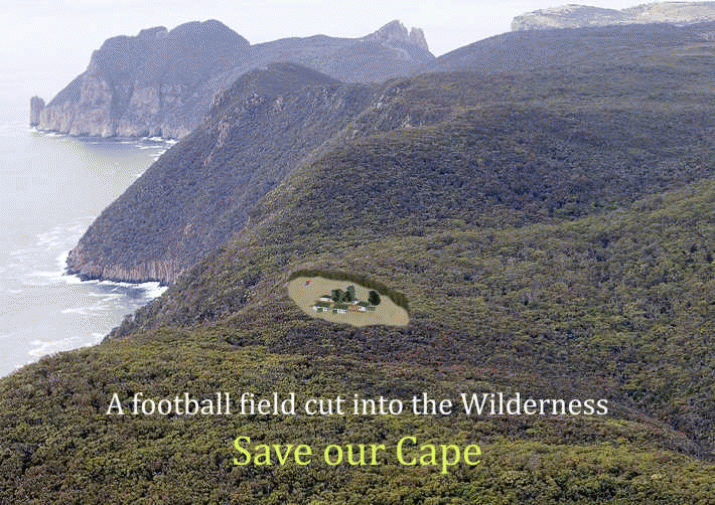

Tasmania, summer, 2014: Wilderness is still being lost … Just take a look!
Once upon a time the offenders were bulldozers – Hydro, Forestry or Mining. Now it’s Tourism led by the very own department assigned the task to promote, preserve and protect our wilderness and parks.
Reserved for posterity? Well at least this is what the Nature Conservation Act and the National Park and Reserves Management Act would suggest that at minimum our national parks should be maintained for the very values they were declared for.
As we enter the 21st century we all believe that wilderness within our national parks was no longer a commodity, but a sanctuary sacrosanct from interference and misguided values.
Well that’s no longer the case! The chainsaw are coming, and time is running out to preserve the high wilderness zones within Tasman National Park.
As summer marches on so does the relentless push for tourism within our national parks. None more insidious and invasive than the poorly planned 3 Capes development.
Five ‘village sites’ have been planned for construction within Tasman National Park. Each has numerous dwellings and infrastructure all aimed at supporting commercial operations.
Some of these village sites are within a short distance of a road, whilst others like the one at Lunchtime Creek are located in the pristine wilderness zones of the Cape Pillar region.
To accommodate the notion of open space, fire management and helicopter access the department’s plan is to cut swathes into the virgin forest the size of a football field and construct a cluster of infrastructure to maintain their delusional dream.
Reproduced directly from the drafted and undisclosed plans of the department, the image shown here is an accurate model of what the incision planned for Lunchtime creek would realistically look like. Not a pretty site, but more importantly it’s a massive invasion to the wilderness values of the area.
With reference to the National Wilderness Index – the Cape Pillar region is rated as a 12+ on the wilderness scale. That is about as high as it gets in the east of Tasmania. It is no coincidence that when the department produced its management plan for the 3 Capes Walk they failed to address anything about the wilderness values of the region.
Why?
Because it would have exposed them to a massive conflict of interest.
In typical Tasmanian political ethos, it is not surprising that the same department undertaking the 3 Capes construction is the same agency responsible for the planning approvals.
Such contempt for the public has undoubtedly brought the department into disrepute.
Unfortunately for wilderness the wheels of this very well greased 3 Capes project, which has been supported in Cabinet by the Greens, seems to rumbling along at an out of control pace unaccountable to anyone.
Ultimately the government’s action on this project is reprehensible to the point that it can only be deemed as environmentally reckless and fiscally irresponsible. It seems that the allocated finances have presently run out though it is most likely their last fling will be the wielding of chainsaws into the last wilderness zone of our Tasman Peninsula.
• Peter McGlone, Director, Tasmanian Conservation Trust Inc: Government research shows that a Two Capes Track would be a better business investment … ‘Clearly the Liberals are supporting the Three Capes Track because they think a bigger track will win more votes but in doing so they are abandoning sound business principles because research shows that a shorter less costly Two Tracks will generate at least as much income. ‘The most recent economic analysis of the likely income generated by the Three Capes Track (by Syneca Consulting in 2012 and released following the 2013 state budget estimates hearings) shows that it is likely that the half track, or Two Capes, will generate as much income as the full track but it will cost much less to construct and maintain.
• Luke Martin, in Comments: What complete and utter rubbish. The huts on Three Capes will look nothing like this, as anyone who has been briefed on the plans by Parks & Wildlife will attest. The perimeter areas around the huts are absolutely not being cleared as this picture fabricates. The bushfire protection zone around the huts requires understory and overhanging limbs up to 2 metres in height to be removed. Everything else stays including all the large trees, and therefore the canopy around the huts.