Economy
Special timbers need to get real. The Honey Trap. Abbott rebuffed

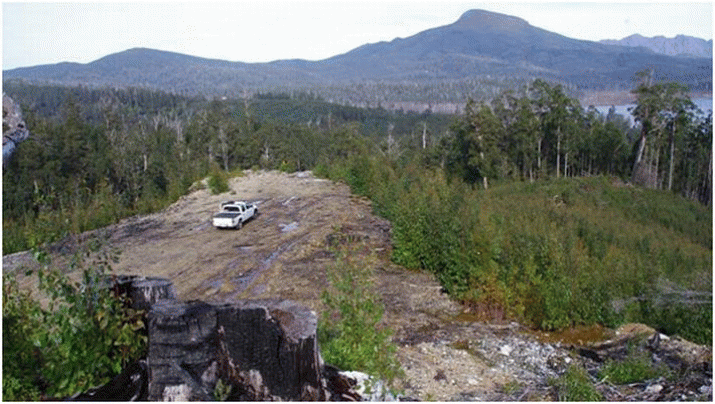

The Tasmanian Special Timbers Alliance just doesn’t get it do they! This recent article by Andrew Denham in The Sunday Tasmanian ( Special timbers need to be cut a break, here ) is a volatile mix of anger, resentment, conflict, hubris and unbridled entitlement.
Sure the special timbers industry is facing extinction. Yes they got a bad deal from the TFA. But when the entire public native forest industry itself is on indefinite life support courtesy of the Tasmanian taxpayer to the tune of $1 million per fortnight, the special timbers industry is of little consequence. And as a forester and blackwood expert I say that with the deepest regret and sadness.
The special timbers industry has been heading toward extinction for decades. Firstly it was an unsustainable by-product of old-growth woodchipping, and now post-woodchipping, is has no viable future. Blaming the TFA and the ENGOs for their problems is indeed specious.
But I’ve said it before. The blatant lack of any viable business plan for the special timbers industry gives them no credibility in any debate about ongoing access to a public forest resource. The 2010 Special Timbers Strategy ( here ) is a joke, which subsequently became offensive to Tasmanian taxpayers when Forestry Tasmania deemed its special timbers activities “non-profit non-commercial”.
Australia’s most “valuable” timbers must now have no commercial value whatsoever! Absolutely pathetic!
And Mr Denham asks to be given a break?
Salamanca Market, our many galleries and furniture shops without gorgeous handcrafted timber products produced by our fine woodworkers will indeed be a sad transformation. And the brilliant and successful Wooden Boat Festival was always built on a mirage, smoke and mirrors.
Tasmania has never had a sustainable boat timber resource.
Likewise the upcoming inaugural Deloraine Stringfest promises to showcase Tasmania’s fabulous tonewoods and our brilliant luthiers. But again, Tasmania does not yet have a sustainable tonewood resource. Only my own proposal for a farm forestry-based Blackwood Growers Cooperative ( here ) holds any hope for that possibility.
30+ years of conflict and a massive waste of taxpayer’s money clearly demonstrates that Tasmanians do not have what it takes to successfully manage a commercial public native forest resource.
The current election campaign is just further proof of this if more proof is required. I think most Tasmanians are thoroughly sick and tired of the whole sad sorry affair ( Big majority sick of forest war ).
As Tony Abbott and Joe Hockey have said, the age of entitlement, the age of the Rentseeker is over (they of course say this knowing full well that politics is all about handing out favours and privileges).
Perhaps one day the forest industry will wake up and become a real business instead of a community service. I suspect however that day is still some time in the future. Certainly the Special Timbers Alliance obviously wants it to continue as a taxpayer-funded community service, and the language of Andrew Denham indicates that they regard conflict as an important and essential element of the future of the industry.
It all makes for excellent tabloid headlines and fodder for the political process.
It also helps build Tasmania’s growing reputation as a divided dysfunctional community. But do we really want this?
• Robin Davey, Saveyourleatherwoodhoney Association: Tasmanian beekeepers rely on the forest
Beekeepers are alarmed that one half of the state forest which contains mature and near mature leatherwood on which all commercial beekeepers rely for viable honey production and the delivery of all pollination services, will again be under threat of destruction if the forest agreement is largely set aside and the new World Heritage status is reversed.
The industry, mainly through its lobby group Saveyourleatherewoodhoney Association, has been campaigning and negotiating for more than 8 years to have timber harvesting practices in the state forest managed by Forestry Tasmania, to take into account the need to preserve all commercial stands of leatherwood and also regrowth leatherwood which will mature after 20 to 40 reserve years.
This process has in the last 3 years begun to bear fruit with Forestry Tasmania beginning to prepare harvesting plans which attempt to avoid the complete destruction of the leratherwood resource. This process is, however, no guarantee that timber harvesting will not nearly always take precedence over beekeeping resource retention.
The Forest Agreement (TFA) and the World Heritage nomination has been a beacon in all this by removing the threat to more than one half of Tasmania`s leatherwood resource.
That threat was the timber harvesting methods of clearfell and burn. This method of harvesting is still favoured by Forestry Tasmania as it is claimed to produce the best seed bed and growing conditions for a monoculture of eucalypts. Such a monoculture produces an environment where there is little or no competing understorey, and this includes the leatherwood tree.
Without a permantly available leatherwood resource there will be little or no pollination of more than 60% of the Tasmanian grown ingredients making up our food chain.
As it is, the additional areas of agriculture created by our recently installed irrigation schemes will not be able to access pollination services unless the beekeeping industry can retain its current leatherwood resource and in fact expand its operations.
It simply will not have the capacity to deliver what the agricultural and horticultural industries must have, which is available honey bee pollination every year. Equally important is the ability to deliver the pollination service at short notice and at precisely the point of time when the crop is ready.
At present, the leatherwood resource and therefore the beekeepers’` capacity to deliver adequate (or any), pollination services is finite. The limit of the industry`s ability to meet current requirements has been reached. In fact in some areas it has already gone into reverse as a result of inadequate access to leatherwood. This trend will certainly continue and accelerate unless the resource is retained at its present level and immature stands of leatherwood are allowed to grow to maturity.
To allow the leatherwood resource to not only be threatened but suffer destruction as a result of timber harvesting methods, invites a situation where Forestry Tasmania either compromises its application for FSC accreditation or if it is accredited, loses that status.
The beekeeping industry is actively involved in the FSC process as a member of FSC and forestry stakeholder, and intends to ensure that the timber harvesting methods allowed under Forestry Tasmania`s accreditation status, sustain the beekeeping industry as well as the timber industry and other users of the forest.
EARLIER ON TASMANIAN TIMES:
• Delisting WHA: What it means
• A Government-funded Forestry legacy
• World Heritage mockery: An act of real bastardry (The article contains links to MRs from Parliamentary Secretary to the Minister for Agriculture, Tasmanian Richard Colbeck, whose recent MRs titled World Heritage mockery can be found in TT Media.
• ABC: Tony Abbott says too much Tasmanian forest ‘locked up’, forms new council to support timber industry Speaking at a timber industry dinner in Canberra overnight, Mr Abbott said too much forest is currently locked up in Tasmania. He also recommitted to repealing part of the state’s Wilderness World Heritage Area made under the forest peace deal. Under the deal, 170,000 hectares of forest was added to the area, and the Government has formally asked the World Heritage Committee to delist 74,000 hectatares. “We don’t support as a Government and Coalition further lock-ups of our forests,” Mr Abbott told the dinner. “We have quite enough national parks, we have quite enough locked-up forests already. In an important respect we have too much locked-up forest.”
• Christine Milne: Too much forest? Get real Mr Abbott “Who in the 21st century would say the environment is meant for man and not just the other way around? Get real Mr Abbott. We have no future without environmental protection. “The Abbott government needs to keep its hands off the Tasmanian Wilderness World Heritage Area and abandon its backward attempt to remove 74,000 hectares from UN protection.
• Jenny Weber: Will Tasmania’s Forest Industry signatory rebuff Abbott over World Heritage delisting “Is FIAT going to rebuff Abbott on World Heritage delisting and proposed logging? What is its reaction to the Prime Minister’s commitment, and what action are they taking to rebuff Tony Abbott, if any, and if not why not?” Jenny Weber said. “Tasmania’s newly listed World Heritage forests and the abundant wildlife that depend on these forests for habitat have world class recognition now and their protection needs to be secured forever,” Jenny Weber said.
• Richard Colbeck: Job only half done in Tasmania
• Tony Abbott is wrong – Australia’s forest protection more important in age of climate change
• SBS: PM forestry speech provokes Tasmanian backlash
• Mercury: Former forestry boss warns of heritage risk to international markets