• On love stories and Reza Barati
Humankind prospers through a terrible paradox, says Richard Flanagan in his closing address to the Perth writers’ festival. As groups we sanction the most terrible crimes. It is love stories that remind us of a better idea of us, a larger idea of our humanity.
Hobart, I discovered flying here the other day, is a thousand kilometres more distant from Perth than Moscow is from London. Misunderstanding the significance of these sorts of distances accounts for a great deal of horror and defeat in human history. Such expanses of space between ambition and achievement have put a summary end to the ambitions of many of the great. Napoleon. Hitler. The Sydney Swans.
Admittedly, I haven’t come here with delusions of conquest, but only to deliver this closing address [at the Perth writers’ festival] about love stories. But I am feeling the same sense of unease as Napoleon must have felt when, finally camped in Moscow, he saw the first flames leap up around the Kremlin’s fairytale onion domes. As Kieren Jack presumably felt at the beginning of the third quarter when something came between him and the sun. And it was Ryan Crowley.
There are several reasons for my unease.
Rainer Maria Rilke was admittedly not a Dockers tagger, but a sort of European equivalent, a German poet – in many respects a charlatan masquerading as a genius who turned out to be a genius. He cultivated anyone he could sponge off – women, the titled, the rich, or, ideally, rich titled women. Once, according to an account in a book long out of print by the long dead Kenneth Rexroth, Rilke was “leaning gracefully against the mantelpiece in a castle in Switzerland while his devoted duchesses and countesses and other disciples were passionately discussing Goethe’s Faust, a discussion in which Rilke was taking no part whatsoever. One of them turned to him and asked, ‘How do you feel about Faust, master?’ To which Rilke answered, ‘I have never been able to read more than a page of it.’”
In truth, not unlike Rilke, there are a great many great books and great love stories that I have never been able to get past the first page of. And then there are even more I have never even started. And the more I read, the greater, I guess, grows the library of unread books. Of all the love stories ever published, I have – realistically – read very few. My despair then in realising I had agreed to talk about love stories for some extended period was great. For I am no expert on love stories.
Then there is the matter of love itself, love, a word so trammelled by overuse as to be almost senseless. We like love, we love love, but perhaps its only meaning lies in its ubiquitous meaninglessness. We apprehend it, we feel it, and we think we know it yet we cannot say what we mean by it. Like Elvis, it’s frequently sighted in unusual locations – the Balga KFC, say, carrying several bags of half-eaten chicken nuggets, or the Mirrabooka Hungry Jacks leaning out of a beaten up Hi-Lux dual cab – but vanishes at the point at which we seek to authenticate it as real. We bury love under the rubble of other words and sentiments, deluding ourselves such gravel is gravitas, to make it seem as if we do know what love means.
To give you but one example: St Paul’s First Letter to the Corinthians, Chapter 13. Its justly famed and poetic evocation of love is perhaps the most popular biblical reading at contemporary wedding ceremonies.
Yet in the Greek original, the word that is commonly translated into English as the word love is the word agape (are-gar-pee). What agape meant in the ancient world is open to debate – it was about love of spouse or family, and contrasted with the word and idea of philia which suggested friendship, fraternity and so on – and eros – which was sexual attraction. The authors of the King James Bible, following the example of Wycliffe’s seminal English translation, chose the word charity as the correct translation of agape. What did Paul really want us to think on our wedding days – that the best we could hope for was that our spouses might view us charitably?
Or, was what he was writing simply beautiful wordplay? Did it mean anything at all? What would happen if we substituted some other word for agape instead of love?
What would happen, say, if it had been, say, a football coach writing to one of his team’s sports scientists, under the excited misapprehension that agape was, in fact, classical Greek for training supplements used by the ancient Olympians, and offering the following new version of St Paul’s letter?
…
Crowded into love stories between the discovery of ourselves in others and of others in ourselves, we glimpse something else, a boat, and on the boat, jammed between the polytarp thrown over the shivering, the sunburnt and the silent, caught between the briny largeness of the sea and the sky, terrifying and hopeful, breathing in the nauseating oily drifts of diesel fumes, stands a tall 23-year-old Iranian called Reza Barati who dares dream that freedom and safety will soon be his as the boat approaches the Australian territory of Christmas Island.
But the sky darkens, the idea cannot hold, the ocean shimmers and transforms into something terrible, and all that remains of that dream for Reza Barati is a white plastic chair he now holds up in front of him, seeking to ward off the inexplicable blows of machetes and bullets and boots – a white plastic chair, all that a rich nation that prides itself on a fair go, on its largeness of spirit, has left for Reza Barati to defend his life against those who have now come to kill him.
In this desert of silence that now passes for our public life, a silence only broken by personal vilification of anyone who posits an idea opposed to power, it is no longer wise for a public figure to express concern about a society that sees some human beings as no longer human; a society that has turned its back on those who came to us for asylum – that is, for freedom, and for safety. And so, with our tongues torn we are expected to agree with the silence, with the lies, and with the murder of Reza Barati.
Will our prime minister say of this death what he so recently said of human rights abuses in Sri Lanka, “We accept that sometimes in difficult circumstances, difficult things happen.” It would be condemned as not showing affection for our national team were a public figure to repeat the story of the Tamil woman, Vasantha – as reported by the BBC at the time of the prime minister’s comments – who describes being “kicked, beaten with batons and pipes, burned with hot wires and cigarettes, submerged in a barrel of water until she thought she would drown, suffocated by having a petrol-soaked plastic bag put over her head, before being repeatedly raped by men in [Sri Lankan] army uniform”, the torture and rape going on for 20 days “before a relative could find her and pay a bribe for her release”.
It would be even more foolish to not accept that human beings crowded like animals without hope in a compound on a hellish island is perfectly right and civilised, as is the language of politicians of both parties who now publicly boast that it is good and necessary to be cruel. This is the most wicked poison to ask any society to drink, and yet we are drinking it, and drinking it to the full.
…
Read the full article on Guardian Australia’s website, here, and comment there also
• Guardian Australia: Manus Island a ‘war zone’ on night of unrest, VIDEO footage reveals
• Australia’s boat people crisis
The state of emergency that is facing Australia.
It is one of the tragedies of our age to wander the streets and malls of Penrith or Rooty Hill or a hundred or more similar suburbs in our great nation of Western Sydney and see the misery, degradation and wanton terror that the boat people have brought from Campbelltown to Parramatta. Outside of the ruins of Aleppo and the wastes of Grozny, to say nothing of the sorrowful boulevards of Pyongyang, few places in the world have known such ongoing misery as the once happy lands of the western Sydneysider.
And it is to Western Sydney and all its great people that I offer the following modest proposal to once and for all end their world of the terrible problem of the ongoing invasion of the west by illegal boat people.
For some years it has been agreed that the problem could only be dealt with by the application of firmness best expressed in the term Stop the Boats. Even the most hardened heart of our most flinty politicians has been moved by the sight of drowned children and drowned mothers scattered over the Indian Ocean like lost shopping bags blowing through a Westfield car park.
For some years, however, the illegal and dangerous refugees have just kept making that journey, blind to the fact that their misery is a selfish vanity and ignores the plight and sufferings of the people of our great nation of Western Sydney. And of late they have waged an asymmetrical war against us in internment camps by stealth, in the form of riots, wounds, rapes and deaths that are ultimately self-inflicted.
And in that time we, as a people, as this great nation, have come to several conclusions, the first being that as well as being unwelcome these people lie outside the purview of any of the customs of decency or laws of humanity that apply to us, and hence they are illegal. Second, that these illegals keep coming not because of their own despair or misery, or the much cited notions of terror and fear. They keep coming because people smugglers – a brutal force of nature that can be easily equated with murderous white pointers – are running a highly successful import business bringing them to Australia. This leads to the third conclusion we have reached – namely, that there is no end of cruelty that is not justified in halting the wicked trade, and about the necessity of cruelty we are as agreed as we are united in knowing that we are only cruel in the interests of humanity and decency.
And yet, it is also clear that we cannot turn around the boats because they sink, or they are scuttled, while if we spend valuable taxpayers’ money on highly expensive lifeboats to shuttle the illegals back to Indonesia we may well provoke an unwanted and unnecessary confrontation with the Indonesian authorities. It is also now apparent that bribing Third World governments to set up gulags at huge taxpayer expense is impossible to administer properly without risking riot, violence, rape, abuse, and murder.
So what will stop the boats? What will end the reign of the evil people smugglers?
…
Read the full Opinion, and Comment, The Saturday Paper, here
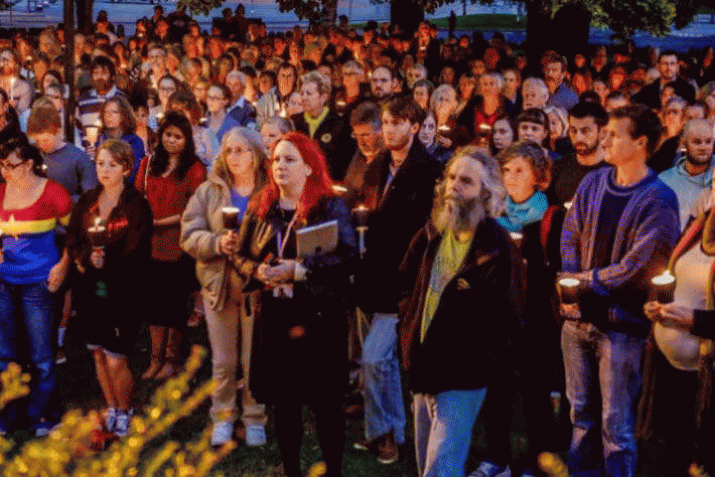
• More Rob Walls’ pics of the Light The Dark rally, here
• The Australian Editorial: An anti-Australian animus …
WHATEVER supercilious mindset pervades their inner-city enclaves, the green-Left minority is clearly devoid of the common sense and decency of most Australians, including the refugees and migrants who are proud to call western Sydney home. After 50,000 asylum-seekers, 800 boats and 1200 deaths at sea under Labor, most Australians are relieved that no leaky vessels have arrived for 77 days.
Rather than being relieved that Immigration Minister Scott Morrison has not needed to send more asylum-seekers to Manus Island, the Greens are fixated on the death of Iranian asylum-seeker Reza Berati, 23, a university graduate who wanted to practise architecture in Melbourne. Berati died during riots on Manus Island, an isolated tragedy that showed why the boats must be stopped. Greens MP Adam Bandt lamented that “a young man came to our doorstep seeking our help and we killed him”. Senator Sarah Hanson-Young demanded closure of the Manus Island “gulag” – which would extend a fresh welcome mat to people-smugglers.
Last July, on The Australian’s front page, then-treasurer and former immigration minister Chris Bowen expressed the views of his constituents in the western Sydney seat of McMahon. He said there was nothing compassionate about an unfair, disorderly refugee system dominated by unsafe boats that had resulted in “far too many drownings at sea”. The people who expressed the strongest views about the need for a robust border protection policy, Mr Bowen said “are not only migrants but also refugees – refugees who have waited in camps”.
The feelings of those who waited for a decade to be resettled in Australia, followed by more years of waiting to be joined by family members, however, do not concern the green-Left.
It would be hard to find a more contemptible critique of ordinary Australians than Richard Flanagan’s supposedly satirical rant in the The Saturday Paper’s first issue. It was addressed to “western Sydney and all its great people” whose streets were wrought with “the misery, degradation and wanton terror that the boatpeople have brought from Campbelltown to Parramatta”. As a logical endpoint to “the cruelty rightly advocated by both Liberal and Labor parties”, Flanagan suggested bombing the boats and killing “all the illegals”.
Just as arrogantly as Flanagan’s sneering, blogger Andrew Catsaras donned the persona of 16th-century mystic St John of the Cross when he wailed: “How black a heart can a human being have? How empty a soul?” Catsaras cited research showing 34 per cent of Australians thought the Coalition’s approach to asylum-seekers was right and 28 per cent thought it was too soft. This, he lamented was “as disturbing as poll numbers can get”. Barrister Julian Burnside has branded Australians “selfish, greedy and cruel”. But in demanding Centrelink and Medicare benefits for asylum-seekers “to regain our national soul”, he ignored the reality that such a pull factor would draw more people on to boats, to risk being drowned or dashed against rocks.
Newspoll shows voters are shifting their focus from boats to the economy, health and education because the Coalition has made major inroads into the people-smuggling trade. This has also relieved pressure on Indonesia, where arrivals have dropped. Aside from the green-Left, Australians at the pragmatic centre of the political spectrum know why this is a good thing.