Economy
Hobart … and architectural masterpieces

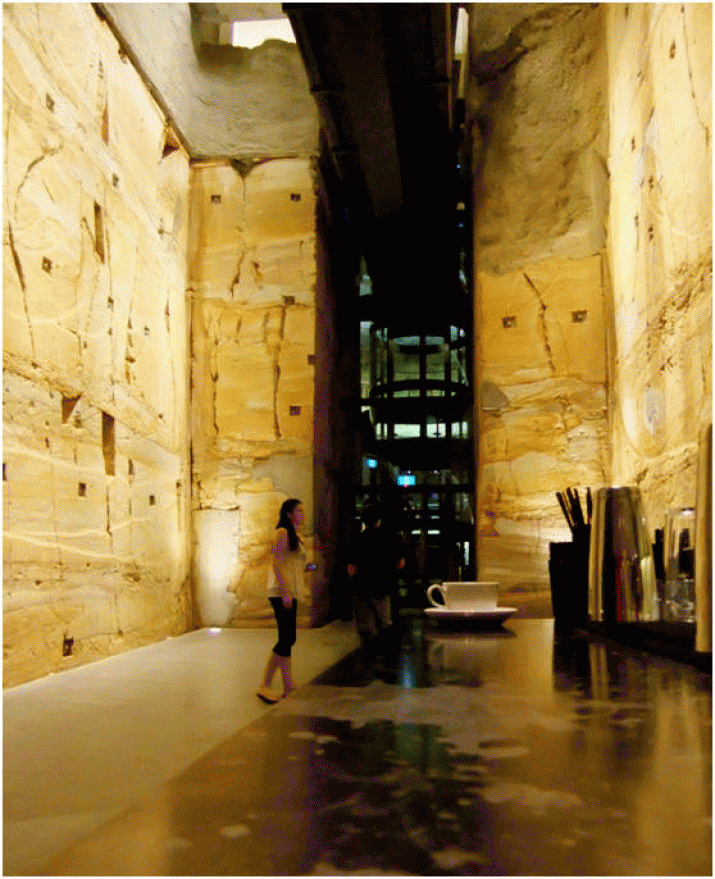


I read with some misgivings Kerry Johnstone’s January 31st Letter to the (Mercury) Editor, in which he lobbied for a “magnificent building, something to rival the Sydney Opera House” on the Hobart railyards site.
He went on to say that the city was crying out for an “architectural masterpiece” that would more than repay its cost in publicity and tourism. How could one argue with a notion that ticked allthe boxes?
Certainly not Leo Schofield. In support, he pointed out [February 8th in his My Tasmania page] that the Sydney Opera House generated more than a billion dollars a year to the economy. For him, the way ahead was clear: “[T]here are two ways to achieve an architectural masterpiece,” he said. “One is to commission an architect with an outstanding international record. The other is to run an international competition.”
At this point one might ask:“What are we waiting for?”
Both writers were generous enough to mention MONA, and in this writer’s opinion, we could stop right there. I have plenty to say on this subject, but if you don’t care to read any further, I’ll summarise by saying that we already have our masterpiece and there is a clear and compelling case for quitting while Hobart is ahead.

Photo: Tony Hagar

The emergence of MONA is instructive in many ways on the subject of masterpieces.
First, an architectural “masterpiece” is not something that can be simply “commissioned”. Even Frank Gehry, architect of the Guggenheim Museum in Bilbao (mentioned by Mr Schofield) has had his share of failures. In this context, a masterpiece is more a matter of artistic genius than architectural skill—and artistic genius is mercurial. Furthermore, there is a lot of luck involved.

Guggenheim Museum, Bilbao, Spain by Frank Gehry

MONA is the result of sheer artistic genius in the person of David Walsh — it is an edifice unique in all the world, and widely recognized as such. And, let us not forget, this was a project launched with an obsession with sex and death. Many art patrons approached MONA with a sense of outrage and offense, not the least because the very public purpose of Mr Walsh was to shock and offend. That, and his penchant for blatant weirdness, brought sneering from his critics — most of them Australian, and who, for the most part, reflected a churlishness reserved for fellow countrymen who fail to conform to insular cultural norms, or forget to genuflect to power.
The point here is that genius is not only very rare but highly likely to become embroiled in controversy. Clearly, in this instance Mr. Walsh had the last laugh, but that was far from being the case with regard to the Sydney Opera House.
Second, it would be wise to consider the organic nature of genius. MONA emerged from a hole in the ground. Mr Walsh’s genius and vision gave rise to a soaring negative space, its potential revealed only by the removal of 35 thousand cubic meters of sandstone.
It was not something to be derived from an architectural blueprint; rather,it was an enormous gamble and, by its very nature, subject to change without notice. It is nothing for an artist to decide, after monumental labor, that a result was not as intended and should be ripped out and redone. It was these very issues that gave rise to the crippling disputes over the Sydney Opera House and which resulted in the resignation of its architect Jorn Utzon (the winner of the competition, incidentally). Mr Utzon’s vision (his artistic sketch, if you will) was in the process of revealing itself but at the time of his departure it had not translated into a construction plan. That had to be “discovered” by others via some very sophisticated mathematics and at the cost of much time, expense and bad press — not to mention bitterness and recrimination. The cost over-runs were massive (estimated: $7 million; actual: $102 million) but that is part and parcel of genius.
One must ask if the city of Hobart can afford genius, with all its attendant idiosyncrasies.
Probably the most extreme examples of organic (and idiosyncratic) genius are the works of Catalonian, Antoni Gaudi (1852–1926) who stands alone in the history of architecture. No adjective can do him justice, but his most famous work, the Sagrada Familia cathedral in Barcelona, exemplifies the extremes to which genius can extend. Gaudi lived in a workshop on the site from 1914 until his death; it was his obsession. In person he looked like he was homeless. Today, the cathedral he envisioned is still a shell and the figure of 100 years is bandied about as being a rough estimate of the time to see its completion. No drawings exist; Gaudi designed the building as he went along. Those who have followed him in its construction just have to guess. What they produce, with the best intentions, will surely be a pale representation of what Gaudi himself might have achieved.
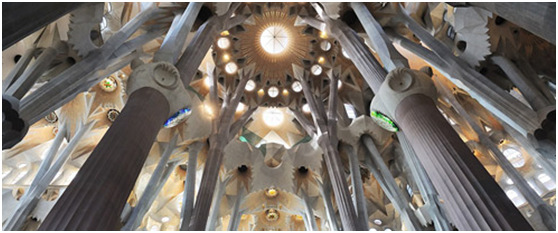
SagradaFamilia, Barcelona, Spain by Antoni Gaudi

Clearly, MONA has had its controversies, outrages and bad press, but Mr. Walsh has been able to circumvent any and all of it with ease — he is fabulously wealthy (a good place to start); he paid for the construction, he owns the building, acts as his own curator, receives no outside funding and charges nothing for entry. This masterpiece came easy for him and all along he thumbed his nose at his critics. But, if your name isn’t David Walsh, and you are not your own client, a masterpiece is likely to cost you dearly — not only in money, but time, frustration and, ultimately, at the hands of the critics.
Third, genius remains subject to the Law of Unintended Consequences. There may have been some unintended consequences in the emergence of MONA, but we will never know — Mr Walsh also controls his own publicity. Turning to the Sydney Opera House however, before it was even completed it was recognized as inadequate for more than one of its intended purposes. This is to take nothing away from its brilliance, but to cite an example: the Joan Southerland Theatre is inadequate to stage large-scale opera and ballet. Blame the original brief; blame the architect; blame those who came after him and made their own changes — but, genius or no — hardly an inconsequential failing.
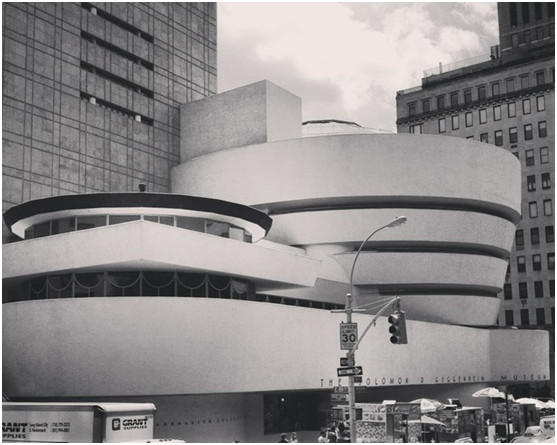
Guggenheim Museum, New York by Frank Lloyd Wright

A better example is the Guggenheim Museum in New York. Several years ago I became acquainted with its architect-in-residence. I imagined the position to be among the most prestigious in all of architecture — basking in the reflected glory of one of the 20th Century’s greatest artists and his most famous work — wow! My awe was short lived. I learned that her job was a nightmare, entailing a never-ending battle to counteract Frank Lloyd Wright’s disregard for practicalities. The structure has no insulation, thus the extremes of New York weather — high 30-degree temperatures with very high humidity in summer and below freezing averages in winter — are transmitted directly from exterior to interior. Thus, heating, cooling, condensation, flaking cement and peeling paint require on-going labor to prevent the building from self-destructing, not to mention avoiding potential damage to priceless works of art hanging from its walls. Falling Waters in rural Pennsylvania suffers from similar problems. There are consequences when a house is built over a waterfall—even for Frank Lloyd Wright. Thus: Beware operating expenses!
Fourth, lightning rarely strikes twice in the same place.
Hobart already has some architectural masterpieces, one of which — the aforementioned MONA — is on the scale of what Messrs Johnstone and Schofield envision for the railyards. A worthy addition would be a huge bonus for all the reasons they give — how wonderful that would be — but, unless Mr Walsh is willing to front several hundred million bucks to finance it, the chances of it happening are slim indeed. In the meantime, let us give thanks for MONA, a masterpiece to make any city, indeed any country, proud.

Photo: MONA File

Whether he intended it or not, David Walsh has become, in my humble opinion, one of Tasmania’s — indeed, Australia’s — most gifted artist/architects. As such, he stands with the prodigiously gifted J.H. Esmond Dorney — high praise indeed.
Mr Dorney studied architecture at the University of Melbourne and worked for Walter Burley Griffin before setting up his own practice in Hobart after WW II. His wife Joan was a friend of my mother’s and, knowing of my interest in her husband’s work, and in particular their own home (Fort Nelson) she invited me to visit.
Mrs Dorney suggested that the evening was the best time to see and appreciate the house, perched as it was on an abandoned 1904 gun emplacement, high above Sandy Bay.
She was right about the timing. I was a teenager and absolutely enthralled. Space does not permit a description but I have never forgotten that house, and — after fifty years and many travels — have yet to see its equal. It was sublime; it was brilliant. Sadly, it burnt to the ground in the 1967 bushfires, but its replacement was important enough that, following Esmond Dorney’s death in 1991, the City Council bought it to hold for the citizens of Hobart in perpetuity.
Hopefully, MONA will exist in perpetuity for us, too.
Tony Clephane Hagar, LLB (Tas) MBA (Columbia) is a committed advocate for historic Hobart. He lived 40 years in New York where he was a student at Parsons School of Design and The Art Students League. He has undertaken architectural and design projects in New York, Rhode Island and New Mexico. His work has been featured in The New York Times (NYT Tony Hagar Habitats).