

It’s the false dawns that must be the hardest.
After finally escaping a war-torn homeland, surviving a harrowing and perilous decampment and, after all that turmoil, finding out that safety and opportunity were still such distant propositions, your life at the mercy of the political wind.
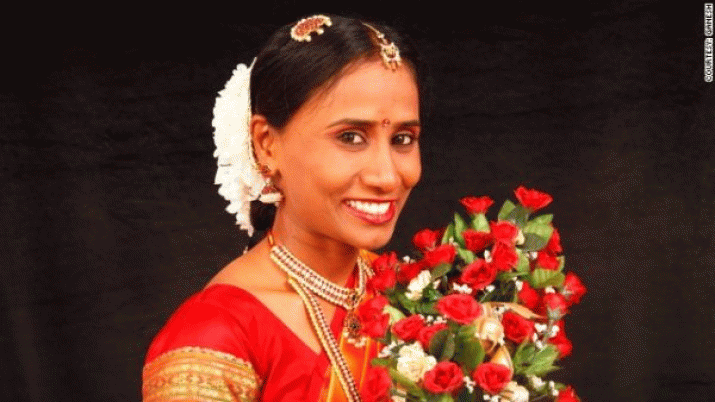
In May 2012 I read an article on Ranjini, a pregnant mother of two who had sought asylum in Australia after fleeing a brutal civil war. After the war claimed the life of her husband, leaving her sons without a father and the family facing persecution, she made the excruciating decision to leave Sri Lanka, a land that was no longer safe for her. She became a refugee.
The true definition of that term finds little credence in the cut and thrust of our domestic politics. It has, distressingly, become seen as a euphemism for illegal and dangerous immigration – a threat that must be turned away, rather than an opportunity to prove our bona fides as the land of the fair go. It has been a linguistic hijacking of the highest order, aided by a despicable brand of fear politics that has created an almost complete dehumanisation of anyone who arrived here by boat.
That was the environment that greeted Ranjini and her two sons in April 2010 when they arrived at Christmas Island, 2,600 kilometres north-west of Perth. After a year spent traversing the detention network on the Australian mainland, Ranjini and her young family were finally released into community detention. They were still asylum seekers – a phrase with perhaps worse connotations than “refugee” – but they finally had safety and liberty. The turmoil and grief that had accompanied Ranjini for years seemed to have finally ceased.
It took nearly a year after her arrival in Australia to satisfy the Immigration Department that her fears of persecution were genuine. But with that hurdle negotiated, attaining a permanent visa was, apparently, a mere formality. While awaiting this final verdict, Ranjini fell in love with an IT contractor from Melbourne. She and the kids moved in with him in suburban Melbourne, and for the first time in years they had a place to call home.
Australia’s humanitarian migration programs are often maligned for a lack of humanity. While it can, and should, be less punitive towards the vulnerable people that rely on it, it is worth remembering that at its heart lies an extraordinarily generous ideal. Thousands of people a year are rescued from persecution, violence and potentially death. They are welcomed into a country that provides both security and opportunity. For a period, the newly married Ranjini thought she would be one of them.
It was May 2012 when Ranjini, then pregnant, was called in for a meeting with the Immigration Department in Melbourne. It would prove her last moment of liberty. She had failed the ASIO security check which was fatal to her visa application and she would be shipped to Villawood Detention Centre in Sydney. In one short day, her new life had fallen apart.
Without the ASIO clearance, Ranjini was in a legal catch-22. Her refugee status meant she could not be returned to Sri Lanka, while the security issue precluded her from receiving a visa in Australia. Effectively stateless, Ranjini become one of about 50 people facing indefinite detention in Australia. Worse still, our national security laws left her without even the basic right to know what she was suspected of doing.
I started Letters For Ranjini because I had to do something. In my country, a Government I had voted for had imprisoned a group of people for an unlimited period, without any charge or trial, for alleged crimes they were under no obligation to reveal. It was, and unfortunately remains, an unprecedented attack on the rule of law and a black mark on our human rights record. These were the kind of stories you expect from rabid dictatorships, not in our land of the fair go.
Read the rest, including Anthiny’s Letters to Ranjini campaign HERE:Letters for Ranjini










