History
Betty King … first white woman in Australia


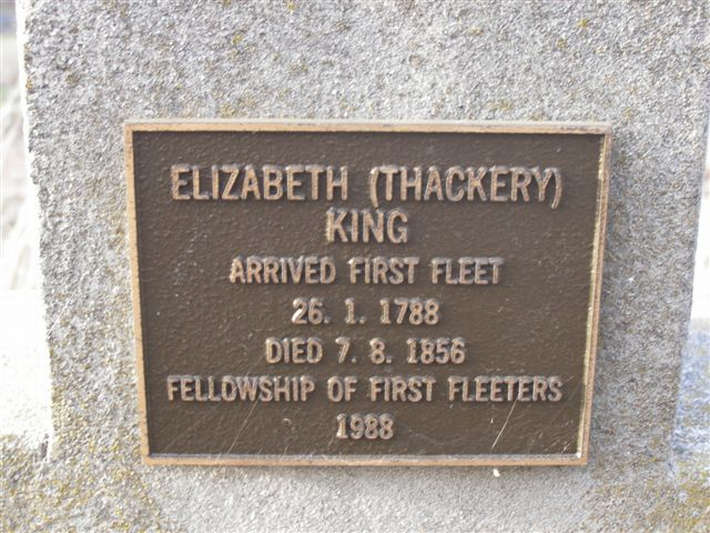

In September 1963, the late Henry Shoobridge of Bushy Park, Tasmania, who was a well know local identity and hop grower, placed the present tombstone and plaque on the grave of pioneer Betty King. Located in the Methodist burial ground at Back River, near New Norfolk in the Derwent Valley, the inscription simply reads:
“Near this spot was laid to rest BETTY KING, the first white woman to set foot in Australia.”
The new tombstone replaced a wooden cross erected by the Trustee of the Church. Miss Maisie Wills, whose family had a life-time association with the church, unveiled the new tombstone.
Betty died in 1856. The Hobart Town Courier reported: “THE FIRST WHITE WOMAN IN NEW SOUTH WALES – Mrs Elizabeth King the first white woman that landed in New South Wales, died this week at the Back River, New Norfolk.” (7th August). She was aged 92 years.
Mr Henry Shoobridge, did not know Betty King, but his father, William, did meet the lady when she was 90 years old, two years before her death. The memory of meeting her was impressed upon his mind, passing the story to his son, Henry. Many years later, Henry was moved to have Betty remembered.
Betty was a convict. She was sentenced at Manchester 4th May 1786 for seven years transportation for stealing two black silk handkerchiefs and three others. She was then known as Elizabeth Thackery (later referred to as Thackary, Thackey, Hackery and Hackley). It is recorded that she was wife of Thomas Thackery, soldier, 15th Foot. Her maiden name is not known. She was born; it is believed, in 1767.
Betty spent her first year in prison hulks, but when the First Fleet set sail she was aboard the vessel, Friendship. She proved to be a troublesome prisoner and at the Cape of Good Hope she was transferred to the vessel Charlotte. Betty was a problem for the authorities. In July 1787 she was handcuffed to Elizabeth Pulley (Pooley), (who had her death sentence commuted to transportation), for making their way to the seaman’s quarters. This did not deter Betty as she repeated the performance. She was then handcuffed to Elizabeth Barber. Lt Ralph Clark wrote: “The damned whores the moment that they got below fell a fighting amongst one another – and Captain Meredith ordered the sergeant not to part them, but to let them fight it out, which I think is very wrong in letting them do so.”
After many months at sea, on the 20th January 1788, “Land Ho” was shouted. At long last Botany Bay was sighted. On 26th January, Governor Arthur Phillip, the principle officers and other marines gathered around an erected flagpole and history was enacted.
There is no documented evidence to state that Betty was indeed the first white woman to set foot on Australian soil. However, the story told to Mr Henry Shoobridge’s father by Betty herself is that she was, by the time of arrival at Botany Bay, acting as a Lady’s Maid to the Officer’s wives.
It was related to the late Mr Shoobridge that the Officer’s ladies were to be the first white women to land. They did not like the look of the surf through which they were to be carried, with the possibility of getting a wetting. Just to be reassured, they asked that a maid (Betty) be carried ashore first as a rehearsal. This was apparently done and as it was only a preliminary trial, there was no official record kept of it. However, no Official account could alter the facts of the incident, which was that Betty was carried ashore first. (Shoobridge letter 29th May 1955).
The story seems feasible, but not proven; but neither disproven.
From Sydney, Betty was transported to Norfolk Island. Trouble followed Betty as she was given 25 lashes for being absent without leave from the settlement. In mid June 1794, however, we find her living with settler James Dodding. In 1800 we find Betty, now free, buying ten acres of land on Norfolk Island from Samuel King. Dodding was to go to Van Diemen’s Land (VDL) with a wife, but not with Betty.
Samuel King was an ex marine who took to farming on Norfolk Island and was married. Yet, when he arrived in VDL in 1808 aboard the City of Edinburgh he came alone. Betty was now an independent woman and like many Norfolk Islanders she too arrived in VDL. Both Betty and Samuel had been given land grants at New Norfolk (Back River) and on Saturday 28th January 1810 they were married by pioneer priest Rev. Robert (Bobby) Knopwood. Samuel was described as a ‘widower’ and Betty as ‘single woman’. Both signed with an ‘x’ and witnesses were Susana Mitchell, thought to be a friend of Betty’s and Thomas Stacks who officiated on many such occasions for Knopwood. The Kings called their property “Kings Rocks”. Nothing remains today.
Samuel died 21st October 1849 and is buried at Back River. There is no marker. In her Will dated, 16th November, 1855, Betty left her property to Ebenezer Shoobridge. It was Mr. Shoobridge’s descendant, Henry, who went to lengths more than a hundred years after her death to erect a tombstone to her memory. This was done by the permission of the Trustees of the Back River Methodist Church. The exact spot of her burial place was not exactly known, so the tombstone was erected “near this spot”. A latter owner of “King Rocks” said that Betty was buried in the corner of the cemetery, about 20 yards beyond the location marked by the headstone and plaque.
Was she indeed the first white woman to set foot in Australia? Possibly; but as we have learnt there is no official documentation of it. She is, however, the last known female survivor of the First Fleet. Certainly a distinction – and if she was not the first female arrival, then certainly it can be said that she was ONE of the first.
© REG. A. WATSON, is a Tasmanian historian and author.www.regwatson.com