Economy
National Trust Brand Devalued

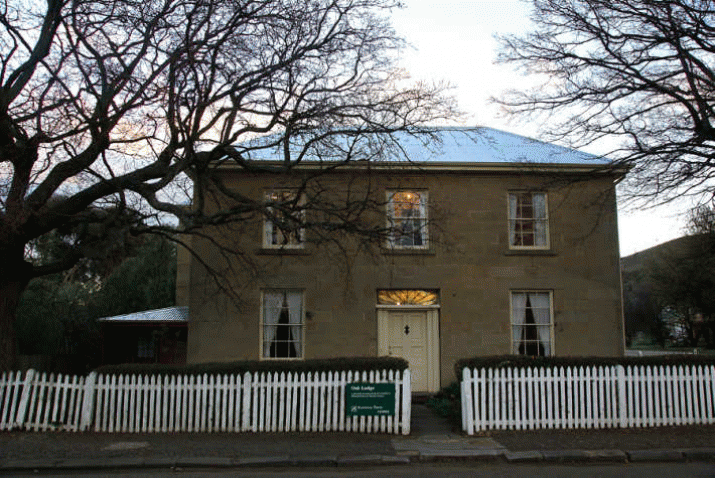

“National Trust” is a strong brand. “National Trust” is associated not only with preservation of built heritage but also with providing access to that heritage. Visiting “National Trust” properties is an expectation if not a right. The owner and franchisees of the brand “National Trust” are suffering a disservice by the brand’s devaluation in Tasmania.
“National Trust” in Tasmania is defined by the National Trust Act 2006. This Act allows for the buying, selling and mortgaging of built heritage as if it were any commercial property. The Act essentially sets up the debt financing of a section of Tasmania’s built heritage. State-owned properties can and have been transferred to National Trust Tasmania. Their maintenance and management can then be financed by debt which in turn is financed by sale of other National Trust Tasmania-owned property. Private persons are now much less likely to leave property to National Trust Tasmania knowing that it will be sold in order to fund an obligation to preserving built heritage that has been dropped by the state. Opponents of the Tamar Valley pulp mill had success when they targeted financiers. The financiers of the debt on National Trust Tasmania properties have left themselves vulnerable to similar pressure by profiting at the expense of publicly-owned built heritage.
The board of National Trust Tasmania is not independent of the state. “The Trust is aware that its future operations are dependent upon continued financial support from the State Government and the receipt of future grant funding. Subsequent to 30 June, 2013, the Trust signed an agreement with the State Government for additional funding of $200,000 to support ongoing operations.” (National Trust of Australia (Tasmania) Notes to the Financial Statements for the Year Ended 30 June 2013, page 8, last paragraph) The board of National Trust Tasmania contains persons who report directly to government and persons who have been closely associated with government. Less than seven years ago, the whole National Trust Tasmania board was government-appointed.
Richmond was once the administrative and commercial centre of the third most populous district in Tasmania. The fertile Coal River Valley produced surplus food when there was a great need in fledgling Australia. Richmond lay at the junction of roads to Hobart, to Risdon, to Brighton, to the East Coast, to the Tasman Peninsula and to the north and Richmond also had a sea port. Governors Davey and Arthur had country estates at Richmond. The resultant prosperity caused the construction of substantial infrastructure, Richmond’s built heritage. The construction of the Sorell Causeway provided alternate land routes and cut off Richmond from the sea. The railways provided alternate land transport. Additional agricultural areas opened up. The resultant easing of commercial pressure assisted Richmond’s preservation. This background led to Richmond being the heritage destination that it is today.
Part of Richmond’s heritage offering to visitors will be lost because National Trust Tasmania is about to sell Oak Lodge, a 1830’s historic house and museum that was gifted by the late Muriel Horsfall. As the only non-institutional building and museum open to the public in Richmond, the loss of Oak Lodge represents a loss to the whole community, just when the construction of the heavy vehicle link road was expected to assist in revitalising the town as a visitor experience. The Richmond Community would like to see the Oak Lodge property remain unaltered and kept open to the public with the community having a say regarding the property’s management.
A plan has been published which discusses ways in which this might be achieved and this plan is openly accessible:
http://coalriverhistory.org/oak-lodge/oak-lodge-futures/
National Trust Tasmania needs to publicly respond to this plan.