Coroner & Legal
He was the guy who got the dingo off

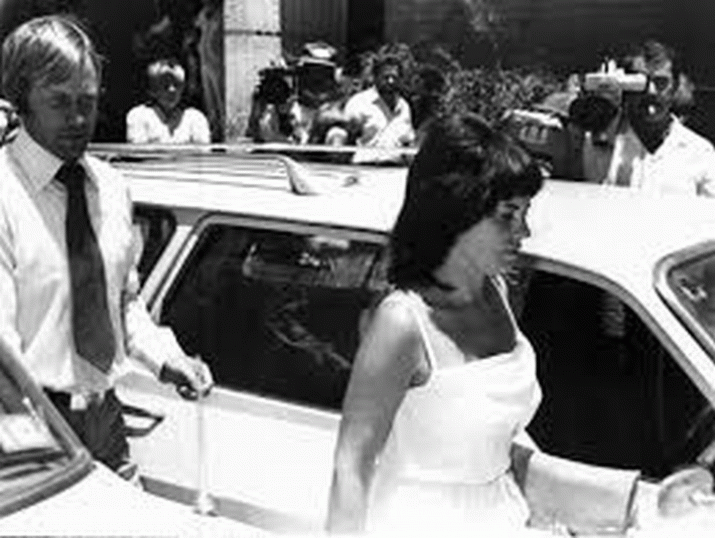

This is the 29th extract from Our Corrupt Legal System, by Evan Whitton (@EvanWhitton1) available free at netk.net.au/whittonhome.asp
The story so far
Justice means fairness, and fairness requires a search for the truth, otherwise the wrong side may win. The common law in England and its colonies has perverted justice for 8½ centuries.
The system began as an extortion racket in 1166. Extorting judges and their lawyer-bagmen formed a cartel. Members of the cartel entirely “devoured” a deceased estate originally worth $1.5 billion of our money between 1798 and 1915,
Judges have never been trained as judges; they are lawyers trained in sophistry, a method of lying, one day and judges the next. US lawyer Alan Dershowitz said: ‘… lying, distortion, and other forms of intellectual dishonesty are endemic among judges.’
European courts adopted a truth-seeking (inquisitorial) system after a conference in 1215. A handful of English judges formally rejected the system in 1219.
European judges perverted justice for five centuries; they believed, like George W. Bush and Barack Obama, that torture is a reliable way of finding the truth.
In common law countries, lawyer-politicians have been able to block change since they became the “dominant interest” in Parliament about 1350. (Vote 1: Anyone but a lawyer.)
The adversary system is a different kind of racket. Lawyers gather and present evidence, question witnesses, and can spin the process out. The civil version dates from 1460; the criminal version from 1695.
Legal academics joined the cartel after a serial liar, Billy Blackstone, began the first law school at Oxford in 1758.
Napoleon began to reform the truth-seeking system in 1800. Versions of his system are used in Europe, South America, Japan, South Korea, and China, and for inquiries in common law countries, including Australia.
Common law judges did the opposite. Since 1800, they have invented a number of truth-defeating devices which bias the law and pervert justice in favour of criminals. Justice is also perverted by a bias in favour of plaintiffs in libel and negligence cases.
Judicial sophistry in tax evasion rulings has stolen billions from the Tax Office and pay-as-you-earn taxpayers.
Wilful blindness has been a crime since 1861. In a second submission to the Productivity Commission (http://netk.net.au/whitton/whitton4.pdf), I explore a question: are judges and lawyers guilty of wilful blindness about the defects in the system?
F. Sliding round truth problem
As the public and Judge Fox know, everything turns on the search for truth: justice, fairness, reality, morality. But, as the foregoing shows, a system which has six ways of concealing evidence and 18 other mechanisms which obscure or defeat the truth is not trying to find the truth. I asked an academic how lawyers deal with the truth problem. Waggling his hand, he said: ‘They slide round it. ’
Mostly, they just ignore it. Of those who do confront the problem, some blandly say the system does search for the truth. Others say justice is process, not truth. Some even say that justice is better than truth. A selection:
John Scott, Lord Eldon, (1751-1838) said in Ex parte Lloyd (1822): ‘ … truth is best discovered by powerful statements on both sides of the question.’
Law professor Monroe Freedman echoed Lord Eldon in Professional Responsibility (1966): ‘The attorney … does participate in a search for the truth … The attorney functions in an adversary system based upon the presupposition that the most effective means of determining truth is to present to a judge and jury a clash between proponents of conflicting views.’ But law professor David Luban said in Lawyers and Justice: ‘No trial lawyer seriously believes that the best way to get at the truth is through the clash of opposing points of view.’
Judge Richard Posner noted that adversarial procedures are contests of liars. The addition of a few words demonstrates the reality of Eldon’s proposition: ‘Truth is best discovered by trained liars making powerful statements on both sides of the question.’
Justice Potter Stewart, speaking for the US Supreme Court, said in Tehan v Shott (1966): ‘…the basic purpose of a trial is the determination of truth.’
Law professor John Strait Applegate, then of the University of Cincinnati College of Law, wrote in Witness Preparation (Texas Law Review 1989): ‘The public perception of the function of the judicial system and ethical rules support the [public’s] view that ascertaining the truth is the paramount goal of the adversarial system and the primary basis of its legitimacy.’ That means the public assumes that the system seeks the truth and is thus a legitimate system. The assumptions are natural but wrong. It also means the public will support change to a truth-seeking (and hence legitimate) system.
Chief Justice (NSW) Jim Spigelman said on his appointment in 1998: ‘[The legal] profession has an ethical dimension and values justice, truth and fairness … The common law and the adversary system – a manifestation of the power of Socratic dialogue – is [sic] one of the greatest mechanisms for the identification of truth and the maintenance of social stability that has ever been devised.’
Law professor Michael Asimow, of the University of California at Los Angeles, summed up his and other lawyers’ views that justice is process in Nova Law Review (Winter 2000). He wrote: ‘[The] general public and lawyers differ about whether justice means truth or justice means process.’ That means 0.2% per cent of the community believe that justice is process. (Justice David Ipp, of the West Australian Supreme Court, said in 2000: ‘When the legal system does not reflect community values it loses its legitimacy.’)
Professor Michael Asimow noted that the public’s belief that justice means truth dooms lawyers to be mistrusted and sadly unloved. He continued: ‘Lawyers will always be distrusted, in part because their assigned task is to play whatever role and manipulate whatever law a client’s interest demands … lawyers are doomed to be unloved because criminal practice is their most public function As lawyers see it, justice requires that an person have the benefit of appropriate process, such as the reasonable doubt rule or the privilege against self-incrimination. This perspective is not shared by most members of the public, especially when it comes to criminal law. Most people think that justice means finding the truth regardless of the adversarial system, procedural technicalities, statutory loopholes, police or prosecutorial misconduct, or lawyers’ tricks.’
David Maxwell Fyfe (1900-67) was an exponent of the view that justice is better than truth, but he was naïve about the system’s capacity to convict the innocent. As Home Secretary in 1953, Fyfe refused to stop the hanging of an innocent youth, Derek Bentley, 19 (mental age 11). Fyfe said: ‘There is no possibility of an innocent man being hanged in England.’ He was thus eminently qualified to become Lord Chancellor (and Viscount Kilmuir) in 1954.
Kilmuir wrote in The Migration of the Common Law (Law Quarterly Report, 1960): ‘Now the first and most striking feature of the common law is that it puts justice before truth. The issue in a criminal prosecution is not, basically, “guilty or not guilty?’ but “can the prosecution prove its case according to the rules?” These rules are designed to ensure “fair play” at the expense of truth. The attitude of the common law to a civil action is essentially the same: the question is “has the plaintiff established his claim by lawful evidence?” not “has he really got a good claim?” Again, justice comes before truth.’
Justice Russell Fox demolished Kilmuir thus: ‘This statement in fact begs the present question by saying that justice is what the parties [i.e. their lawyers] present in evidence, true or not.’
Harold Macmillan (1894-1986, Prime Minister 1957-63) dismissed Kilmuir during the Night of the Long Knives in 1962. Kilmuir complained that his cook would have got more notice. Macmillan said it was harder to get a good cook than a Chancellor. Derek Bentley’s conviction was quashed in 1998.
G. Conviction rates
The words ‘fair trial’ are never far from the lips of common lawyers and judges, but former prosecutor William T. Pizzi, now a law professor at the University of Colorado, said in Trials Without Truth (New York University Press, 1999): ‘The goal of the defense attorney is not to obtain a fair trial for the defendant; a fair trial might spell disaster for the client because it would likely result in a conviction, given the evidence. Instead the goal is to win above all and that means doing almost everything to win. It may require what lawyers refer to as a “scorched earth” defense in which anyone and everyone is likely to come under attack – including not just prosecution witnesses, but the prosecutor personally as well as the judge.”
Sir Lionel Luckhoo QC (1914-97), a Guyanese of Indian descent, was listed in The Guinness Book of Records (1990) as the world’s most successful lawyer: he procured 245 not guilty murder verdicts in a row. Luckhoo probably knew that perhaps 241 (99%) were guilty. Luckhoo was knighted in 1966, presumably for services to perverting justice. His client, the Rev Jim Jones, presided over the murder/suicides of 913 people at Jonestown, Guyana, in 1978, but saved Luckhoo’s record by suiciding himself. In 1980, Luckhoo declared himself ‘Ambassador for God’.
Estimates of conviction rates in the adversary system vary, but it is clear that more than half known serious criminals get off. Law professor Michael Zander said in 1989 that since 1979 approximately 50% of all accused were acquitted in British criminal trials.
In 1997, Dr Lucy Sullivan, of the Sydney Centre for Independent Studies, noted 1993 figures showing that the murder conviction rate in NSW was 26.5%. The rape figure was 11.5%. In 2004, NSW Bureau of Crime Statistics figures showed that the rate in sexual assault cases in NSW was 19%.
The Hindu reported in September 2003 that Mallikarjun Kharge, Home Minister for the state of Karnataka, had urged the Indian Government to change to a truth-seeking system because the conviction rate in Karnataka was 28% and the national average was 16%. India’s population in July 2009 was estimated to be 1.17 billion, almost 75% of the total afflicted by the anti-truth system.
The New South Wales Independent Commission Against Corruption (ICAC) uses the investigative system to find the truth about the corrupt in the public sector, but charges are heard in the adversary system. In the period 1989-95, 63 of 208 were found guilty, a conviction rate of 30.3%.
Inquests likewise use the investigative system, but some evidence heard by the coroner will be concealed either by the DPP or the trial judge.
In 1984, Jennifer Tanner died from two bullets from a bolt-action rifle that required reloading. The bullets went through her fingers and into her brain. Police said it was suicide. In 1998, a Victorian Coroner found that Jennifer Tanner’s brother-in-law, Detective-Sergeant Denis Tanner, shot and killed her. The DPP did not charge Tanner.
In 1994, Detective-Sergeant Geoffrey Bowen was murdered by letter bomb. In 1998, a South Australian coroner found that an organised criminal, Dominic Perre, had sent the bomb. The DPP did not charge Perre.
The implied reason for the major cause of low conviction rates – concealing evidence – is that jurors’ mental calibre is low. OxfordLQ quotes law/economics professor Gordon Tullock, of George Mason University, Virginia, as stating in The Logic of the Law (1971): ‘When I took courses on Evidence in law school, the explanation given for this giant collection of rules was simply that Juries were stupid.’
If that were the case, the remedy would be to use intelligent semi-professional lay judges, as they do in Germany. While noting that no other legal system conceals evidence, Professor Julius Stone QC and former Justice W. A. N. Wells put the stupid theory more delicately in Evidence: ‘[The] great canons of exclusion of relevant facts [are] unique in the world’s evidential systems. [They] sprang from the exigencies of protecting lay jurymen from dangers of confusion and prejudice. They represented the judges’ evaluation of the mental calibre of the jury. To some extent this evaluation was excessively low, and presented unnecessary obstacles for the free exercise of their common sense.’
The argument gets sillier: judges sitting alone are bound to conceal the same evidence from themselves. Stone and Wells said ‘these rules are today applied to all trials, whether before a jury or before a judge alone’. That must mean that judges are as stupid as they think jurors are. In fact, and bearing in mind that almost all accused are guilty, judges are apparently more stupid. Janet Fife-Yeomans reported in The Australian of 27 August 1994: ‘Figures from the NSW District Court show that the jury convicted in half the cases while the judge, when hearing a case alone, convicted in only a quarter.’
Jurors deliver wrong not guilty verdicts in 50% of cases because of lawyers’ tricks and because judges conceal evidence. Judges sitting alone don’t have those excuses. They know lawyers’ tricks; they hear the evidence before concealing it from themselves; and they know that 99% of accused are guilty. In another example of Orwell’s doublethink, they then find as many as 75% of accused not guilty when they know they are guilty.
Some of their not guilty verdicts may be more sinister than mere stupidity. Since there is no appeal against an acquittal, some judges may let criminals off to avoid the shame of being overturned by stupid appellate judges. And some may merely be doing favours for the defence Bar. The public is not deceived. The [Sydney] Daily Telegraph reported in July 2004 that 92% of 7,000 readers believe the judicial system is unfair, and that 78% believe it favours criminals.
A criminal system exists to protect the community, and police are demanding that they be allowed to do their job properly. Ian Blair, Deputy Commissioner of London’s Metropolitan Police said in May 2003: ‘We need inclusivity of evidence. If the jury is the light by which freedom shines, why don’t we tell them the truth and allow them as adults to weigh that truth?’
Chief Justice David Malcolm, of Western Australia, said in 1999: ‘Historically, the concept of a fair trial has applied [only] to the accused. In my view, that concept needs to be changed – a trial should be fair not only to the accused but also to the victim and the prosecution.’
H. Convicting the innocent
The adversary system’s win-at-all-costs culture gets the worst of both worlds: criminals get off, and innocent people, particularly the poor, go to prison. Some estimates for the US, Britain and Australia:
The US. C. Ronald Huff, Ayre Rattner and Edward Sagarin estimated (Convicted But Innocent, Wrongful Conviction and Public Policy, Sage, 1996) that 5% of convictions per year in the US are wrong. That is approximately 10,000. Their figures suggest that at the start of 2008 perhaps 150,000 of some three million inmates were innocent.
The Chicago Tribune’s Ken Armstrong and Steve Mills reported in 1999 that 12 of 285 (4.2%) prisoners on the Illinois Death Row since 1977 were found to have been wrongly convicted, and that throughout the US at least 381 homicide convictions had been ‘thrown out because prosecutors concealed evidence suggesting innocence or knowingly used false evidence’.
It is thus too much of a risk to kill those found guilty. The US Bureau of Justice Statistics says 3859 people were executed between 1930 and 1972. If 4% were not guilty, the state wrongly killed 154, including Bruno Hauptmann, who was convicted on fabricated evidence in 1936 for allegedly kidnapping Colonel Lindbergh’s baby.
Five US Supreme Court judges – Potter Stewart, Byron White, William Douglas, William Brennan, and Thurgood Marshall – abolished the death penalty in Furman v Georgia (1972) on constitutional grounds, i.e. that it was ‘cruel and unusual punishment’. The four in favour of executions were Warren Burger CJ, Harry Blackmun, Lewis Powell and William Hubbs Rehnquist.
Four years later, Douglas had been replaced by John Paul Stevens and Stewart and White switched. In Gregg v Georgia (1976), the vote was 7-2 to restore executions. In favour were Burger, Stewart, White, Powell, Blackmun, Rehnquist, and Stevens. Brennan and Marshall were against. They dissented in every death penalty case until they retired, Brennan in 1990 and Marshall in 1991.
From 1976 to 1 April 2008, there were 1099 executions; 44 were probably innocent. Relatives of those killed were no doubt gratified when Harry Blackmun (1908-99, Justice 1970-94) admitted in 1994 that he had been wrong about the death penalty, and when John Paul Stevens (b. 20 April 1920, Supreme Court 1975-) said on 16 April 2008 he now believed the death penalty is unconstitutional
George W. Bush allowed the executions of 152 people – six probably innocent – during his period as Governor of Texas (January 1995-December 2000), many on the cursory advice of his lawyer, Alberto (Seedy) Gonzales. Bush thus presided over an execution every nine days; Britain’s Lord Chief Justice (1946-58) Rayner Goddard (1877-1971), who achieved an orgasm when he ordered an execution, would have been an ecstatic Governor of Texas.
After a spate of forced releases from Death Row, Time reported in May 2001 that 20 of the 38 States with death penalties were considering moratoriums on executions. On 1 April 2008 there were 3261 on death row; 130 (4%) were probably innocent.
Britain. Mike Mansfield QC noted in Presumed Guilty that studies by English probation officers found that ‘500 or more’ (at least 1%) prisoners were wrongly convicted. Timothy Evans was wrongly hanged for murder in 1950 and pardoned in 1966. Uproar followed the hangings of Derek Bentley in 1953 and James Hanratty in 1962. England abolished executions in 1965. That was fortunate for Irish suspected of terror.
In 1974, detectives tortured the Birmingham Six to get false confessions to murder. In 1980, Lord (Alf) Denning (1899-1999, Master of the Rolls 1962-82) heard the Six’s civil action alleging assault by police. He said: ‘If the six men win it will mean that the police were guilty of perjury, that they were guilty of violence and threats, that the confessions were involuntary and were improperly admitted in evidence and that the convictions were erroneous … This is such an appalling vista that every sensible person in the land would say it cannot be right that these actions should go any further.’
The Six continued to seek justice. Lord Denning, 89, turned Blackstone and Starkie on their heads in 1988. The kindest thing to say about the following statement is that he had sadly succumbed to dementia. He said: ‘It is better that some innocent men remain in gaol than that the integrity of the English judicial system be impugned … Hanging ought to be retained for murder most foul. We shouldn’t have all these campaigns to get the Birmingham Six released if they’d been hanged. They’d have been forgotten, and the whole community would be satisfied.’
In 1991, after 16 years in prison, the Six were acquitted and freed by appeal court Justices Lloyd, Mustill and Farquharson. The Home Secretary, Kenneth Baker, a lawyer, then set up an inquiry into the criminal system chaired by Viscount (Garry) Runciman, a sociologist. Some saw the inquiry as a damage limitation exercise; others hoped it might result in change to a truth-based system.
Research for the inquiry showed that the innocent are rarely charged in France and Germany, but the Runciman Report (1993) was a throwback to 1219: it said the UK should persist with the Dark Ages system. The only useful thing to emerge from the inquiry was a recommendation that a body be set up to investigate possible perversions against the innocent. The Criminal Cases Review Commission (CCRC) began work in 1998. It consisted of eight non-lawyers and six lawyers and had a staff of 100.
A Commissioner, Dr James MacKeith, a forensic psychiatrist, told me that the commissioners accept all relevant evidence. The recommendations of the pro-truth CCRC have to be ratified by the Court of Criminal Appeal (CCA), which adheres to the anti-truth system. In what may be an example of the British spirit of compromise, the CCA has agreed with the CCRC in 70% of cases. To 31 August 2008, the CCRC had received 11,061 applications and had referred 395 cases to the appeal court. The court had quashed the convictions in 260 cases and upheld the convictions in 110 cases. Some results:
Mahmood Mattan. Hanged 1952. Conviction quashed 1998 because evidence of main prosecution witness was unreliable.
Derek Bentley. Hanged 1953. Conviction quashed because Lord Chief Justice Rayner Goddard, misdirected the jury. Lord Chief Justice Bingham said Lord Goddard was ‘blatantly prejudiced’ and denied Bentley ‘that fair trial that is the birthright of every British citizen’.
Stephen Downing. Convicted of murder in 1973 and would have been paroled in 1990 if he said he was guilty. He refused and remained in prison for 29 years. His conviction was quashed in 2002 after forensic evidence against him was found to be unreliable.
Patrick Nicholls. Convicted of murder 1975 and sentenced to life. Conviction quashed because new evidence showed the ‘victim’ died from natural causes.
William Gorman and Patrick McKinney. Convicted of terrorism 1980 and given indefinite sentences. Convictions quashed 1999 because Electrostatic Document Analysis (ESDA) of police interview notes showed significant rewriting of pages.
David Ryan James. Convicted of murder 1995. Conviction quashed because the ‘victim’s’ suicide note was found in 1996.
Australia. If, as in Britain, 1% of Australian prisoners are not guilty, 235 of 23,555 inmates in 2003 were probably innocent. Australia has not risked killing the alleged guilty since 1967. Listed here, courtesy of the New South Wales Council of Civil Liberties’ website, are the dates of the last executions in the various states, with, in brackets, the dates when the states formally abolished the death penalty:
Queensland 1913 (1922)
NSW 1940 (1955 for murder; 1985 for treason and piracy).
Tasmania 1946 (1968).
Commonwealth and Australian Capital Territory no executions (1973).
Northern Territory 1952 (1973).
Victoria 1967 (1975).
South Australia 1964 (1976).
Western Australia 1964 (1984).
As it happens, I was an official witness, on behalf of Mr Rupert Murdoch’s Truth, at the last execution in Australia, that of a minor criminal named Ronald Ryan, in Melbourne in 1967. My account, in a book called Amazing Scenes: Adventures of a Reptile of the Press (Fairfax Library, 1987), begins with a nod – theft if you insist – to Graham Greene’s The Third Man: ‘One Friday in February 1967 I got a letter from the man I had seen hanged a week before. A week later, the hangman sent a carping letter.’
Ryan’s letter, written on 10 feet of lavatory paper the night before he was hanged, said he was not guilty of intent. I tend to believe him, and that life for manslaughter would have been appropriate. The hangman, a Melbourne chemist, took exception to my observation that his movements were hurried and jerky. He wrote: ‘I have carried out executions throughout Australia and beyond Australia for the past 38 years, and I have never been told that my work has been jerky.’
A dingo (a wild dog) kidnapped Mrs Lindy Chamberlain’s baby daughter, Azaria, from their tent near Uluru, Central Australia, in 1980, but in 1982 Lindy was found guilty of murdering the baby. A later inquiry found the truth, and her conviction was quashed in 1988.
Ian Barker prosecuted Mrs Chamberlain. In 1994, as chairman of the NSW Bar Association, he said my book, Trial by Voodoo, was the silliest book of the decade. I said he might very well be right, but he was the wrong person to say it: he was the guy who got the dingo off.