Economy
EPA Director Alex Schaap misleads Tasmanians over nationally binding emissions standards

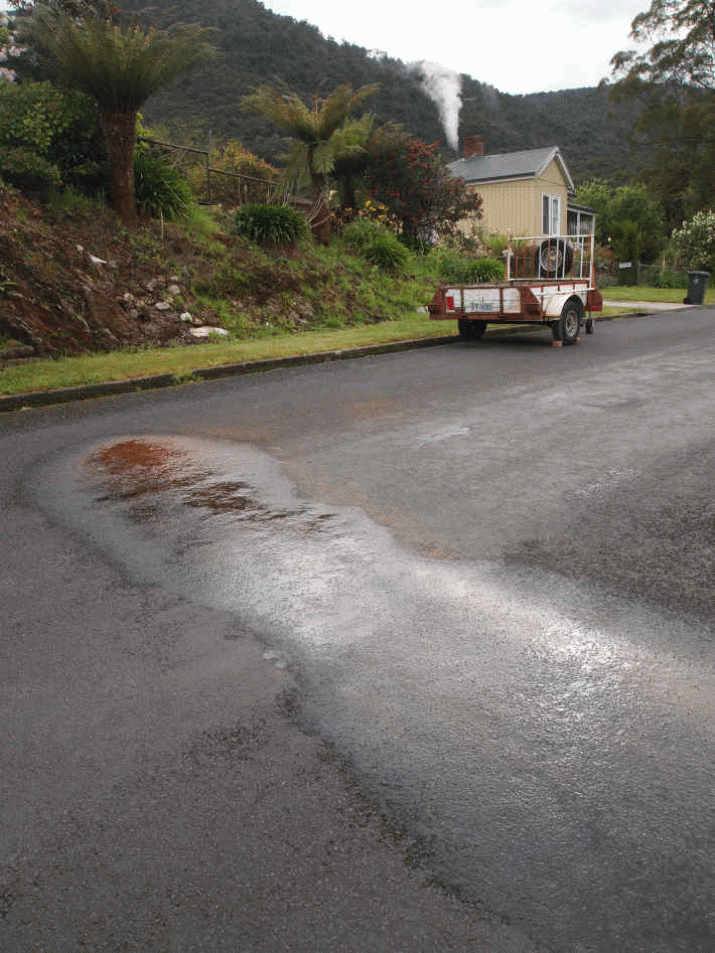

Kay Seltitzas: Acid Mine Drainage at Rosebery: Typical example of Acid Mine Drainage seeping through a Rosebery Street. This street lies below the open cut and behind is the emissions plume from the mine vent shaft. The drinking water supply intake from Mountain Creek is about half a kilometre to the east of this vent shaft plume and less than 1 km from the main mine operations.
The Tasmanian Public and Environmental Health Network and the Toxic Heavy Metals Taskforce Tasmania have today repudiated the misleading statements published in a Letter to the Mercury newspaper by Tasmania’s EPA Director Alex Schaap regarding legally binding air quality emissions standards for industries in Tasmania.
Mr Schaap in his letter to The Mercury on 10th December wrote:
‘This national standard represents a lead-exposure threshold for residential areas which regulators should seek to achieve by managing lead emissions from various sources around a residential area. It is expressly not intended as a regulatory compliance limit for a particular lead emitting operation. That compliance limit for lead emissions from the Rosebery mine has been set at the level specified in Tasmania’s Environment Protection Policy for Air Quality and the mine’s continued compliance with that level is a good indication the national standard is likely to be met in the residential areas of Rosebery.’
Alex Schaap’s comments are misleading and contradict information on the Australian Government Department of the Environment Air Quality Standards website\:
http://www.environment.gov.au/topics/environment-protection/air-quality/air-quality-standards
Tasmania’s Environment Minister Brian Wightman as a member of the National Environment Protection Council (NEPC) would be aware of the “legally binding status of the Ambient Air Quality Standards” laid down in 1998 and due to be fully implemented by 2008:
Under the Air National Environment Protection Measure [NEPM], all Australians are afforded the same level of air quality protection.
and,
The standards, which are set out below, are legally binding on each level of Government, and must be met by the year 2008. The Air NEPM requires the jurisdictions to monitor air quality and this helps to identify potential air quality problems. All jurisdictions commenced formal reporting against the Air NEPM standards in 2002.
As Tasmanian Environment Protection regulator, Mr Schaap should be fully aware of these legal compliance obligations for Tasmanian industries. It appears that he has failed to enforce these legally binding emission standards on MMG Rosebery Mine.
In addition the Minister for the Environment Brian Wightman can have little confidence in the director of the Tasmanian EPA who relies on competent advice on the legally binding NEPM air quality standards applied to industry in Tasmania.
Letter published in The Mercury 10th December, 2013,
Lead levels safe in Rosebery residences:
RECENT media coverage of lead emissions from the Rosebery mine is misleading. It has been asserted the Rosebery emissions do not meet National Environment Protection Measures for atmospheric lead emissions. This national standard represents a lead-exposure threshold for residential areas which regulators should seek to achieve by managing lead emissions from various sources around a residential area.
It is expressly not intended as a regulatory compliance limit for a particular lead emitting operation. That compliance limit for lead emissions from the Rosebery mine has been set at the level specified in Tasmania’s Environment Protection Policy for Air Quality and the mine’s continued compliance with that level is a good indication the national standard is likely to be met in the residential areas of Rosebery.
Research in the area shows lead levels vary from house to house as other sources of lead in the area influence lead levels. Lead occurs in geological formations and sediments in the area and at higher levels where lead-based paints have been used or where lead has been worked such as in the moulding of fishing sinkers.
Monitoring and research over recent years at Rosebery is available on the DHHS website and demonstrates public health is adequately protected. I encourage anyone with concerns to consult that work rather than be guided by media reports
Alex Schaap
Environmental Protection Authority
http://www.environment.gov.au/topics/environment-protection/air-quality/air-quality-standards
• Earlier on Tasmanian Times: MMG Rosebery mine top toxic polluter in Tasmania