Coroner & Legal
Death of the Forestry Department: Part 2

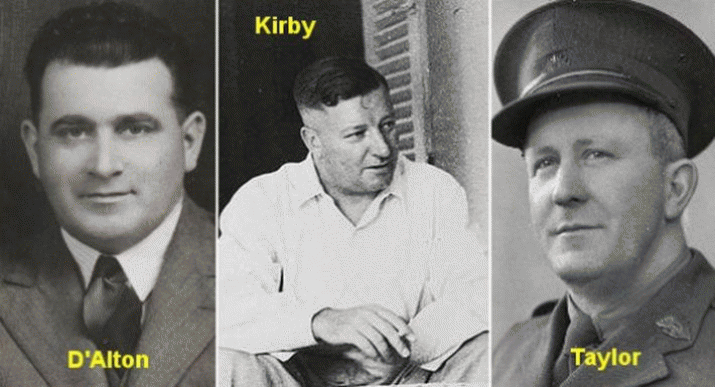

D’Alton and Alstergren: Loongana
One of the more interesting findings of the 1946 Royal Commission into forestry administration (and some earlier inquiries) was that sometime-Minister for Forests ‘Tommy’ D’Alton had a long and close relationship with the Melbourne-based Alstergren group.
In 1937 the Loongana Sawmilling Co held an exclusive forest permit over a modest 1000 acres of Crown land forest. When Alstergren Pty Ltd bought the company it applied for an additional 600 acres, and the Forestry Department approved the extension in late 1941. However, the Department received no answers to letters written subsequently to Alstergren’s concerning the permit.
The Royal Commission heard an explanation from W. Layh, a Launceston accountant and a Loongana Sawmilling company director. Layh said he had received a letter from Edvard Alstergren in 1942 instructing him to forward any correspondence from the Forestry Department directly to D’Alton, who at the time was Minister for Forests. According to Conservator of Forests S.W. Steane, a confidential letter from Layh to D’Alton was found in a Forestry Department file in May 1942, and when Steane showed it to D’Alton, the Minister grabbed it and crumpled it up.
Loongana Sawmilling later applied for an increase in its maximum cut. When Steane met with D’Alton to discuss the proposed increase, D’Alton said he had committed himself to 4 000 000 super feet per year in discussions with Alstergren. Steane reluctantly agreed to 3 000 000 super feet. He heard later that D’Alton had pressured the new Minister for Forests, W.P. Taylor, to allow Loongana an unspecified cut with an annual maximum of 10 000 000 super feet.
The Royal Commission examined a letter from D’Alton to Taylor that confirmed what Steane had heard. According to Judge Kirby, the letter ‘demonstrates that D’Alton’s personal interest in the welfare of the Alstergren companies was so intense as to be beyond the usual in a minister and to be so great as to impel him to make a request for an unspecified cut on behalf of one of the Alstergren companies before that company had itself made its request.’
D’Alton and Alstergren: a £300 donation
In addition to its sawmills in Tasmania, Alstergren Pty Ltd operated a plywood plant at Somerset, just west of Burnie. The plywood plant had been built in 1941 and was managed by H.J. McKay. In the month before the State election in December 1941, McKay was told by an Alstergren director, W. Nosworthy, that the company would contribute £300 to the Labor Government’s re-election campaign.
A few days later, Alstergren rang McKay from Melbourne and told him to meet the S.S. Nairana when it docked in Burnie. The Nairana captain would give McKay a package containing the £300. McKay picked up the package as instructed. Together with Alstergren’s Burnie manager, K.W. Dunham, McKay took the package the next day to the Club Hotel in Burnie. There they handed it to D’Alton, who said he knew what it contained.
According to E.N. West, MHA, secretary of the ALP in Tasmania, no £300 donation was ever received by the party. D’Alton told the police during the Burbury inquiry that the package contained films he had lent to Alstergren. Dunham said he thought the package might have contained cigars.
Both Alstergren and Nosworthy declined to give evidence to the Royal Commission. They also instructed their Tasmanian companies in February 1946 to send to Melbourne all company letters and correspondence, presumably for safekeeping while the Commission was issuing subpoenas.
D’Alton and Alstergren: business as usual
As explained in part 1 of this article, the Crown case against D’Alton, Alstergren and Nosworthy failed because the Victorian Full Court protected the Melbourne businessmen from appearing in the Hobart Criminal Court. Their businesses continued to prosper, and D’Alton was re-elected to Parliament, this time as a Legislative Councillor from the West Coast electorate of Gordon.
In August 1948, it was noted in Parliament that one of the boats constructed by the ill-fated Tasmanian Wooden Shipbuilding Board had been sold. It had cost more than £70 000, but had been disposed of to the Leven Shipping Co. for less than £10 000. Leven Shipping was wholly owned by Alstergren Pty Ltd, and the company’s business address was D’Alton’s residence in Sandy Bay.
Two months later, the Labor Government asked the House of Assembly for money to purchase and maintain a car. The vehicle would be used by its leader in the upper house, D’Alton, on Parliamentary business and for occasional private trips to Ulverstone. It was reported that D’Alton had insisted on the car as a condition of being made the Government’s leader, and it was well-known that D’Alton oversaw Alstergren’s timber shipping from Ulverstone to Melbourne.
Members protested that public funds should not be used for private purposes. The Government hastily amended the request, saying the car would also be used by the President of the Legislative Council, the Speaker of the Assembly and select committees of both houses. The purchase and maintenance proposals were defeated in the House.
D’Alton and the Upper Mersey
The Royal Commission also investigated a curious case of Ministerial influence that did not, apparently, involve bribes, but centered on D’Alton.
The Forestry Department had been reluctant to allow sawmillers into the Upper Mersey forests before a working plan had been prepared. The plan would contain the results of field assessment of the quantity and quality of timber. It would specify how the timber could be cut and extracted, and at what annual rate. At least three sawmillers’ applications had been turned down, most recently in 1942, with an explanation that the Upper Mersey, the largest high-quality forest area in Tasmania not yet under lease, would eventually be made available through a tendering process.
J.K.E. Bulman, a former Hobart sawmiller, approached Pugh Bros., sawmillers of Frankford, with a proposal to log the Upper Mersey. He testified that he did so only because he was a close friend of one of the Pughs. Bulman also contacted Rowe, Webb and Anderson (RWA), sawmillers of Melbourne, and interested them in acting as financial backers. Anderson himself came to Tasmania in December 1942 and drove to the Upper Mersey for an inspection. His car had a false licence plate and carried a man who pretended to be a mineral prospector – a ruse to prevent other sawmillers tracing the car and ‘getting wind’ of what the group were up to.
If the group could secure a special forest permit for the Upper Mersey, Pugh Bros and RWA each planned to erect a sawmill in the area. Provided RWA offered a fair market price, Pugh Bros were prepared to sell them their entire mill output. In this way they would get around the Tasmanian disinclination to allow mainland millers to cut Tasmanian timber. C.H. Rowe told the Commission, ‘Bulman suggested that as I was a Victorian I would have no hope of getting the area as a mainlander was regarded as a foreigner in Tasmania’. Bulman would not be directly involved in the scheme, but Pugh Bros were planning to offer Bulman an interest.
Bulman rang D’Alton, asked for and was granted a private meeting. Anderson and one of the Pughs were also in attendance. When D’Alton heard the proposal he told the men not to apply to the Forestry Department, but to leave the matter with him. In January 1943, D’Alton asked Conservator of Forests Steane for his opinion. Steane objected. D’Alton told Steane not to take notes of their meeting. Steane did so, without telling D’Alton.
In March 1943, Rowe wrote directly to the Conservator of Forests for advice on progress. Steane replied that he had seen no application yet.
D’Alton met Steane again on 6 April 1943. Steane repeated his objections to the Pugh Bros/RWA proposal, this time pointing out that although RWA claimed the area would be a source of shipbuilding timber for wartime purposes, the Upper Mersey timber was in fact unsuitable for shipbuilding. Steane also said the Government should build a road into the area, because if a private company built a private road, they would have monopolistic control of access. D’Alton said he had discussed the Pugh Bros/RWA proposal with the Premier, who was fully aware of D’Alton’s actions, and the Government would not be building a road into the Upper Mersey. D’Alton then ordered Steane to attend Parliament the next day with a list of conditions under which a permit could be issued to Pugh Bros and RWA.
Steane met D’Alton on 7 April outside Parliament. A member had just asked for an adjournment debate on rumours of a proposal to lease a large part of the Upper Mersey forests without Parliamentary approval. According to Steane’s notes, D’Alton was ‘a little excited’ and said he would not be handing over control of the Forestry Department to anyone. He also told Steane the proposal would not now be advanced.
Rowe (from RWA) told the Royal Commission he had come to Tasmania about the same time and had seen D’Alton. When Rowe told the Minister that the millers would be unable to produce shipbuilding timber within one year, D’Alton appeared to lose interest in the scheme. Rowe also interviewed the Conservator, who said the Upper Mersey would be held for post-war development.
Commissioner Kirby found that D’Alton had not acted improperly in the Upper Mersey matter.
Bob Mesibov is a former Tasmanian forester with an interest in local history. His website http://www.circularheadhistory.info/forests recounts little-known stories from the forests of Circular Head.
The full Royal Commission report is in the Tasmanian Parliamentary Papers for the year 1946.