Economy
Lest We Forget: the need to morally justify Afghanistan

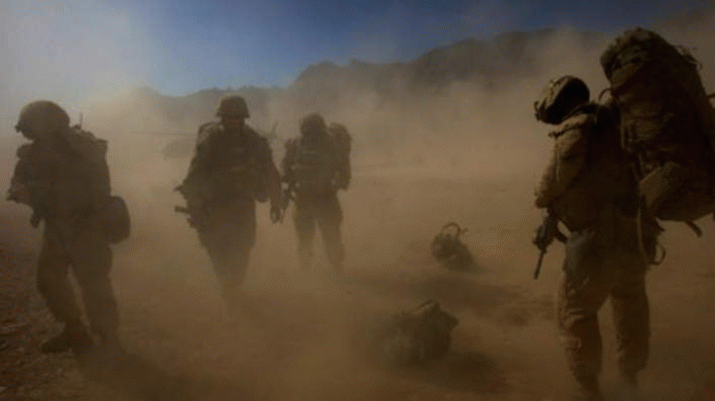

Today, to mark Remembrance Day, Tasmanian Times republishes Scott MacInnes’ searching essay … Lest We Forget: the need to morally justify Afghanistan, which was published on November 14 last year. Forty Australians serving with the Australian Defence Force have been killed in Afghanistan since troops were sent there in 2001. It is Australia’s longst war … was the cost worth it?


On Remembrance Day last Friday many of us paused for a moment’s reflection on the dreadful human cost of military conflict.
The admonition ‘Lest we forget’ was based on the hope that if we could only keep close in our collective memory the experience of horror then we would never go there again.
The day is not just about keeping this memory alive but acting on it to bring about change for a more peaceful world. How might we go about this?
In my Remembrance Day reflection (HERE), I suggested we should begin with the recognition that we all live in the shadow of war and are more or less complicit in its perpetuation.
We need to keep the real impact of our involvement in terms of human suffering continually at the forefront of our consciousness – as our dominant moral concern – both before and throughout any military intervention.
We should become more questioning, of ourselves and others. The next time a politician, commentator or friend tries to justify our military intervention, why not ask them whether they would be willing to sacrifice their own or any of their loved one’s lives for any of the reasons they advance? If not, then ask whether they think it’s OK to get others to sacrifice their lives and those of their loved ones on our behalf. We should also reflect on our own answers to these questions.
For it is the quality and depth of our personal attachments that ground our wider moral concerns.
We need to re-commit ourselves to upholding the moral and legal principles adopted in our community and under international law, designed to act as restraints on aggression. Both clearly prohibit the killing of people in all but the most exceptional circumstances. These are restricted to proportional self-defence from imminent attack and the keeping of the peace in ways specifically authorized by a recognized legal authority.
We should strengthen these safeguards and promote their universal application. The rule of law that is now recognized and accepted within our own and many other countries domestically can and must be extended across the board as the norm for international relations. This requires the painstaking building up and support of international institutions capable of maintaining peace across borders. We now live in one world and must behave accordingly.
One of the touchstones of a principled moral response is acceptance of the universality and reciprocity of the principles upon which it is based: ‘Do not do unto others what you would not have others do unto you.’
In Australia we do not permit a person to kill another in revenge, or because they fear the other might attack them ‘sometime’ in the future, or in order to gain some economic or political advantage, or to please a third party, or because they believe it is in the national interest. There are good reasons why we severely restrict the legitimate use of force in our own community. We should apply the same rules to our conduct elsewhere. A marginal reduction in the risks of some vague, future security threat would never pass such a test.
At the domestic level, decisions about whether military intervention by Australia is (and continues to be) justifiable should be made by Parliament and not the Executive, except in emergency situations. Such decisions must be made in accordance with recognized legal and moral principles, not political expediency.
Moreover, it is of crucial importance that Parliamentary Committees of Enquiry be established to gather, scrutinize and evaluate the ever-changing facts upon which such momentous decisions can be soundly based.
To justify military intervention is the most serious question ever likely to be asked of our representatives. Each Member of Parliament has a personal responsibility to decide the matter individually, not allow themselves to be directed by their Party or their constituents. They should decide like a properly instructed jury, according to their own individual best judgment and conscience.
Once military action is undertaken, there must be a system for regularly reporting back to Parliament about its progress, including a requirement for independent reporting on the full extent of both military and civilian casualties on all sides. We need to be continually confronted by the reality of war and the potentially devastating consequences of our decisions in terms of human suffering. Ignorance can be no excuse.
Of course, there may be circumstances where the use of military force is both necessary and legitimate. And where courage and self-sacrifice are required. But it should only be for the very best of reasons and as a last resort.
What about Afghanistan?
With the tenth anniversary of the military intervention in Afghanistan and the recent tragic deaths of three more Australian soldiers there, many concerned citizens are asking themselves whether the sacrifice of human lives (on all sides) can still be justified, notwithstanding the predictable Government reassurances, public indifference and the lack of proper media scrutiny.
While our military involvement in Afghanistan is easy to explain, it is much more difficult to justify. The terrible truth is that what we have to be able to justify is the sacrifice and killing of other human beings. There have to be very good reasons to justify what would otherwise be regarded as state-sponsored murder. The question is: are our reasons still good enough?
The need to apply fundamental principles
It is a pity that increasingly the debate on the war is about operational details of how it is progressing and the prospects of “success”, rather than re-addressing this fundamental issue of whether we can still morally justify exposing our troops, other combatants and an ever increasing number of innocent civilians to death, injury and extreme suffering.
This primary threshold moral issue should always be determined quite independently from any secondary arguments concerning our broader national or international interests.
Some people believe that arguing on the basis of our moral values is naïve and too idealistic for the ‘real’ world, where decisions are made elsewhere by brutes, liars and cheats, based on ruthless political or economic self interest and corruption. Of course, these realities must be recognised and exposed for what they are. But by what standards are we to judge them, or our own responses to them, if not on the basis of the values we profess to live by?
The only way forward is for such decisions to be based on strict and well established international legal principles, which arise out of ‘just war’ moral principles and which derive ultimately from our inherent and commonly shared personal moral values.
These emphasize such factors as: the right to self-defence from the threat of an imminent attack; whether military action is a last resort (or whether diplomacy or aid might produce a more peaceful outcome); the proportionality of our response to the threat; the minimization of injury to innocent third parties; the likelihood of a successful restoration of peace within a foreseeable time frame; the nexus between the proposed military action and the elimination of the risk of imminent attack; the legitimacy of any proposed military intervention to protect others (eg. whether it is specifically approved by the United Nations); and whether further threats of violence are likely to be avoided or exacerbated by military action.
These are all legitimate considerations in deciding whether military intervention is and remains legally and morally justifiable.
By contrast, among the public policy arguments excluded at this threshold stage are such factors as: the pressure to support a military ally; the desirability of regime change; adjusting the international balance of power; the wish to promote democracy; to protect trade interests; to secure energy resources; to gain economic or political advantages; to advance social welfare; and all other policy agendas.
While such matters may be relevant in determining whether military intervention can be justified in the national interest, they are not relevant and must be ignored when determining whether it is legally and morally justifiable. Otherwise, the more fundamental debate becomes contaminated and confused.
It is important to keep in mind the above distinctions not only when thinking about our original justifications for getting involved militarily in Afghanistan but also for our continuing involvement. This requires ongoing moral justification, having regard to ever changing circumstances.
Of the two ‘official’ reasons put forward to justify our continuing military involvement, the first is disingenuous because it cannot operate as an independent justification. And the second now lacks all credibility.
Our commitment to the US alliance
Our total subservience to the US alliance remains the simplest and most credible explanation for our involvement in Afghanistan, as it was in Vietnam and Iraq. We are there solely because of pressure from our US allies and our belief in the need to support them in the hope that this will serve our future security and/or trade interests. All the other reasons are merely justifications after the fact.
This should be exposed for what it is: a legally and morally indefensible position for any government to hold.
The US alliance may well be in our long term security and economic interests. But even if it serves our national interest in these ways, it cannot, of itself, justify our continuing involvement. In the absence of an imminent threat of attack, one cannot legally or morally justify sacrificing/killing other human beings. And certainly not just to please one’s friends or to otherwise advance our interests.
It is worth asking whether are there any circumstances involving the sacrifice of human lives in which we would not continue to support our allies? If the answer is YES, then it is likely to be because there comes a point where we do accept limits on our freedom to sacrifice others. The implication is that we simply have not reached that threshold yet.
Many commentators believe this point will only be reached when the number of Australian casualties becomes too much for public sentiment to stomach. This is why we are never told the full physical, emotional and psychological impacts of the war on our own soldiers and their families.
The equally devastating impacts on the many more Afghan combatants and others similarly affected in Afghanistan hardly rate even a mention.
Until the real impacts of our involvement in terms of human suffering become our dominant moral concern, the realpolitik of our dominant ideology of ‘all the way with the USA’ will continue to be the political imperative. However, it is important to make it absolutely clear that the government cannot rely on the alliance itself as a legitimate justification, unless the threat to either country’s national security is sufficient to invoke the doctrine of proportional self-defence, with no other reasonable option available. This has become increasingly difficult to maintain.
National security
The other official justification argues that we need to protect our national security from the threat of Al Quaeda and global terrorism. This was originally to be achieved by defeating the Taliban. Now the goal is to inflict sufficient damage to force them into an acceptable negotiated settlement, thereby ensuring enough political stability to facilitate a ‘dignified’ exit.
Whatever the original rationale, it is now accepted that the threat from Al Quaeda will not be reduced by continuing the war in Afghanistan because there are very few members left there. Most reside in other countries. Al Quaeda is clearly highly mobile and widely dispersed. It is not dependent on any one safe haven. Moreover, we are told the death of Bin Laden and other Al Quaeda leaders have seriously undermined its effectiveness. At most, our goal now is to minimize the possibility of Afghanistan again becoming a safe haven for terrorism in the future.
As for global terrorism, it is difficult to see how such a generalized ever-present ‘threat’ could ever justify military intervention. Otherwise we could justify being constantly at war with an ever widening number of countries suspected of having terrorists in their midst. Indeed the assertion that the threat is from ‘global’ terrorism, and not just Al Quaeda, undermines the argument that eliminating its base in Afghanistan will significantly reduce such a threat.
The defeat of the Taliban is predicated on the belief that they are either international terrorists themselves or that they are committed to the ongoing protection of Al Quaeda. There is very little evidence to support either belief. Despite sharing a common hatred of the US and allied invasion forces, the Taliban’s interests are local rather than global.
The US willingness to engage in negotiations with the Taliban makes it clear that their defeat is no longer regarded as a prerequisite for political stability or a reduction in the threat of terrorism. The Taliban are simply one of many nationalist groups struggling violently for political power in Afghanistan. The reason they have been the enemy is because the US prefers to support a corrupt Karzai regime that it can control to a brutal Taliban one which it cannot. This has nothing to do with our national security.
The notion that training the Afghan army is required for our national security could be dismissed as tenuous at best and laughable at worst, were it not for its tragic consequences.
No-one believes our involvement in Afghanistan has reduced the threat of terrorism to Australians. It is now officially accepted that the greatest threats of terrorism in future will come from home grown terrorist groups. We should be concentrating on dealing with that domestic threat through our law enforcement agencies rather than dealing with overseas terrorism through military intervention.
Other ‘justifications’
A number of other ‘unofficial’ reasons have been advanced to justify our continuing military involvement: to ‘support the Afghan people’, to build democratic institutions, to educate the children and improve the appalling situation for women, to make us feel safer etc.
However noble and worthwhile these goals are, such reasons are not usually considered legally or morally sufficient justifications for military intervention and their recent promotion by the Government is disingenuous.
Our moral duty to help vulnerable people in other countries is constrained by international law that recognises national sovereignty and precludes military intervention for such purposes. We would not accept foreign military intervention into the Northern Territory to help Aboriginal women and children and we would not send our troops into Tibet to help those who suffer appalling treatment at the hands of the Chinese.
Until we have developed our international law to provide for law enforcement and ‘global government’ which transcends national boundaries, desirable social welfare goals can only be legitimately pursued through non-violent means as part of our foreign aid development goals.
Some people argue that since we are partly responsible for creating the mess we are now in, we have a moral obligation to stay in order to mitigate the damage of our ten year intervention and avoid a blood bath if we leave prematurely.
It is interesting that the very people who support staying because of compassion for human suffering oppose any withdrawal based on the same grounds. The evidence of comparative impacts on the lives of all concerned is clearly of crucial importance here and may legitimately lead reasonable people to different conclusions.
But this is really more to do with designing a proper exit strategy than justifying ongoing military involvement
The Government also points to UN and NATO Resolutions authorizing ‘peacekeeping’ operations in Afghanistan as further justifications for our involvement. But it is clear that their validity depends ultimately on whether the specific ‘operations’ are within the scope of the authorizations and are themselves independently morally justifiable.
Unfortunately, we all now live in a world increasingly vulnerable to threats of terrorism. However, we need to ask ourselves whether we can really justify sacrificing other human lives for what is ultimately a futile military attempt to alleviate our feelings of anxiety and insecurity. If we are not willing to pay such a price ourselves, we can only ask others to do so by treating their lives as being of less worth than our own.
Which brings us back to Remembrance Day
If this day is to have real integrity and continuing relevance, it can only be because the suffering of all those affected by warfare is brought to the forefront of our consciousness.
People who demand that our government justify its decisions to expose our troops to death and injury in Afghanistan should not be attacked for being disloyal. They are invariably motivated by concern for their relatives and fellow countrymen who are being asked to risk their lives on our behalf.
Likewise, the concern expressed for the many Afghan people affected by our decisions is also legitimate. Australian lives and Afghan lives should be accorded equal dignity and attract the same moral concern. The legal and moral principles we profess to live by have universal application.
Of course our troops should be properly resourced and given every support for as long as they are there. But they should not be required to continue to risk their lives for reasons that no longer stack up.
Few of us would be willing for our most cherished loved ones to be sacrificed on the basis of any of the justifications trotted out by the proponents of our continuing involvement in Afghanistan. We should not expect others to die on our behalf, or allow our leaders to demand such sacrifice in our name.
Remembrance Day invites us to pause and reflect on the horror that our military involvement perpetuates and to ask whether it can really be justified. Or whether there might be a better way.
This reminder and challenge was the legacy entrusted to us by our forbears from the trenches.
Have you forgotten yet?…
Look down, and swear by the slain of the War that you’ll never forget.
………….
Have you forgotten yet?…
Look up, and swear by the green of the spring that you’ll never forget.
(Siegfried Sassoon: Aftermath 1919)
We must all work for peace – in ourselves, in our family, in our community and in our world.
Lest we forget!
• Harry Leslie Smith, 91, The Guardian: This year, I will wear a poppy for the last time; I will remember friends and comrades in private next year, as the solemnity of remembrance has been twisted into a justification for conflict
…
However, I am afraid it will be the last time that I will bear witness to those soldiers, airmen and sailors who are no more, at my local cenotaph. From now on, I will lament their passing in private because my despair is for those who live in this present world. I will no longer allow my obligation as a veteran to remember those who died in the great wars to be co-opted by current or former politicians to justify our folly in Iraq, our morally dubious war on terror and our elimination of one’s right to privacy.
Come 2014 when the government marks the beginning of the first world war with quotes from Rupert Brooke, Rudyard Kipling and other great jingoists from our past empire, I will declare myself a conscientious objector. We must remember that the historical past of this country is not like an episode of Downton Abbey where the rich are portrayed as thoughtful, benevolent masters to poor folk who need the guiding hand of the ruling classes to live a proper life.
I can tell you it didn’t happen that way because I was born nine years after the first world war began. I can attest that life for most people was spent in abject poverty where one laboured under brutal working conditions for little pay and lived in houses not fit to kennel a dog today. We must remember that the war was fought by the working classes who comprised 80% of Britain’s population in 1913.
This is why I find that the government’s intention to spend £50m to dress the slaughter of close to a million British soldiers in the 1914-18 conflict as a fight for freedom and democracy profane. Too many of the dead, from that horrendous war, didn’t know real freedom because they were poor and were never truly represented by their members of parliament.
My uncle and many of my relatives died in that war and they weren’t officers or NCOs; they were simple Tommies. They were like the hundreds of thousands of other boys who were sent to their slaughter by a government that didn’t care to represent their citizens if they were working poor and under-educated. My family members took the king’s shilling because they had little choice, whereas many others from similar economic backgrounds were strong-armed into enlisting by war propaganda or press-ganged into military service by their employers.
For many of you 1914 probably seems like a long time ago but I’ll be 91 next year, so it feels recent. Today, we have allowed monolithic corporate institutions to set our national agenda. We have allowed vitriol to replace earnest debate and we have somehow deluded ourselves into thinking that wealth is wisdom. But by far the worst error we have made as a people is to think ourselves as taxpayers first and citizens second.
…
Read the full article, the Guardian here
• Paul Keating:
…
Paul Keating delivered the Commemorative Address, marking 20 years since his eulogy to the unknown Australian soldier killed in WWI.
“One-hundred years ago, the horror of all ages came together to open the curtain on mankind’s greatest century of violence,” he said.
He said the unknown soldier has come to symbolise the bravery and sacrifice of troops, and that ordinary people “were not ordinary at all” during the war.
“Despite the fact that the military campaigns were shockingly flawed and incompetently executed, those ordinary people distinguished themselves by their latent nobility,” Mr Keating said.
“The unknown Australian soldier interred in this memorial reminds us of these lessons, as much as he reminds us of the 100,000 Australians lost to us by war.”
Mr Keating said he was heartened that many young Australians find a sense of purpose in the Anzac legend.
“They are fortunately too wise to the world to be cannon fodder of the kind their young forebears became, young innocents who had little or no choice,” he said.
“Commemorating these events should make us even more wary of grand ambitions and grand alliances of the kind that fractured Europe and darkened the 20th century.
“In the long shadow of these upheavals, we gather to ponder their meaning, and to commemorate the values that shone in their wake.
“Courage under pressure, ingenuity in adversity, bonds of mateship and above all, loyalty to Australia.”
• Read for yourself … The Transcript:
Remembrance Day Speech
Paul Keating Prime Minister, The Hon. P.J. Keating MP
Below is a transcript of the eulogy delivered by the Prime Minister, The Hon. P.J. Keating MP, at the funeral service of the Unknown Australian Soldier, 11 November 1993.
We do not know this Australian’s name and we never will. We do not know his rank or his battalion. We do not know where he was born, nor precisely how and when he died. We do not know where in Australia he had made his home or when he left it for the battlefields of Europe. We do not know his age or his circumstances – whether he was from the city or the bush; what occupation he left to become a soldier; what religion, if he had a religion; if he was married or single. We do not know who loved him or whom he loved. If he had children we do not know who they are. His family is lost to us as he was lost to them. We will never know who this Australian was.
Yet he has always been among those whom we have honoured. We know that he was one of the 45,000 Australians who died on the Western Front. One of the 416,000 Australians who volunteered for service in the First World War. One of the 324,000 Australians who served overseas in that war and one of the 60,000 Australians who died on foreign soil. One of the 100,000 Australians who have died in wars this century.
He is all of them. And he is one of us.
This Australia and the Australia he knew are like foreign countries. The tide of events since he died has been so dramatic, so vast and all-consuming, a world has been created beyond the reach of his imagination.
He may have been one of those who believed that the Great War would be an adventure too grand to miss. He may have felt that he would never live down the shame of not going. But the chances are he went for no other reason than that he believed it was his duty – the duty he owed his country and his King.
Because the Great War was a mad, brutal, awful struggle, distinguished more often than not by military and political incompetence; because the waste of human life was so terrible that some said victory was scarcely discernible from defeat; and because the war which was supposed to end all wars in fact sowed the seeds of a second, even more terrible, war – we might think this Unknown Soldier died in vain.
But, in honouring our war dead, as we always have and as we do today, we declare that this is not true.
For out of the war came a lesson which transcended the horror and tragedy and the inexcusable folly.
It was a lesson about ordinary people – and the lesson was that they were not ordinary.
On all sides they were the heroes of that war; not the generals and the politicians but the soldiers and sailors and nurses – those who taught us to endure hardship, to show courage, to be bold as well as resilient, to believe in ourselves, to stick together.
The Unknown Australian Soldier we inter today was one of those who by his deeds proved that real nobility and grandeur belong not to empires and nations but to the people on whom they, in the last resort, always depend.
That is surely at the heart of the ANZAC story, the Australian legend which emerged from the war. It is a legend not of sweeping military victories so much as triumphs against the odds, of courage and ingenuity in adversity. It is a legend of free and independent spirits whose discipline derived less from military formalities and customs than from the bonds of mateship and the demands of necessity.
It is a democratic tradition, the tradition in which Australians have gone to war ever since.
This Unknown Australian is not interred here to glorify war over peace; or to assert a soldier’s character above a civilian’s; or one race or one nation or one religion above another; or men above women; or the war in which he fought and died above any other war; or of one generation above any that has or will come later.
The Unknown Soldier honours the memory of all those men and women who laid down their lives for Australia.
His tomb is a reminder of what we have lost in war and what we have gained.
We have lost more than 100,000 lives, and with them all their love of this country and all their hope and energy.
We have gained a legend: a story of bravery and sacrifice and, with it, a deeper faith in ourselves and our democracy, and a deeper understanding of what it means to be Australian.
It is not too much to hope, therefore, that this Unknown Australian Soldier might continue to serve his country – he might enshrine a nation’s love of peace and remind us that in the sacrifice of the men and women whose names are recorded here there is faith enough for all of us.
The Hon. P.J. Keating MP
Prime Minister of Australia
• Guy Barnett: Remembrance Day, 11 November 2013, Westbury Cenotaph, Tasmania
• openDemocracy: Hiding behind the Cenotaph, Cameron will seek to re-write history