Economy
If, one day, the proverbial hits the fan …


Are you sitting comfortably? Then I’ll begin.
(That was actually the opening line to the BBC’s Listen with Mother on radio about a thousand years ago.)
I want to take you out of your comfort zone today. I want you to contemplate what daily life might be like in Tasmania if, one day, the proverbial hits the fan.
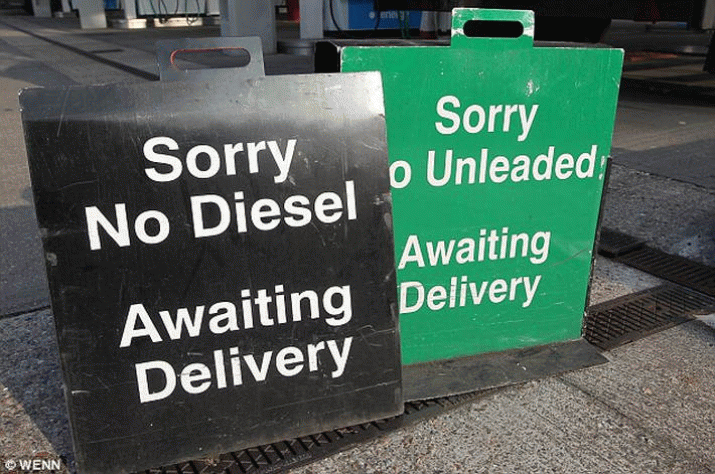
Take, for instance, the consequences of Tasmania losing its supply of oil for an indeterminate period. There are a number of reasons it could happen: another Middle East oil crisis; a pandemic that prevents all aircraft and shipping movements in and out of Tasmania; a sophisticated terrorism plot.
I am not suggesting that any of these things are going to happen; but, if they did, what would be the consequences for us, stranded on an island, and how would we cope?
Last week, the state government organised an exercise that looked at this hypothetical situation. It looked at five possible scenarios: at one end of the scale, a minor disruption to oil supplies caused by a shipping dispute; at the other end, a worst-case scenario of a complete lockdown where we are down to 25 per cent of oil stocks held in the state and the disruption lasts for 28 days. I have a very vivid imagination – and that’s nowhere near my definition of the worst-case scenario. Nevertheless, those were the parameters of the exercise.
There were lots of public servants and emergency service people there, as you would expect, the TFGA was there but there were few other private enterprise people to make a contribution.
One of the questions was: who gets access to the oil?
There was lots of discussion about the police, ambulances and the fire brigade and public servants having to catch the bus or share cars but, until we raised it, nobody had given much thought about how we all might eat. How do you distribute food?
There was no-one there from Coles or Woolworths so we didn’t know how many weeks’ food reserves are normally held until we start eating each other.
No thought had been given to how we would distribute whatever food supplies we had and what would happen if the disruption went beyond 28 days. Could farmers still get fuel to keep producing food? Who would be responsible for storing emergency supplies for farmers – the farmers?
There were some related key questions for which there were no answers. How much food does Tasmania store? How much oil do we store?
Law and order was obviously an important consideration. The police were mindful of the need to protect service stations. We suggested they might also like to think about how they might prevent looting at supermarkets and food stores.
My purpose in raising this is not to continue my mantra about the seeming lack of awareness within the bureaucracy that there may be anyone with anything useful to contribute beyond their own ranks. Rather, this time, it is to sound the alarm bells that we have to start thinking about such contingencies and formulating some crisis management responses that relate to the real world.
There are many situations that could impact on our lives in Tasmania. These scenarios could just as easily have been about a mass disruption to electricity or telephone communications, the Internet, etc. To that end, the TFGA congratulates the government for extending its vision to these scenarios.
The fact we live on an island and we are a very complacent community should trigger a wake-up call for us all.
Now you are sitting uncomfortably, I shall finish.