Economy
They’re Taking Over!

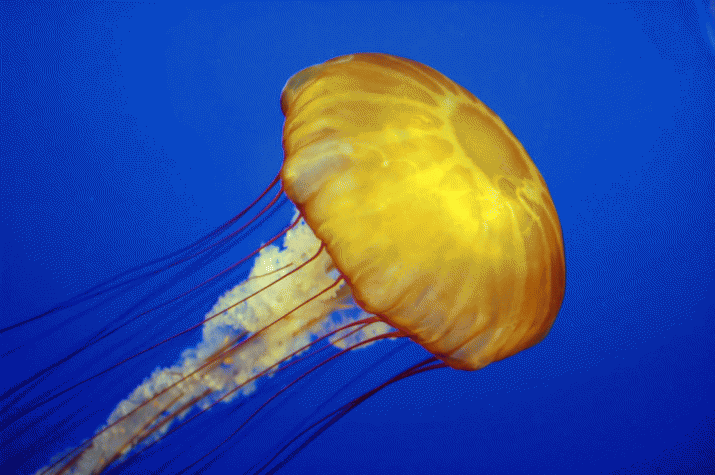

Climate change expert and Climate Commission chief Tim Flannery has just reviewed Launceston-based Dr Lisa-Ann Gershwin’s new book Stung! in the New York Review of Books. It makes fascinating reading …
They’re Taking Over!
Tim Flannery
Stung! On Jellyfish Blooms and the Future of the Ocean
by Lisa-ann Gershwin, with a foreword by Sylvia Earle
University of Chicago Press, 424 pp., $27.50
It’s become fashionable to keep jellyfish in aquariums. Behind glass they can be hypnotically beautiful and immensely relaxing to watch. Unless we are enjoying them in this way, we usually give little thought to the creatures until we are stung by one. Jellyfish stings are often not much more than a painful interlude in a seaside holiday—unless you happen to live in northern Australia. There, you might be stung by the most venomous creature on Earth: the box jellyfish, Chironex fleckeri.
Box jellyfish have bells (the disc-shaped “head”) around a foot across, behind which trail up to 550 feet of tentacles. It’s the tentacles that contain the stinging cells, and if just six yards of tentacle contact your skin, you have, on average, four minutes to live—though you might die in just two. Seventy-six fatalities have been recorded in Australia since 1884, and many more may have gone misdiagnosed or unreported.
In 2000 a somewhat less venomous species of box jellyfish, which lives further south, threatened the Sydney Olympics. It began swarming at the exact location scheduled for the aquatic leg of the triathlon events. The Olympic Committee considered many options, including literally sweeping the course free of the menace, but all were deemed impractical. Then, around a week before the opening ceremony, the jellyfish vanished as mysteriously as they had appeared.
Most jellyfish are little more than gelatinous bags containing digestive organs and gonads, drifting at the whim of the current. But box jellyfish are different. They are active hunters of medium-sized fish and crustaceans, and can move at up to twenty-one feet per minute. They are also the only jellyfish with eyes that are quite sophisticated, containing retinas, corneas, and lenses. And they have brains, which are capable of learning, memory, and guiding complex behaviors.
The Irukandjis are diminutive relatives of the box jellies. First described in 1967, most of the dozen known species are peanut- to thumb-sized. The name comes from a North Queensland Aboriginal language, the speakers of which have known for millennia how deadly these minuscule beings can be. Europeans first learned of them in 1964 when Dr. Jack Barnes, who was trying to track down the origin of symptoms suffered by swimmers in Queensland, allowed himself to be stung by one. With nobody attending but a lifeguard and his fourteen-year-old son, he was lucky to survive.
It’s now known that the brush of a single tentacle is enough to induce “Irukandji syndrome.” It sets in twenty to thirty minutes after a sting so minor it leaves no mark, and is often not even felt. Pain is initially focused in the lower back. Soon the entire lumbar region is gripped by debilitating cramps and pounding pain—as if someone is taking a baseball bat to your kidneys. Then comes the nausea and vomiting, which continues every minute or so for around twelve hours. Shooting spasms grip the arms and legs, blood pressure escalates, breathing becomes difficult, and the skin begins to creep, as if worms are burrowing through it. Victims are often gripped with a sense of “impending doom” and in their despair beg their doctors to put them out of their misery.
It’s difficult to know how many victims the Irukandji have claimed. The extreme high blood pressure that often kills is hardly diagnostic. Many deaths have doubtless been put down to stroke, heart attack, or drowning. There is some evidence that the problem is growing: Irukandji have recently been detected in coastal waters from Cape Town to Florida.
The box jellies and Irukandjis are merely the most exotic of a group of organisms that have existed for as long as complex life itself. In Stung! On Jellyfish Blooms and the Future of the Ocean, biologist Lisa-ann Gershwin argues that after half a billion years of quiescence, they’re on the move:
If I offered evidence that jellyfish are displacing penguins in Antarctica—not someday, but now, today—what would you think? If I suggested that jellyfish could crash the world’s fisheries, outcompete the tuna and swordfish, and starve the whales to extinction, would you believe me?
…
Regrettably, today Gershwin and the handful of jellyfish experts in the world struggle for access to what is clearly pitifully inadequate funding.
Gershwin leaves us with a disturbing final rumination:
When I began writing this book,… I had a naive gut feeling that all was still salvageable…. But I think I underestimated how severely we have damaged our oceans and their inhabitants. I now think that we have pushed them too far, past some mysterious tipping point that came and went without fanfare, with no red circle on the calendar and without us knowing the precise moment it all became irreversible. I now sincerely believe that it is only a matter of time before the oceans as we know them and need them to be become very different places indeed. No coral reefs teeming with life. No more mighty whales or wobbling penguins. No lobsters or oysters. Sushi without fish.
Her final word to her readers: “Adapt.”