Coroner & Legal
Tears on the handling of the Western Tiers …

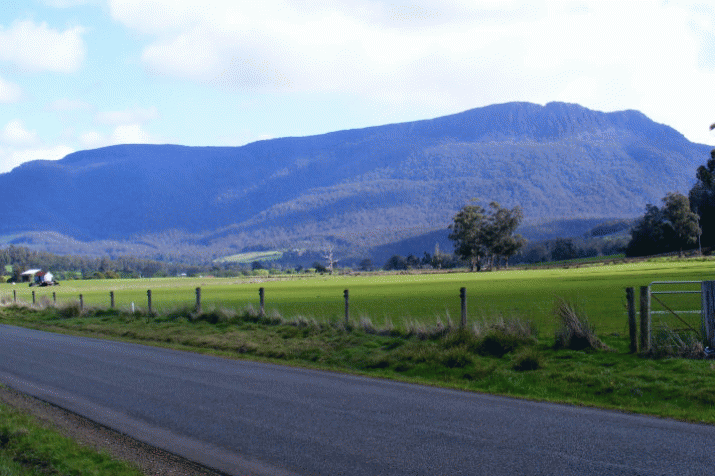

So this is Taytitikitheeker, and I wish I could show you a better pic. It’s like when you want your place to look at its best when you have visitors coming. On the left, that last rounded bit, we call ‘The Chump’, it’s a hillock apart from the chain of bluff cliffs, yet linked to them. On the far right, just passed that highest point, is ‘Bob Brown’s’ track, which many will know leads past his kitchen window and climbs relentlessly up to the scree and then the ‘last scramble. We also know this mountain by its official name: ‘Drys Bluff’.
I’m not the only one who loves this place and I’m so glad it been included in the latest World Heritage Area extensions. When Drys Bluff was first included in the WHA, its boundary was the top of the cliffs. Everything below was State Forest able to be logged. Bob and Christine had applied for the slopes to be part of the WHA, but Michael Field and David Llewellyn had intervened. Yes, by the Field Govt’s intervention this mountain slope was excised from the original WHA application. As I recall, this was in 1989. I remember that time well.
Once, when I first came to the Liffey, the valley was defined and enclosed by the heavily wooded Cluan Tier to the valley’s north, and to the south, the Mountain Vale slopes. There, on the right border of the picture, are the lowest trees of the Cluan, and on the left, just above those two sheds, are the Mountain Vale slopes. These two features were like a pincer of bush and hill which enclosed the Liffey Valley itself. The Liffey (the valley) was dotted with farms (dairy, pig etc) and supplemented by logging on the lower slopes.
Since then, the Cluan has been extensively logged, and so too with the Mountain Vale slopes, which are now plantations in their second rotation. Shit happens. When Michael Field and David Llewellyn prevented the WHA from including the slopes of Drys Bluff, logging started on the high Glovers Flat. You can see it in the pic, a horizontal line of shade next below the scree line and above those gums in the flat foreground. A track wide enough for skidders was bulldozed up from the first bench to the trees at Glovers Flat, some 500-600m above the valley floor. It was only a hectare or two, but they forced that track up there, in what should have been WHA, and then they cut and brought down the logs, to a snig point way down, where the log trucks could take them. When a nearby area was also logged, on the lower Glover Flats, the designated route for the trucks avoided the Oaks Road and snuck out through the Bishopsbourne-Carrick road. In those days, the saw mills were to the west, in Westbury. Before Gunns woodchipping forced their closure. However, the route taken by the log trucks suggests that some of them were headed for Long Reach – the back way.
Maybe you remember, those high, high mountains of woodchips that were once near the wharf at Long Reach, in the days when there was a woodchip quota and when more of our bush was being logged and chipped than could be legally exported. That’s where I think some of the trees from Glovers Flat may have ended up. From their spot, high on the mountain, taken and chipped, waiting for the eventual boat that would take them to Japan.
On that mountain in Liffey are wonderful slopes. If you went on a bird-spotting walk up to the top, you could run across an astonishing number of bird species. I once asked a friend, an expert in the birds of the Liffey, to provide me with a list a birds that I might encounter on a day/overnight ‘walk’ up the mountain. The species list from valley floor to plateau top, was in the 60s. I did my best, and spotted 1dozen, or maybe a few more. Having the time is the thing. To be there season in, season out.
After they logged the high Glovers Flat, protection was extended someway down the mountain, but still not to the boundaries of the privately owned land. We got the Drys Bluff Reserve which came under the WHA. Bob won an international prize and with the money put up a deposit on a couple of private blocks on the lower slopes – slopes that should have already been protected. And the Bush Heritage fund was born. The Liffey has been associated with a number of important things: the creation of the Wilderness Society, the greens as a political movement, Bush Heritage Australia which owns and preserves land of outstanding environmental value. We formed the first landcare group in Tasmania, wrote the first catchment management plan, and initiated Tasmania’s first landcare project – in the Liffey, on the banks of the river. It grew, there are over 200 groups now in Tassie. We also were there at the birth of the Forest Protection Society – now known as Timber Communities Australia. What a name! It was never about protecting the bush, it was about protecting those who wanted to keep logging the hell out of it. Barry Chipman was there, in the Liffey, explaining the unexplainable.
It’s ‘a long time ago now’, but only a hiccup in time, a blink of an eye in the ongoing effort to preserve our environment against further depredations. The water spills off the plateau, down cliffs hundreds of feet sheer, at the top. There are cataracts and shining rocks glistening with the water. I haven’t seen a thylacine there, an emu or even a boomer. But I’ve seen a lot else. Cormorants! That was a surprise! The first cormorant I saw in Liffey was hanging on a piece of rope, from the branch of a small gum tree, on our side road up to the house. It was put there by a local, born and bred, and left to hang and rot for us to see, each time we went down to pick up the kids from the bus-stop. The second cormorant I saw was hanging from the same tree. I used to think that local’s action was questionable. I still do. Forest Protection Society be damned. The third bird was flying upstream, following the Liffey River.
I once returned home from a visit down south, to see in the darkness, flames on the slopes, near the road that leads to my house. Closer, the mountain was in smoke. Turns out, it was started by another local ‘born and bred’. They were good at that sort of stuff. Curiously, I saw, as I returned home in the dark along the Liffey Road, this local running along the road about 100metres from his house. I saw his face in my headlights. I got round the bend, and 150metres further saw that the roadside vegetation had just been set alight. I kept on driving, towards the larger fire, which was very near my home.
After it was out, in the following days, I went to look at it. As I followed a track through the bush, I saw another local, close to the burnt bush, and just inside his own fenceline. Seeing him, I went over and without anger, without abuse or that sort of stuff, told him that I thought he should take more care etc. (His fire had escaped onto other properties, burning out a fruit orchard and some infrastructure). He, this local, looked up to the bush slopes (where I live), nodded, and looked me in the eye and told me: ‘That’s your place (up there), you go and worry about that.’ ‘Fuck off’, in other words.
Within weeks, another fire was lit. This time it got big. It escaped onto that Bush Heritage block that I’ve mentioned. And it escaped onto my block. For that I have not forgiven. I was home-alone with the kids, and turned out to fight the fire. As the day wore on, I returned to my creek gully to fill my knapsack. I was amazed to find a spot fire, which must have passed over my head, there in my bush, near the creek and burning between me and my kids, back at the house. I put it out, and returned to the main fire.
We had a local brigade in those days (based at Bracknell), and us greenies in Liffey belonged to it. We greenies got to the fire first. Chris, my mate, came straight through the bush, from what used to be called the Liffey Tea Rooms. Herb and I were already there, as well as other neighbours. Before long, the Bracknell truck turned up and they ran from it, following their leader to initiate a back-burning operation. The Bracknelll truck crew included members of the local footy club. It was a ground which was a focal point for the town’s drainage problem. Yep! Somehow it surfaced up through the winter mud of the footy field in the middle of the town – before it reached the river. In those days, that same town had all its storm water drains, all its household run-off running into the river just a few metres above the dam wall for the water intake – from which the town pumped its drinking water! When we greenies from Liffey pointed it out, they denied it – of course – and in the next month they quietly dug a ditch which diverted that run-off to a point below the water intake point. But we were still ‘greenie bastards’.
Back at the fire, a crew ran from their truck into the bush. One had a wick and was touching everything for the back-burn. Some people are big on back-burns. Trouble was, others couldn’t keep up. It was very dry and the back-burn got out of control and then joined forces with the advancing fire-front. Things went haywire then. It suddenly got very big. Meanwhile Chris, having hiked through the bush, had come across a fire truck (now with no one in attendance), and had seen that the side front of the fire was about to destroy it. He fought a brave single-handed and ultimately successful action to defend it while the crew was off elsewhere.
My memory gets a bit hazy here. It must have got to the end of the day and we must have held the fire on one front but not put it out. With that done we met up with other crew members. We argued about keeping on fighting the fire. They were of the opinion that it would not do the bush any harm to let the fire keep going, (low intensity) and thus reduce the fuel on the ground. We greenies wanted it out. Our concerns were for the totality of the environment, not to mention every single living creature in the path of the flames. We had a rest break, them by their vehicles on an access track, and us, in the bush, some metres away, in the trees, on the ground. There we were talking about global warming and species creep. How we must leave a continuous corridor of lower bushland which was continuous up to the very top of the mountain. ‘Species Migration’ I think it was called. The others were on the track, kicking their heels, the fire had waned, they were wanting to go home and leave it burning, making the inevitable jokes about Bob Brown and how the bush would be brown like him, not many greenies left, after the fire. They were the local fire brigade. Off they went and so I scouted. I scouted the perimeter of the fire before dark. Then I went home. The wind had dropped, It was getting dark.
The next morning I was back over there like a flash. I left the access track and, exploring down through the bush, I found an area where the flames were coming on briskly. I was amazed – the day was still young. I beat it back up the hill and found the brigades had turned up, this time too there was a fellah from Hobart who knew that it was WHA up on top of the cliffs above us. The day warmed and the wind came back. The fire was again upon us. It had died down overnight. A forestry crew turned up and sat in their truck, reading the paper, eating their takeaways, tossing the stuff out the window. The local brigade turned up. A tanker turned up. The wind turned up.
We were back into it. I told them where the seat of the resurgence was and with the bloke from Hobart being there, they all sprang into action. It was not a moment too soon. I showed them where the tanker could access creek water, right within 100metres of where there were already parked. ‘Nah mate, it’s too shallow’. They wanted to go kilometres back out of the bush down to the bridge over the side road. Maybe I did a WTF thing with them. I ran to the nearby creek, there in the bush and pulled rocks from the pool and built up the down side, stuffing it with moss, lichen and whatever I could lay my hands on. The level of the creek rose. They consented to bring their tanker to it and began pumping from it. With the bloke from Hobart, I went up that Glovers Flat track, on the back of his 4Wbike. From there we could see the extent of the fire. Down we came to the ‘HQ’ at the bottom of the snig track, on that landing. It had got pretty strong, while we were up the ‘snig’ track, but it had just been stopped from crossing the lower track that travels the lower bench. It had been touch and go.
Later, I went with him by foot, taking him around the whole lower perimeter of the fire, showing him where it started, how it started and introduced him to other witnesses who had seen a person emerging from a gully with the bush crackling and smoking behind him. The evidence of the fire wick was all around, either side of the track which goes through bush. In spite of the witnesses and the evidence before the Hobart bloke’s eyes, the fire bloke (turns out he was also the investigator) never did anything about it. He would only commit to going and having a chat. There were no charges, even though I asked for charges to be laid.
Of course, there was a third fire, some years later, and that was much more serious than the first two. It had been started in the time-honoured fashion, using the traditional land management technique … slash and burn. It was a tough night, that one. At one stage I thought the surge of flames over the crest signified my house had gone, but it was some bracken in the last paddock before my bush. My back was playing up, so in the dark I could only stand and watch while others, who didn’t know the lay of the land, battled it out in the dark.
Again the fire got onto my place. (I saw this when later I was able to walk around one of my bullock tracks. What saved me this time was a literal 11th hour (in the evening) change of wind, which came along the tiers from the south. Hooly dooly! In the fullness of time the crews all packed up and were taking off. But as I waved to them, on the track going out, I saw over to the south east, another glow! It was a couple of kms away and if the new wind kept up it would come our way. The fire captain had had enough and told me it must be Poatina way (which is miles plus!) and went home. I showed it to my greenie neighbour (it was somewhere not far beyond his eastern boundary) and he went off in the dark and the bush – how he navigated I do not know/can only guess – and found about five small fires, a couple of kms away. They appeared to have been deliberately lit.
Earlier this year, I was amazed to see on the front page of the Examiner a photo of five men, born and breds, [ “Tears on handling of Western Tiers | The Examiner ” http://www.examiner.com.au/story/1338421/tears-on-handling-of-western-tiers/ ] who were outraged about not being consulted about the recent WHA extensions. It was crap. The care they reckoned they took of the mountain. Here is not the place to itemise the things which contradict their claims – but if you care to read the article on that link, and view the photo above it, you will see the men surrounded by blackberry, which like foxgloves has spread through the lower reaches of the Liffey. What care is that?
Higher up, where logging has never taken place, there are no weeds. Well, you might find an occasional thistle, but that’s about it. There’s always something new to find. Last year I found a cave on a cliff facing north-east, out of the weather. It was halfway up a very high sandstone cliff, accessible only along a narrowing ledge. About the size of a big loungeroom. And the unknown flower in bloom that led me to it. And the perfectly pyrimidine rock below it, some 15 metres in height, which rose to one single point – just large enough for me to sit on. And the Japanese garden at the very top of the cliffs, with its myrtle, king billy and sassie; and rock sentinel boulder vale – leading to a waterfall and a magic grove at the foot of ‘one last rock scramble’.
I can comment on other places in Tassie, which have been included in the recent WHA extensions, and I’d tell you that I think the extensions are probably appropriate. Sometimes people seem to think that a criterion for WHA must be old growth, and yes, to an extent, that is so. But it’s not the complete story. This piece that you’ve just read, is written to let you know that there are people who live out in these new WHA places, who welcome the extensions, who understand and accept that being next to WHA land places a responsibility on them as adjoining land managers to manage their own properties sympathetically. I am one of those people. Look back at the photo up top. You can’t seen my place for the trees – and it wasn’t always like that!
This mountain has been given extra protection through the recent WHA extensions. These extensions occurred as part of the TFA process. There are other areas which are up for protection, through Reserves, such as the Blue Tier in the N.E. I hope that when the next durability report is done, it will enable the Blue Tier to get the protection that it deserves. There are those that say ‘not a single tree has been protected’. To them I say: “Look at Taytitikitheeker.” I will oppose any attempt to remove this mountain from the WHA area and I will oppose any logging that might be attempted on the public forests that you can see there on Drys Bluff.