Economy
Oak Lodge … and the incredible stories it can tell …

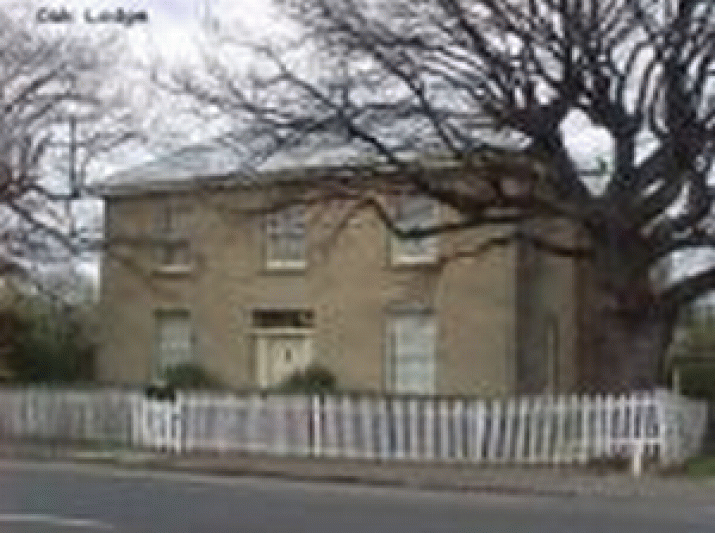

Oak Lodge, Richmond
Oak Lodge has been described as a property that has significance only to its locality, Richmond, Tasmania. This statement appears to be inaccurate. Various owners and occupiers of Oak Lodge have had state-wide, national and international connections of historical interest. The following are examples:
James Richard Booth R. N. owned the Oak Lodge property from 1843 to 1852. He was a son of, Richard Booth, a Royal Navy purser who had served in the Napoleonic wars under Lord Nelson. Entering the Royal Navy in 1805, James Booth rose through the ranks to command H.M.S. Tricuno in operations against the African slave trade over the period 1832-1835.
James Booth married Jane Elizabeth Wylde at the Cape of Good Hope, South Africa on 17 December, 1834. Jane Wylde was a daughter of Sir John Wylde, the Chief Justice of the Cape colony from 1827. From 1816 to 1826, John Wylde had been Judge Advocate for New South Wales. Over this period he accumulated considerable property including Cecil Hills Farm at Cabramatta, New South Wales. John Wylde’s wife was also named Jane Elizabeth (nee Moore). Her brother and uncle of Jane Booth, Joshua John Moore, was a veteran of the Battle of Waterloo and accompanied the Wyldes to Australia in 1816. He was an officer in the law courts before turning to farming. Joshua Moore built the mansion, Horningsea Park, also at Cabramatta, a property later owned by Count Strzelecki who named Mt Kosciusko. Joshua Moore was the first settler to own the land on which much of Canberra now stands.
Jane Wylde and her elder sister Harriet followed their parents to Australia in 1822. Their father, John Wylde returned to England in 1825, was knighted and then posted to South Africa as Chief Justice in 1827. His wife remained in Sydney. She had a child some years after he left. They divorced in 1836 through the South African courts.
After residing in England for several years, James and Jane Booth travelled to Sydney, Australia in 1837 and apparently lived with Jane’s divorcee mother, Lady Wylde, at the Cecil Hills property where sons were born to them in 1838, 1840 and 1841, the first dying in infancy. James Booth was appointed to the magistracy and acted as agent for his father-in-law’s extensive interests.
James and Jane Booth moved to Tasmania in 1843. James Booth was a brother of Charles O’Hara Booth, then commandant of Port Arthur and later superintendent of the Queen’s Orphan School, Hobart. James and Charles Booth, through their sister Charlotte O’Hara Bartley nee Booth, were uncles to Theodore Bryant Bartley (1803-1878), a prominent northern-Tasmanian public servant and land-owner. In 1842, a census revealed that Richmond was third largest district in Tasmania with over 4,000 residents and 600 houses in a state total of 50,000 persons. Hence the Booths did not come to Richmond by accident. While living at Richmond, James Booth participated in many levels of the Tasmanian colony’s life. He was a magistrate, a church-warden at St Luke’s Anglican Church, Richmond and a member of the Hobart Regatta committee.
The Booth family abruptly returned to England in 1845, possibly because of news of the ill-health of James’ father, who died later in 1845. James briefly returned to the Royal Navy, commissioning H.M.S. Columbine in 1846 for use against piracy in the Far East. Through Jane Booth’s family, they had good connections within the British Government and judiciary. Jane was niece of 1st Lord Truro, a British Lord Chancellor and she was first cousin to 1st Lord Penzance, a prominent judge. James Booth was appointed Lieutenant Governor of Montserrat, West Indies in 1851. He and his wife died there of cholera in 1853. Two of their sons went on to have naval careers and the third migrated to Ontario, Canada and practiced law. On leaving the Royal Navy, one son joined the Imperial Chinese Customs Service, commanding the ship “Fei Hoo”.
A second, more recent example of the connectivity linked to Oak Lodge is the Clark family. William Goodwin Chadbourne Clark was a Harvard medical graduate. He came to Melbourne, Australia in 1898 when he worked in a St Kilda hospital. He married Emma Kate Dixon in Victoria in 1901 and they moved to Tasmania. In Tasmania, Dr. Clark practiced in Launceston, Hobart and the Huon before settling in Richmond in 1909. The Clark’s five children were born in Tasmania, the last two, twins, at Richmond.
The state of the hospitals in Hobart and Launceston were a matter of considerable political turmoil in 1918 and Dr. Clark was enticed to work at the Hobart hospital. Dr. Clark found working conditions at the hospital unsatisfactory and they parted ways in 1922, Dr. Clark winning a significant court case. Dr. Clark took up general practice in Sorell then returned to Richmond in 1924. He remained there until he retired in 1947.
Dr. Clark’s children grew up at Oak Lodge, Richmond where they had a governess for early schooling. They went on to have diverse and interesting careers. Joseph, aka Anthony became a Shakespearian actor and left Australia to work in England. Joseph married Mary Arden Symon in 1925. Her father, Sir Josiah Symon was one of the fathers of Australian federation.
Max Clark became a senior Australian naval officer who was awarded the Distiguished Service Order in World War Two. In 1957 he was Naval Officer in Charge, North East Australia Area with the rank of Acting Captain. In 1958 he was made an Officer of the Order of the British Empire. He married Rosemary Buchanan of Point Piper, NSW.
Marjorie Clark married Dudley Barnett of Melbourne, Victoria. Hilda Clark married Geoff Swan of Strath Ayr, Richmond and they later moved north to the Hermitage, Bracknell.
Geoffrey Clark went to live in U.S.A. about 1930 where he married Irene Isham. They returned to Australia at the start of the Second World War. While Geoff was on active service, Irene was living at Richmond. Irene had training in ballet and used her talents to provide entertainment in Hobart during the war years. They returned to California after the war where Geoff was with the Scripps Institute and Irene was, for a while, the ballet teacher of actor Rachel Welch.
Dr. Clark was a distant cousin of the two Presidents Roosevelt of U.S.A. and could trace his ancestry back to the migrants on the “Mayflower”. Dr Clark corresponded with President Franklin D. Roosevelt.
These are just two brief examples of stories that a house with an age of over 180 years has to tell.
It may be that those who make the decisions regarding the future of Oak Lodge, its physical integrity and its public access have not been aware of the background of the owners and occupiers of the house. It may be that the term “significant” means very different things to different people.
Richmond is already a destination for over a quarter of a million people annually. A fraction of those people are interested in expanding their Richmond experience by learning more of the history of the town, its buildings and district and how it relates to greater Tasmania and to Australia. Oak Lodge is a potential venue for providing that experience. This would provide greater continuing income than a transient cash injection from private sale.