

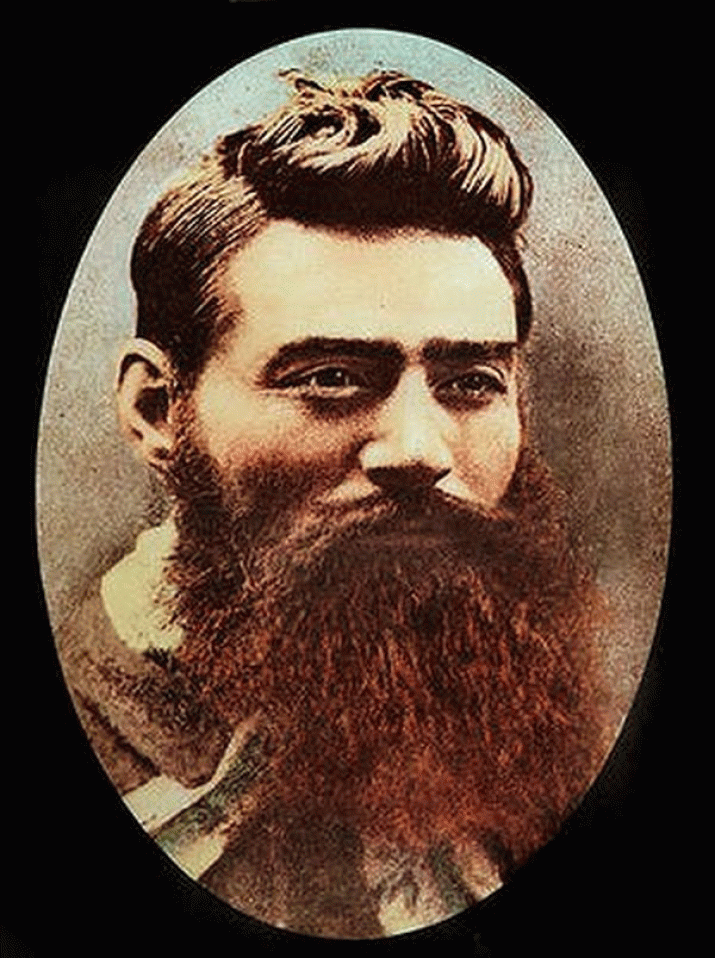
Call me old-fashioned, but as far as celebrity outlaws go, I’ll take Ned Kelly over Chopper Read any day.
The rise to fame of recently deceased Mark “Chopper” Read symbolised the emptiness of our celebrity culture. In a world governed by large-scale gangsters in control of big industry and finance, Read was a mere petty psychopath and opportunist who figured out how to turn a buck from the fact that, as he famously noted, “posh people love gangsters”.
Ned Kelly, on the other hand, achieved fame and notoriety for entirely different reasons. The son of an Irish convict, sent to Van Diemen’s Land by the British occupiers for stealing two pigs, Kelly represented a distinct social layer — the often Irish Catholic rural poor who represented one of the lowest rungs in the social order of the white colonisers.
Like many released convicts, Kelly’s father Red took a piece of land in rural north-east Victoria as a “selector”. However, the best land was already taken by the wealthy “squatters”, a key part of the colonial ruling elite. As well as poor land, the selectors were banned by law from farming livestock.
In the face of such restrictions, selectors inevitably turned to stealing cattle and horses from rich landowners. In turn, the squatters set the corrupt and brutal police force, essentially their private armed force, on the selectors.
The Kelly family suffered greatly from police persecution. Red was charged with stealing and cooking a cow. Cleared of theft, he was nonetheless found guilty of removing a brand from the cow’s hide and given a fine of 20 pounds or six months hard labour. Unable to pay the fine, he served his sentence. The hard labour destroyed his health and he died soon after release.
The police persecution of the Kelly family continued, culminating in the ridiculous incident that drove Kelly and his brother Dan into hiding. Constable Alexander Fitzpatrick, an infamous drunkard and liar later sacked by police, was involved in an incident at the Kelly house where he was alleged to have threatened the family.
He later claimed to have been shot in the wrist by Ned. Not only did Ned insist he was nowhere near the house at the time, but the doctor who treated Fitzpatrick’s wrist said the constable was extremely drunk and the injury was not caused by a bullet.
Ignoring the doctor’s evidence, Judge Redmond Barry (who would later sentence Kelly to hang) sentenced his mother Ellen Kelly to three years in jail for aiding and abetting attempted murder. Two other men present for the incident were sentenced to six years. Barry said if Ned had been at the trial, he’d have gotten 15 years jail. A reward of 100 pounds was offered for the capture of Ned and Dan.
Hunted by police, Ned, Dan and two friends Steve Hart and Joe Byrne, ended up in a shoot out with a police squad at Stringybark Creek in October 1878 that left three officers dead. In his famous “Jerilderie Letter”, Kelly disputes the police account of the shoot out, insisting he acted in self-defence.
Regardless, there was no turning back for the gang. Officially outlawed, Kelly could be shot by anyone on sight for an ever-growing reward. The path was set that led to what appears to have been an aborted uprising at Glenrowan more than two years later.
The story of the Kelly family is the story of thousands of the Irish poor. And, with the poor farmers often Irish and the squatters largely English Protestants, it is not surprising Kelly viewed his struggle against authorities in the British colonial outpost as a direct continuation of Ireland’s fight for national liberation — a view he set out in the “Jerilderie Letter”.
Often dismissed as just a bank robber and police killer, Kelly was widely viewed as a symbol of opposition to a corrupt and brutal justice system and social inequality. This was not just among the rural poor that protected the Kelly Gang. A horrified Age journalist, in November 1878, described the strong support from the city’s poor for Kelly as “more than astonishing — positively sickening”.
After Kelly’s trial in 1880, a mass meeting of 8000 people demanded a reprieve. More than 30,000 people signed a petition against Kelly’s execution.
Read the full article on GLW HERE:










