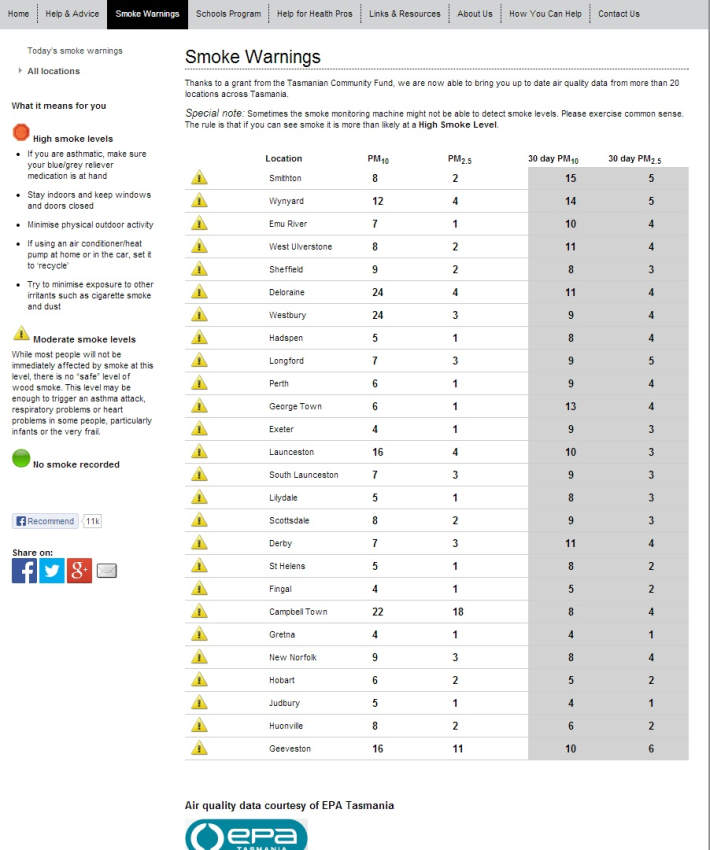
Tasmanians with asthma can now limit their exposure to smoke in the air, with the launch of a new
online smoke alert system that will issue warnings on Facebook and Twitter when smoke levels are
high in any given area across the State.
The Asthma Foundation of Tasmania (AFT) went live on the new system today, which will use realtime
data from 19 smoke monitors distributed throughout the State to generate smoke alerts to its
followers on Facebook and Twitter.
The system also features a new interactive map on the AFT website, where people with asthma can
access the most up-to-date smoke levels in each region and take the necessary precautions to limit
their exposure in areas where levels are high.
AFT Chief Executive Officer, Cathy Beswick, said the new system built on the organisation’s previous
work with the Public and Environmental Health Service (PEHS) and Environment Protection
Authority (EPA) to warn people in the community who were susceptible to health effects of smoke.
“The PEHS and EPA have done an exceptional job in developing the Wood smoke, air quality, your
health website, launched in early 2012, which combines real-time air quality monitoring with health
and air quality information,” Ms Beswick said.
“We really appreciate this valuable work, as it has allowed us to take the EPA’s data one step closer
to the 60,000 Tasmanians (approx.) in the community with asthma, providing precautionary advice
through social media platforms.
“All Tasmanians should be wary to limit their exposure to smoke, but this is especially important for
people with heart and lung conditions, including asthma, as well as infants (under 1 year) and
people over 65 years of age,” she said.
“Smoke is a year-round issue and is generated from a wide range of sources, including wood
heaters, incinerators, bushfires, back-burning, burn-offs and regeneration burns.
“Regardless of where smoke comes from, there is actually no safe level of smoke for people with
asthma and exposure can trigger symptoms such as wheezing, coughing, chest tightness and
shortness of breath.
“If people can see or smell smoke, it is a risk to their health and they need to ensure they take the
necessary precautions to protect themselves against it.”
Sixty-eight-year-old Sue White, who has adult onset asthma which is exacerbated by smoke, said the
new service would enable her to minimise her exposure to smoke and plan her days accordingly.
“My husband and I enjoy taking day trips and to be able to monitor smoke levels across the State at
any given time will allow us to avoid any areas where smoke levels are high,” Mrs White said.
“It also means when it’s smoky outside, I can take preventative measures to avoid breathing it in,
such as staying indoors, resting up and switching the air conditioner to ‘recycle’ as well as steering
away from domestic activities that stir up dust, such as vacuuming or sweeping.”
Ms Beswick said thanks to a grant from the Tasmanian Community Fund, the new system was now
available for anyone wanting to find out in real time when smoke levels were becoming dangerously
high for people with asthma or other lung or heart problems.
“We are encouraging all Tasmanians to jump online and access the free service on our website at
www.asthmatas.org.au as well as following the Twitter handle @smoke_alert_tas or liking the
Smoke Alert Tasmania page on Facebook to receive automated smoke alerts,” she said.
“By creating an online forum that’s accessible to everyone, we’re also hoping the community will
enhance the service at a local level, by contributing any information they may have about smoke in
the air where they are.
“We have invested significant time and research into developing a service that is free and available
to all Tasmanians and we are very excited about the outcome, which we hope will greatly assist
those living with asthma to better protect their health during smoke incidents.”
Remember, if you can see or smell smoke it is a risk to your health. If you are in an emergency
situation or if you find breathing uncharacteristically difficult, call 000 immediately.
AFT Chief Executive Officer, Cathy Beswick,