Coroner & Legal
Will Brian Wightman protect Tasmanian’s World Heritage Area forests?

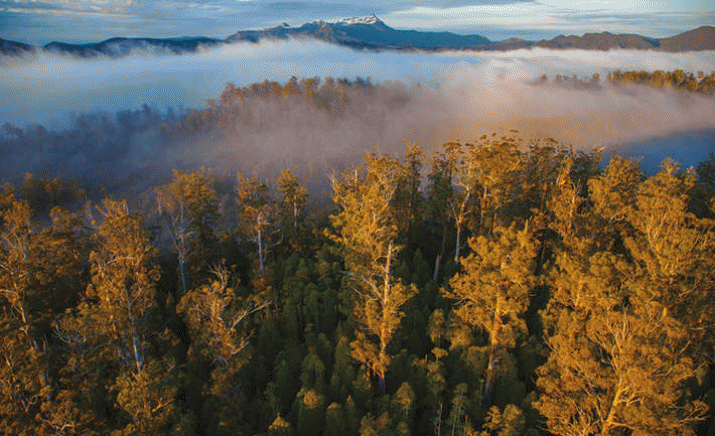

The legal guide from the Environmental Defenders’ Office to the TFA Act 2013 demonstrates that the ball is now definitely in hands of one State Labor Minister, Brian Wightman. So what is he waiting for?
The EDO Guidelines document states: ‘If either House of Parliament – House of Assembly and Legislative Council – does not accept the initial Proposed Reserve Order, the entire TFA Act 2013 is repealed.’
‘If the Conservation Minister [Brian Wightman] does not make the second and third Proposed Reserve Orders in the time required, Schedule 1 of the TFA Act [published in the Government Gazette] is repealed. Schedule 1 lists the 295 lots which can become reserves under the TFA Act. This means the TFA Act will no longer function.’
‘However, any reserves that have been declared prior to the repeal of Schedule 1 will not be affected.’
If the Conservation Minister acts to recommend to the Governor on the boundaries of the 30 World Heritage listed lots (amounting to ~100,800) those forest reserves will stand even if the TFA Act 2013 is subsequently repealed. The Act does not determine any specified time for the Conservation Minister to detail the final boundaries to recommend to the Governor for ratification.
The Edo document continues: ‘A decision in relation to the proposed extension of the Tasmanian Wilderness World Heritage Area to include these lots is likely to occur in June 2013 [30 lots[1] – 100,793 ha]. In June 2013 the United Nations Educational, Scientific and Cultural Organisation meeting Phnom Penh, Cambodia approved extensions of the WHA-listed forests in Tasmania.’
‘The Conservation Minister can either:
• determine the boundaries, values and purpose of the proposed reserve as being the same as those approved by Parliament in the Proposed Reserve Order.
OR
• determine different boundaries, values and purpose of the proposed reserve to those approved by Parliament in the Proposed Reserve Order.’
‘It is not clear why the boundaries, values or purpose might be different. This mechanism has presumably been included to deal with situations such as where the boundary agreed in the Tasmania Forest Agreement process was incorrect or needs to be changed for any reason.’
‘If there has not been a failure of durability the Conservation Minister must recommend to the Governor that the land be declared a reserve in one of the classes set out in the Nature Conservation Act 2002, for example national park, regional reserve, conservation area and nature recreation area.’
‘If the Conservation Minister determines boundaries, values and purposes for proposed reserve areas that are significantly different from the Proposed Reserves Order, the revised proposal must go back to Parliament for approval.’
‘If the Governor makes a declaration, the area becomes a reserve under the Nature Conservation Act 2002.i’
‘The Governor will almost certainly also declare that:
• the land be removed from the register of Multiple Use Forest (which the TFA Act renames Permanent Timber Production Zone Land) and;
• the land is no longer State forest.’
‘Once the land is reserved, it will be managed by the Parks and Wildlife Service under the National Parks and Reserves Management Act 2002. The reserves would then have the same management regime (which is unlikely to include timber harvesting) as other reserves already in place in Tasmania.’
‘One exception to this is special species timber harvesting. In theory this could occur in areas that have been made reserves through the TFA process, subject to Parliamentary approval.’
Reference: Environmental Defenders’ Office (Tasmania) Gide to Creating Reserves under the Tasmanian Forest agreement Act 2013.