Economy
Waste not, want not

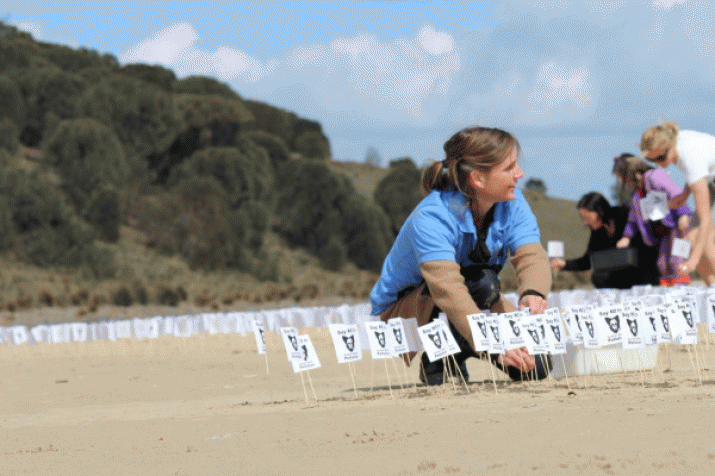

Waste is a perennial problem. It is an inevitable component of all systems, from biological metabolism through to industrial plant. The efficient control and processing of waste is as critical in maintaining a functional society as it is in metabolic processes. The proper control of the exorbitant waste generated by a modern consumer society is just as paramount to our health and wellbeing at a large community level as it is in blowing off carbon dioxide with every breath we take.
Indeed, as a reductionist society we like to compartmentalise everything, so that few people actually make the obvious connection that the ‘great moral challenge ‘ of our age, in climate change, is at base an energy waste problem, less significant for the poison -CO- but for the dose. So why then, when it comes to the material waste that you and I generate, that which comes from the local garage and supermarket and hazardous waste which emanates out of the large industrial plants, do we subjugate so much of the waste responsibility onto local government? It is little wonder that in such a context, Tasmania has become reliant on the cheap expedient option for waste – landfill.
The problem is, landfill treats waste as something to be discarded, when what is really needed is a paradigm shift that sees waste as resource, if not for reuse, then at least for its embedded energy. Simply burying on mass the material and chemical cocktail of daily detritus in a large whole in the ground is a process that is dissonant with proper and effective waste management from a sustainable ‘systems’ perspective. In truly efficient biological systems and manufacturing systems, waste is broken down and reconstructed, reprocessed and reused. And where there is a need to shed an unwanted material, it generally has a secondary synergetic exchange with an overlapping system that can utilise what the generating system cannot. If waste was not managed in this way in nature, biological and ecological systems would rapidly collapse.
So in this systems context, it is clear that simply discarding unwanted materials into large quarries to accumulate in contaminated repositories is anachronistic and one of the clearest examples of a society out of sync with sustainable systems.
However, this is no revelation. The guiding principles that underpin the Commonwealth’s National Waste Policy and the Tasmanian Waste and Resource Management Strategy explicitly recognise the wasteful practice of discarding waste to landfill. Yet, in Tasmania that is where 84% of our waste ends up.
In the debate that has emerged out of a concerned southern beaches community not wishing to be the dumping ground for the state’s hazardous waste we have seen a somewhat intriguing juxtaposition of ideals between government and the residents of the southern beaches. This community, in the broader debate on waste, have simply pointed to Tasmania’s appalling record of diverting waste from landfill and asked how does government plan to reconcile this with its own waste management strategy when all it seeks to do is help promulgate further landfill developments? Yet these same residents have been labelled fringe protesters and unrepresentative in asking that government and proponents honour those commitments. Recently, the community has learned, in the complete absence of Council / community consultation, that Copping is to become the master regional landfill for much of Tasmania’s waste. If this has been a long-standing plan by government, it is one that they have certainly kept well hidden from the residents of the state. No feasibility study that includes cost benefit analysis and incorporates such significant costs as trucking waste from all over Tasmania to distant Copping has ever been conducted.
Moreover, where is the clearly articulated case for a landfill reliant future? Triple bottom line analysis of the options is unlikely to find in favour of a landfill landscape. Yet this is the path we are set to tread if Copping is to be realised as a very large regional landfill over its potential lifespan.
The problem appears to be a state government that is unwilling to step up to take control of waste management in Tasmania. Happy with the broken model of local government taking responsibility of collection and disposal, government has sat on its hands over the decades to allow Tasmania to become,in relation to waste, anything but the clean, green, clever state. If we are to accept that waste management is as fundamental to the operation of a productive healthy society as education, transport and the health system – and it is – then why does our government shy away from its responsibilities in managing this critical functional component of society?
To reform the state’s waste management landscape the Tasmanian government needs to develop as a matter of some priority, a state waste policy. Such a policy needs to address waste management from a state-wide perspective and override the current inefficient and disjointed regional and municipal approach. Such a policy should contain a regulatory framework that drives reform in the waste sector that meets our obligations to recover waste from landfill. Measures that would help to both act as a market price signal and capitalise alternate waste management technologies include both a waste levy and a container deposit scheme (CDS). The former needs to recognise the transfer of liability that occurs when commercial, industrial and hazardous waste is discarded to municipal landfills by charging significantly higher levies for such waste as occurs in other states. The latter needs a flow on commitment to recycling processing within the state. Plastic beverage containers recovered from the environment then sent to landfill only partially satisfies the intent of a CDS which has recycling at its heart.
Further regulatory measures that a state policy on waste could explore is an extension of product stewardship schemes from largely Commonwealth supported voluntary schemes to state based co-regulatory schemes, packaging covenants, landfill bans and a push to compostable packaging from organics (not to confused with the oft misleading term ‘biodegradable’) through compulsory certification and logo scheme.
Unless or until every individual takes full responsibility for their own waste, whether we like it or not, waste is an industry. An industry sending what is essentially resource to discard at landfill, is a kind of wastefulness we can’t afford in the long term. Landfill is not a wealth or job creator. Sorell Council, a joint owner of the Copping landfill through Southern Waste Solutions – report that the landfill has never generated revenue for them and,infact, appears to have been subsidised by Council revenue year on year.
Tasmania needs to entertain alternate waste management streams including waste to energy plants. Modern state of the art waste-to-energy plants based on high-temperature gasification technologies, such as plasma-arc, (capable of processing general and hazardous waste into inert, non-leachable materials) operate throughout Europe and elsewhere and have proven to be preferable to landfill. These technologies involve the process of pyrolysis and should not be confused with incineration. Waste to energy represents an opportunity to use a transition technology to help recover energy from waste that has no other avenue for reuse. It could potentially replace such carbon intensive energy as coal through a transition period to a world predominantly reliant on renewable energy. Not only is waste consumed in this way, primary resource extraction of fossil fuels such as coal seam gas, can be left in the ground.Meanwhile, landfill discards potential resource, which if recovered could mitigate against seeking greenfield extraction of the same resource, Plastics derived from crude oil is a good example. In an increasingly resource constrained world with seemingly endless growth in demand this is not only sensible it will ultimately be a necessity.
If we accept that waste is a perennial issue and that dealing with it is an industry, then it is high time we invested in this sector in Tasmania. Whether it be recycling, reprocessing and waste to energy, all of these approaches require investment and labour that the Tasmanian economy desperately needs. Currently, if a plastic bottle in Tasmania is to be recycled after consumption it needs to be shipped to mainland Australia or South East Asia. No wonder so much of these items are ending up in landfill.
Those who argue in favour of the status quo, often point to economies of scale issues. On deeper analysis it’s a lazy argument. Iceland has a population of approximately 150 000 less than Tasmania. In 1995 it also was sending 80% of its waste to landfill. After a concerted state sponsored approach to dealing with waste management including waste levies and investment in recycling capacity, the small economy with a 2012 GDP of just $14 billion USD, was able to reduce waste to landfill to just 30% in 13 years! Iceland did commission a waste to energy plant, which interestingly only consumes 5% of the overall waste stream. One additional advantage it has brought with it, is better sorting and streamline recovery of other waste not destined to be converted for energy production.
On the political front, only Federal Denison member, Andrew Wilkie has had the foresight to call publicly for a state government policy on waste management. It is incumbent on government, whoever is at the wheel, to step up and take control of one of the fundamental pillars of a functioning society. Even if you are a champion of a profligate consumer society you should equally champion effective waste management outcomes. If, in relation to waste, we wish as a modern society to operate as a sustainable system and not suffer under the weight of its own waste burden then we should, as a state, seek to address this issue.