Economy
Timber!!! Strange bedfellows in Huonville. Advice from a truckie …

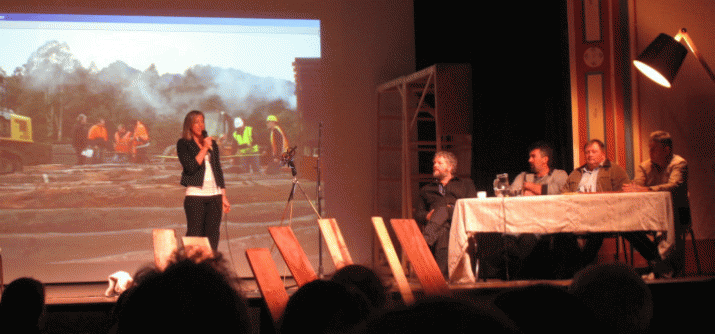


L-R: Jason Weller, Glen Bakes, Nick Bennetto and Rosalie Woodruff. In the background is Bakes’ Sheffield sawmill site.


Rosalie Woodruff with a sample of what might be made from timbers that FT would otherwise burn: the head is Huon pine, the handle blackwood

Unlikely bedfellows: the Greens’ Rosalie Woodruff and ‘Timberworker’ George Harris
It was music to many ears in Huonville Town Hall on Wednesday evening (September 4). On the stage were one sawmiller, two forestry contractors and a sawmiller-turned-pollie in near but not quite perfect harmony. Their refrain: More Jobs. Less Logs. Their main message: Forestry Tasmania (FT), get out of the commercial end of the timber industry and simply stick to growing trees.
Sub-texts that emerged through the meeting included the need for forest contractors and sawmillers to get a more reliable and better-quality log supply from FT; Tasmanian businesses not missing out because FT chooses to export sawlogs for woodchip at giveaway prices rather than sell them at a realistic price locally; and thoughts about access to specialty timbers.
The generally polite and attentive 75-strong audience — roughly a mix of 75% varying shades of green, and 25% in one way or another dependent on the forestry industry for their livelihood — were mostly appreciative of the information and ideas on offer.
Certainly not everyone was won over by the panel’s call for radical change aimed at transitioning the timber economy from perennially unprofitable (and a scandalous drain on the public purse) to a viable industry that could lead to many more jobs, higher skilling and, most importantly, a better than evens chance of small timber businesses turning steady profits.
There were moments that highlighted the personal pain that today is widespread in Tasmania’s disastrously floundering timber industry. And this was symbolised by the desperation ringing in the voices of a couple of people still grimly clinging to the forlorn hope of maintenance of the status quo — they way things “have always been”. One woman cried, why was poor old Forestry Tasmania copping a shellacking? Just think of all the good things it does — like road-building, fire protection, jobs . . .
Though it was muted, one sensed (dare it be said?) an air of hope as the audience mixed convivially after the Q&A session was wrapped up by MC Rosalie Woodruff, a Huon Valley councillor and the Greens’ candidate for the federal lower-house seat of Franklin.
Just about everybody had been invited to attend this Greens initiative to bring together a wide cross-section of the community. Indeed, there were people from a variety of forestry-related sectors in the room.
Conspicuous by their absence were seven of the nine Huon Valley Council (HVC) elected representatives (Mayor Robert Armstrong, Deputy Mayor Mike Wilson, and Councillors Tony Duggan, Rohan Gudden, Bruce Heron, Ian Paul, and Peter Pepper) And, it seems, there were no apologies from any of them — to my mind, yet further confirmation that HVC’s controlling bloc treats with contempt any constructive idea about anything when it comes from a quarter of which they don’t approve.
Considering Mayor Armstrong’s oft-expressed concern for the well-being of the Huon’s timber industry, and the valley’s desperate needs for jobs, it might be thought that at the least he would have turned up, if only to listen.
And not a Forestry Tasmania rep was in sight!
Also in the audience were Woodruff’s fellow Greens’ Huon Valley councillor, Liz Smith; Roger Larner, a member of Tasman Council and a property owner (who didn’t seem much impressed by the quartet’s refrain, and whose question on timber waste was, unfortunately, not dealt with); Waratah-Wynyard’s Mayor Robbie Walsh (who didn’t identify himself when local government councillors were being acknowledged); and Burnie City Council’s Alderman Malcolm Ryan, who listed many examples of “forestry mismanagement” and suggested that if FT were a private company it would have been “trading insolvent for many years” and “been subject to fraud investigations”.
The panel on stage comprised Kim Booth, a Greens state MP and former sawmiller; Glen Bakes, a Sheffield sawmiller; Jason Weller, a Burnie private forest contractor; and Nick Bennetto, a Hobart civil contractor who is also in private forest contracting and exporting, and is a strong critic of the way government has handled forestry industry compensation payouts.
At the front of the Town Hall stage was a selection of quality timbers — eucalypt, myrtle and blackwood. They had been milled after Booth had persuaded FT earlier this year to allow him to demonstrate that export logs (categorised not suitable for milling) stockpiled and deteriorating for months on the Burnie waterfront were, in fact, millable. Three B-Double loads — one each of myrtle, eucalyptus and blackwood — went to Glen Bakes’ sawmill at Sheffield.
MC Woodruff kicked off proceedings by showing freelance film-maker Russell Hawkins’ brief video on how Weller and Bakes justified Booth’s belief that the timber stockpiled for export was under-graded and capable of producing timbers of a quality suitable for the construction industry and other value-adding uses in the hands of Tasmanian enterprises and individual artisans.
Booth, in his usual forthright manner, continued with his assault on Forestry Tasmania. He sees it as a government business that gets its trees at no cost, gets hundreds of millions of dollars in assistance from the public purse, yet still declares huge losses in the scores of millions.
It’s hard for anyone to assert that Booth is not on safe ground when he makes his charges. Down the years, with the help of federal and state (Lib/Lab) generosity amounting to a billion dollars-plus, FT has been pillaging the state’s native forests while proving that, as a governed-owned business, it is not viable and never can be given the policies it pursues.
Nothing short of a royal commission will turn the situation around, Booth argues. Bennetto — prefacing his words on Wednesday night that his presence was not necessarily an indication of his support for the event’s organiser, Greens candidate Woodruff — obviously thinks the same.
Before the meeting, Booth said contractors had told him that, recently — at a time when local sawmillers were crying out for timber — 41,000 tonnes of sawlogs stockpiled at Brighton and Leslie Vale had been split and loaded for export to China.
“It’s an insult to our local industry that these logs are being split up and exported to China for woodchips rather than being provided to the local sawmillers,” he said.
The logs at Brighton and Leslie Vale, Booth said, were the same category as those that had been sitting for months in the Burnie export stockpile. “Export for woodchip is a sure money loser,” he said, “and Forestry Tasmania is displaying a reckless disregard for the public purse while wilfully destroying our beautiful native forests.”
After the meeting, Woodruff said: “The purpose of the event was to bring the results of the sawmilling trial to the south, and to discuss the implications of those findings for future processing of wood by Forestry Tasmania. It’s clear that even the most initially sceptical people in the audience were persuaded of the trial’s results.
“FT has been using inaccurate assessment techniques for timber and consistently undervaluing our resource. Timber of high market value has been downgraded to poor quality, and, as a result, has been shipped out of the state for low-value export as chips, or broken up and sold as firewood.
“The reason for this is simple,” said Woodruff. “FT does not have to function as a business. It operates as a completely supported workshop. It does not value its market product — because it doesn’t have to. The public pay for every lack of innovation, every sloppy decision. And the result — as the trial demonstrates — is that we’re wasting a resource that could be bringing in wealth to regional areas.”
The best result of the night, said Woodruff, was demonstrated by the fact that Mercury staff, who’d turned up in the expectation of covering a “flaming debate”, had packed up and left early.
Woodruff said: “People who have been vocal opponents sat and listened, and absorbed the evidence from the very credible panel of speakers. There wasn’t much to disagree about, which was what I’d hoped to achieve: some bridge-building on the issue, and a space to talk about how we can reinvigorate local processing.”
Wednesday evening’s proceedings conjured up, in the mind’s eye of this lay observer, an image of an industry in which, each day, its captive participants — even when they get to the end of a day with cash enough in their pockets to cover running costs and put food on their tables — are always yet a few dollars more deeper in debt.
Nearly a decade ago, Christine Milne, now the Greens’ national leader, came up with a “way forward” for Tasmania’s forests. I’ve got a hard copy of it but have been unable to find it online. If anyone has a link to it, please put it in a comment to this article. Everyone should examine it.
Milne’s vision in 2004 made economic and environmental sense then. And it makes sense now. With just a bit of updating to compensate for developments in the interim, her strategy is a blueprint for a way out of today’s forestry impasse. In fact, it meshes well with the views of Wednesday evening’s panel. With even fewer in the industry today than a decade ago, her plan looks ever more attractive considering her 2004 predicted “transition” figures were 720 new jobs and only 65 jobs lost.
Tomorrow, tragically, it looks as if the lights will go out all across the nation. Which could make it just the time for Tasmania to take charge of itself and stop looking to Canberra for salvation.
A tiny few forestry private-enterprise locals have had the courage to point the way to a profitable and sustainable forestry future. It’s worth giving their ideas a go rather than relying on the morally corrupt and economically nonsensical short-term fixes constantly handed out by federal and state governments irrespective of their political hue. — Bob Hawkins
Bob Hawkins is a friend of both Huon Valley Greens councillors.
Main pic: Greens candidate Rosalie Woodruff, with, from left, Kim Booth, Jason Weller, Glen Bakes and Nick Bennetto
• Leica: Picture essay of logs being loaded in Hobart bound apparently for China. And watch some ‘friendly’ advice from a log truck driver
The log truck I followed to the wharf came from the south, presumably from a stockpile at Leslie Vale. There are claims that the logs were deliberately split so as to be downgraded for export, and from the pictures that seems to be the case (fresh looking splits). Kim Booth and others know more about the history of these logs.
Watch Here:
http://cdn-src.tasmaniantimes.com.s3.amazonaws.com/get-a-job.mov


