History
Treasure Islanders

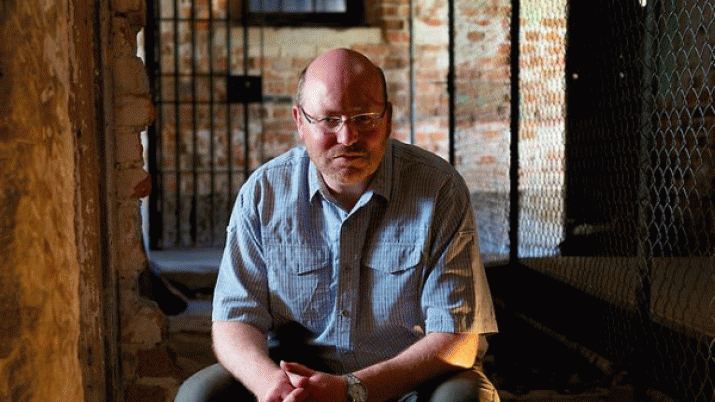

WHEN 18-year-old Arthur Orchard enlisted in 1915, his father wrote a letter to the military giving his son a “free hand” to sign up. “I expect him to be brave and conduct himself as a true soldier of the King and I sincerely trust that he may return,” Arthur Orchard Sr wrote in a thin, even hand. What misgivings he may have had aren’t revealed in the records.
Young Arthur won the Military Medal for bravery, but he didn’t return. He died of his wounds at a field ambulance in 1917 near Ypres in Belgium. His father waited patiently before inquiring after the medal. “As it is now about nine months since the medal was won I would like to know if there is any possibility of me ever having the pleasure of receiving the medal which we would treasure very much in honour of the brave lad who won it,” he wrote, adding that he had two other sons fighting and would go himself if fit. Within a month young Arthur’s mother, the granddaughter of an early Tasmanian convict, received the medal that was all that was left of her son.
Volunteer researcher Colin Tuckerman stumbled across this muted tragedy in the course of the mammoth Founders and Survivors project, in which amateur historians and family history buffs have been enlisted by university historians to study the lives of Tasmania’s 73,000 convicts, along with its 14,000 World War I soldiers, and to identify soldiers who were descended from convicts. There are 70 members of this volunteer army, helping to reconstruct history from the grassroots up.
In a project so big it’s almost overwhelming, it’s the little things that resonate. Tuckerman has been struck by the instances of humility and extraordinary resilience contained in the records.
“There you have this humble letter when I would be furious,” he says of Orchard Sr’s missive.
Young Arthur, at 175cm, stood almost 13cm taller than his convict great grandfather William Bryan, who came to Van Diemen’s Land in 1826 aged 22, after being done for stealing spoons.
Both men had brown hair, though Arthur’s eyes were blue and William’s hazel. William’s early life had clearly been a tough one. On arrival in Tasmania he sported scars between his eyebrows and on his knuckles, as well as a “pock pitted” nose.
In contrast, Arthur is recorded as having no distinctive markings. William was blue-collar, a former horse-driver and house-painter, but almost 100 years later his descendants had moved up in the world; Arthur is recorded as a clerk.
We know all this because it was meticulously written down, in William’s case by his jailers and in Arthur’s by the army. Tasmania’s 19th century records of convicts are a unique cache of data, a laboratory of human behaviour that has a use far beyond an amateur sleuth’s family tree research. They contain forensically detailed descriptions, better than anything else in the world at the time, taking in elements such as height, eye colour, literacy, skills, family history and temperament. University of Melbourne professor Janet McCalman, realising the potential of the records, contacted University of Tasmania convict expert Hamish Maxwell-Stewart in 2005 and they assembled an international team including economic historians from the US, Canada and the UK.
Armed with a $930,000 Australian Research Council grant …
Read the full story, The Australian here
Pic*: Matthew Newton
Photography / Cinematography
GPO Box 1585, Hobart, 7001
Tasmania, Australia
http:/www.matthewnewton.com.au
rapidexposure@ozemail.com.au