Coroner & Legal
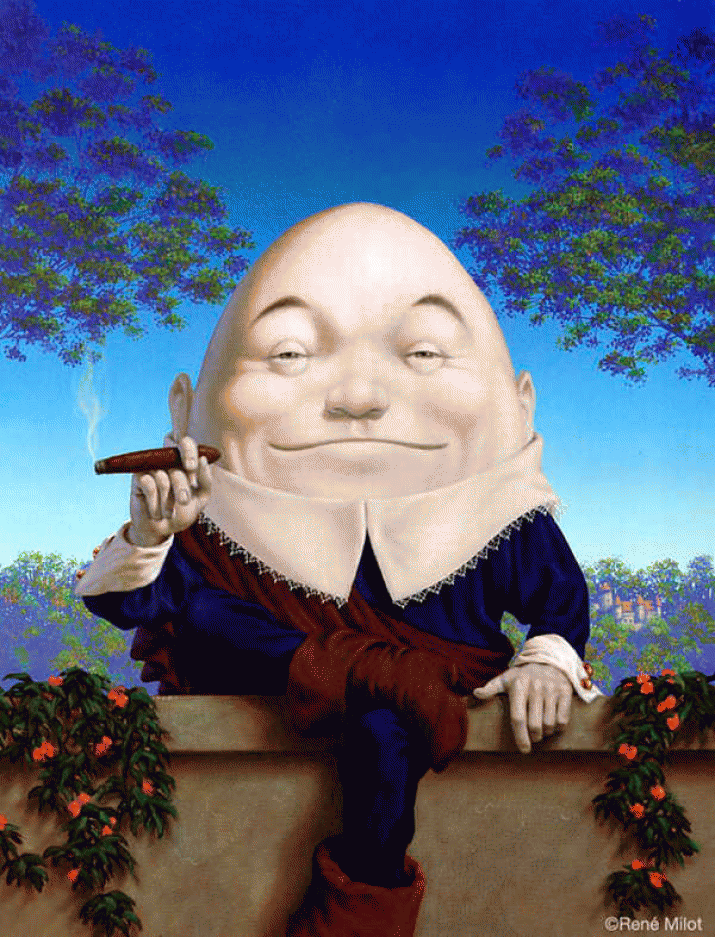
The judge as Humpty Dumpty


This is the 17th extract from Evan Whitton’s Our Corrupt Legal System, available free at netk.net.au/whittonhome.asp. Whitton is a legal historian, a trade almost as rare as the pig-footed bandicoot.
The story so far
Justice Russell Fox said justice means fairness; fairness and morality require a search for the truth, otherwise the wrong side may win; truth means reality, what actually happened.
The common law in England (and later its colonies) has never sought the truth. It began as an extortion racket in 1166, and went downhill from there. Extorting judges and their lawyer-bagmen formed a cartel to increase profits.
Trial lawyers have been called serial liars because they are adept at sophistry, a technique of lying by false arguments, trick questions etc. Judges have never been trained as judges; they are serial liars one day and judges the next.
Lawyer-politicians have been able to block change to a truth-seeking system since they formed an oligarchy in Parliament about 1350. (Vote 1: Anyone but a lawyer.)
The adversary system is a taxpayer-funded system in which trial lawyers control evidence and question witnesses. That enables them to confuse witnesses with sophistry, spin the process out, and extract more money from clients.
Lawyers and judges say the adversary system is the Rolls Royce of legal systems; Yale law professor Fred Rodell said it is a racket. Both are right: it is the Rolls Royce of rackets. The civil version dates from 1460; the criminal version from the 18th century. Since then, judges have invented a number of truth-defeating devices which make it relatively easy for rich criminals to escape justice.
Legal academics joined the cartel after a serial liar, Billy Blackstone, began the first law school at Oxford in 1758.
Zealous prosecutors; Humpty Dumpty judges; a country’s values
Prosecutors must know the system is unfairly rigged against victims, detectives, jurors, the community, and themselves, but they do not agitate for a fair system, and some try to balance defence lawyers’ dirty tricks with their own.
The win-at-all-costs culture thus gets the worst of both worlds. Criminals get off and the innocent – particularly the poor and those whose colour is different from those in the majority – go to prison.
Claire Cooper, of The Sacramento Bee, noted in February 2004 that in two trials in Solano County, California, prosecutors identified Jonathan Shaw and Mango Watts as the single robber who held a gun to a restaurant manager’s head.
Cooper said three appellate judges said the prosecutions were ‘something between stunningly dishonorable and outright deplorable’, but that they could not reopen the case because the Supreme Court had ‘never directly addressed the issue of whether due process permits two persons to be convicted for a crime that only one committed’.
Irving Younger (1932-88) was a defence lawyer, judge, academic, inventor of the sodomised parrot defence (see below, Diminished responsibility), and hypocrite. He complained (The Perjury Routine, The Nation, 3 May 1967) that judges do not assume that ‘arresting officers are committing perjury’.
Younger said: ‘Why not? Every lawyer who practices in the criminal courts knows that police perjury is commonplace. The reason is not hard to find. Policemen see themselves as fighting a two-front war against criminals in the street and against “liberal” rules of law in court.
If it is wrong for police to lie to put criminals in prison, it is wrong for lawyers to lie to keep them out.
The judge as Humpty Dumpty
When lawyers got control of the process, judges had to be passive, but they do the decent thing: they try to stay awake. Lord Coleridge’s wife sat on the bench and nudged him. A Sydney judge, Roddy Meagher, had his tipstaff at the ready to kick him. Lord Thankerton’s solution enraged barristers; he took to knitting on the Bench.
Given the system’s distance from reality, it is appropriate that judges’ mindset is accurately described in Through the Looking Glass, and What Alice Found There (Macmillan, 1871):
‘When I use a word,’ Humpty Dumpty said, in rather a scornful tone, ‘it means just what I choose it to mean — neither more nor less.’
‘The question is,’ said Alice, ‘whether you can make words mean so many different things.’
‘The question is,’ said Humpty Dumpty, ‘which is to be master – that’s all.’
US Chief Justice (1969-86) Warren Burger (1907-95) confirmed the Humpty mindset. Bob Woodward and Scott Armstrong reported in The Brethren (Coronet, 1979) that Burger told his brother judge, John Marshall Harlin II: “We are the Supreme Court and we can do what we want.”
In Bush v Gore (Monday, December 13, 2000), five Humpties effectively said democracy means you don’t count all the votes. They stopped the counting of Florida votes which, research showed a year later, would have made Albert Gore President rather than George W. Bush. There is a view that some consequences were not good.
The Humpties were: William Hubbs Rehnquist (1924-2006, judge 1972-2006), Sandra Day O’Connor (b. 1930, judge 1981-2006), Antonin Scalia (b. 1936, judge 1986-), Anthony Kennedy (b. 1936, judge 1988-), and Clarence Thomas (b. 1948, judge 1991-).
A dissenter, Justice John Paul Stevens (b. 1920, judge 1975-) observed: ‘Although we may never know the winner, the loser is perfectly clear. It is the nation’s confidence in the judge as an impartial guardian of the rule of law.’
Don Vito Corleone said lawyers can steal more than 1000 gangsters, but he did not say how they are helped by judges, e.g. Justice Brett on discovery (1882), Lord Atkin on negligence (1932) and tax evasion (1936), Chief Justice Owen Dixon on tax evasion (1957), and Chief Justice Garfield Barwick on tax evasion (1964-81). Their actions, detailed later, tend to support the Barton Hypothesis [that judges tend to favour lawyers’ financial interests].
Judging is different from advocacy, but judges are not trained as judges; they are lawyers one day and judges the next. Abimbola A. Olowofoyekuw, a lawyer, pointed out in Suing Judges: a Study of Judicial Immunity (Oxford, The Clarendon Press, 1993):
With all the training given to physicians (college, pre-med, medical school, internship, years of specialist training) no hospital in the world would permit a general practitioner (or a dermatologist) to do surgery.
But with no special training, the law permits a real estate lawyer, a banking counsel or a legal scholar to become a judge one day and on the morrow sentence a defendant to thirty years in prison, grant a divorce, adjudicate insanity, render judgment in an accident case, hold a director liable for damages, grant an injunction in a labor dispute, provide for custody of children, reapportion a legislative district, punish for contempt or reduce the tax assessment on an office building.
How long does it take a new judge to get a smattering of the learning necessary to do all these things? … Does it not make sense to train the judges before they go on the bench … Should not the judge be trained in his special discipline before being given the awesome responsibility of sitting in judgment on others?
Since judges’ only training is as lawyers, do they suddenly stop lying and perverting justice when they go aloft? Alan Dershowitz wrote in The Best Defense:
… lying, distortion, and other forms of intellectual dishonesty are endemic among judges … The courtroom oath – ‘to tell the truth, the whole truth and nothing but the truth’ – is applicable only to witnesses. Defense attorneys, prosecutors and judges don’t take this oath – they couldn’t!
People who persistently make mistakes are dismissed, but it is difficult to get rid of judges who are persistently wrong. In Europe, judges are trained separately from lawyers and appointed on the basis of rigorous examinations.
In the common law world, a judge is said to be a lawyer who knows a politician. A US judge, Curtis Bok, said in 1941: ‘It has been said that a judge is a member of the Bar who once knew a Governor.’
In Trial by Jury (1875), barrister W. S. Gilbert has a judge admit:
It is patent to the mob
That my being made a nob
Was effected by a job.
Chorus: And a good job too.
During the administration (2001-2009) of President George W. Bush, potential appointees to the Supreme Court were subjected to questioning by Vice-President Richard Cheney. In 2009, President Barack Obama (Harvard Law School) continued the procedure with Sonia Sotomayor.
Chief Justice (NSW) Jim Spigelman said Sir Owen Dixon (1886-1972, High Court 1929-64, Chief Justice 1952-64) was ‘Australia’s greatest jurist’ and that his court was ‘one of the great common law benches of history’.
Spigelman must have been unaware that Dixon took court further into fraud. He wrote judgments for Justice Sir George Rich (1863-1956, High Court 1913-50), and let Rich put his name on them. Dixon also wrote judgments at variance with his own and let other judges sign them. Lawyers could use the fraudulent judgments in argument before the court.
The origin of lawyers’ immunity from suit is a brazen example of the Barton Hypothesis. Courtesy of jurist Brett Dawson, we can name the guilty men: Sir Jonathan Pollock (1783-1870), Sir William Watson (1796-1860) and Sir George Bramwell (1808-92).
In Swinfen v Lord Chelmsford (Exchequer Court, 1860), the judges were put to the exigency of protecting a former – and, as it turned out, future – Lord Chancellor who had cheated his client.
Lord Chelmsford (1794-1878) had a glittering career. Born Fred Thesiger, he was, at age 13, a plucky little midshipmite at the Battle of Copenhagen. Perhaps tiring for the moment of rum, sodomy and the lash, he left the Navy at 17 and took to the bar and Tory politics. He rose to Solicitor General, Attorney General, and Lord Chancellor in 1858, but the 14th Earl of Derby’s Government fell in 1859, and he fell with it.
Down on his luck and with mouths to feed – his son, Alf, a future appellate judge, was still at Oxford – Lord Chelmsford had to resort to the bar. A client, Ms Patricia Swinfen, instructed him by telegram not to settle her case but, finding himself double-booked, he took the time-honoured course of settling the action, Ms Swinfen’s. which promised the smaller fee.
A June 2004 editorial in FLAC (For Legally Abused Citizens) Australia noted how Pollock et al defrauded Ms Swinfen and established immunity. The ‘reasoning’ of the court was: we can’t find any case where a barrister has been successfully sued for negligence. Therefore, it must be the law that barristers cannot be sued for negligence. That notion still obtains in Australia, if in few other countries.
The most recent assertion of lawyers’ immunity – largely on the ground that legal actions must have some finality – was D’Orta-Ekenaike v Victoria Legal Aid (Australian High Court, March 10, 2005).
Those in favour were Murray Gleeson CJ and Michael McHugh, Bill Gummow, Ken Hayne, Dyson Hayden, and Ian Callinan JJ. When the lone dissenter, Justice Michael Kirby, shortly had an emergency heart bypass operation, Justinian commented: ‘It’s sad to see that the only judge on the court with a heart is now having trouble with it.’
A barristers’ carousing song might go:
O, the moon shines tonight
On Mrs Porter
And on her D’Orta.
In May 2006 the Ontario Chief Justice’s Advisory Committee on Criminal Trials defined the function of judges thus:
Central to the adversary system is the concept that it is the lawyers who prepare and present the case … Trial judges would prefer to be, and should be, passive observers … there is no need for the trial judge to become involved in trial management.
It is certainly preferable for judges to be awake when concealing evidence, and when telling the jurors to decide what the remaining evidence means, but for the rest of the trial they might as well be the scarecrows described by T.S. Eliot:
We are the hollow men
We are the stuffed men
Leaning together
Headpiece filled with straw
Sleeping is fairly passive, but Australian High Court judges ruled in September 2008 that two men found guilty on drug charges did not get a fair trial because the trial judge, Ian Dodd, was sometimes asleep. The judges, who were paid AU$7,254.42 a week, were apparently unaware that no trial is fair because fairness means truth.
Oxford law professor Patrick Atiyah wrote in Justice and predictability in the common law (NSW Law Journal 1992): ‘ … less predictability in the law means more litigation.’
Justice Sir Frank McKinnon (1871-1946) said in Salisbury v Gilmore (1942) that the law lords are ‘the voices of infallibility, by a narrow majority’. David Goldberg QC, a London tax lawyer, said in 1997:
It is, I think, generally accepted that every case or virtually every case which goes to the House of Lords could be decided either way. At any rate Lord Reid is reported by Alan Patterson in his book The Law Lords as saying that at least 90% of the cases which came before him [1948-75] could have been decided either way.
That means appeal courts are effectively casinos, lacking only scantily-clad young ladies offering the gamblers high-octane cocktails. Lawyers can thus advise clients to have another roll of the dice; they might win, however dubious their case.
Lawyers can get two bites of the appeal cherry because many common law countries have appeal courts for provinces and another for the nation. Britain has two appeal courts, the Court of Appeal and the judicial committee of the House of Lords.
Sir Alan Herbert (1890-1971) was called to the Bar in 1918 but never practised, perhaps because he feared he could not keep a straight face. He put the casino question in Why Is the House of Lords? (Punch, 1933). In Board of Inland Revenue v Haddock, he has the Master of the Rolls (head of the Court of Appeal) admit:
The institution of one Court of Appeal may be considered a reasonable precaution; but two suggest panic … the legal profession is the only one in which the chances of error are admitted to be so high that an elaborate machinery has been provided for the correction of error …
In other trades to be wrong is regarded as a matter of regret; in the law alone is it regarded as a matter of course.
Harold Clough, a Perth engineer and former President of the Australian Chamber of Commerce, said in 1998:
We avoid litigation like the plague. When we have differences of opinion with our clients and we are stalemated in positions from which neither can move, rather than bring in the lawyers I suggest we toss for it. Tossing a coin has great advantages. It is quick, it is cheap, it is decisive and in my view equally as fair as any court case.
Some judges usurp the role of the jury. Three classic cases:
The Birmingham Six
During the Northern Ireland ‘troubles’ in the 1970s, it accused were said to be presumed innocent until proved Irish. At the 1974 trial of the innocent Birmingham Six, Justice Sir Nigel Cyprian Bridge (1917-2007) told the jury: ‘I am of the opinion, not shared by all my brothers on the bench, that if a judge has formed a clear view it is much better to let the jury see that.’
Bridge summed up for a conviction. Mike Mansfield QC noted his technique in Presumed Guilty: The British Legal System Exposed (Heinemann, 1993): ‘In a careful, almost total demolition of every defence witness and the lauding, sometimes verging on deification, of prosecution witnesses, the jury was corralled into the guilty pen as though driven by a diligent sheep-dog.’
Jeremy Thorpe
Justice Sir Joseph Cantley (1910-93) presided at the 1979 trial of Jeremy Thorpe, a barrister and Liberal politician, who was accused of conspiring to have Andrew (Gino) Newton murder Thorpe’s former lover, Norman Scott, in 1975.
Cantley summed up for an acquittal. He said the evidence of the chief prosecution witness, Peter Bessell (1921-85), a Liberal politician, was ‘a tissue of lies’. The jury was originally split 6-6, but eventually found Thorpe not guilty.
A few days later, Peter Cook (1937-95) detonated a parody of Canley’s summing-up at the Secret Policeman’s Ball for Amnesty International. Cook, who had said: ‘I could have been a judge, but I never had the Latin’, called his summing-up Entirely a Matter for You, which is judgespeak for ‘entirely a matter for yours truly’. Cook said:
We have heard for example from a Mr Bex Bissell, a man who by his own admission is a liar, a humbug, a hypocrite, a vagabond, a loathsome spotted reptile and a self-confessed chicken-strangler. You may choose if you wish to believe the transparent tissue of odious lies which streamed on and on from his disgusting, reedy, slavering lips. That is entirely a matter for you …
We have been forced to listen to the whinings of Mr Norman St John Scott, a scrounger, a parasite, a pervert, a worm, a self-confessed player of the pink oboe, a man, who by his own admission, chews pillows …
On the evidence of the so-called hitman, Mr Olivia Newton John, I would prefer to draw a discreet veil. He is a piece of slimy refuse, unable to carry out the simplest murder plot …
You are now to retire, as indeed should I, carefully to consider your verdict of Not Guilty.
Jeffrey Archer
Justice Sir Bernard Caulfield (1914-94) presided at a 1987 libel case in which a politician, Jeffrey Archer, falsely denied having resorted to a dwarfish prostitute, Monica Coghlan. Caulfield seemed entranced by the icy charm of Mrs Mary Archer, who stood by her man. Caulfield asked the jury:
Has she elegance? Has she fragrance? Would she have, without the strain of this trial, radiance? … Has she been able to enjoy rather than endure her husband Jeffrey? Is she right when she says to you – you may think with delicacy – Jeffrey and I lead a full life? … Is he in need of cold, unloving, rubber-insulated sex in a seedy hotel?
The jury gave Archer £500,000, and Caulfied added costs of £700,000.
Prime Minister John Major made Archer a peer in 1992. In 2001, Lord Archer got four years for perjury at the libel trial.
A country’s values
Business economist James R. Forcier wrote in Judicial Excess: The Political Economy of the American Legal System (University Press of America, 1994):
A nation’s values and problems are mirrored in the ways in which it uses its ablest people. In Japan, a country only half our size, 30 percent more engineers graduate each year than in all the United States. But Japan boasts a total of less than 15,000 lawyers, while American universities graduate 35,000 every year.
Japan uses an inquisitorial (truth-seeking) system. When Forcier wrote, the population of Washington DC was 500,000, but Washington alone then had 50,000 lawyers, three times as many as Japan. In 1992, France, had 22,000 lawyers.
Next: The corrupt civil process