Environment
Lessons from Love Canal: toxic expertise and environmental justice


August 7 marks the thirty-fifth anniversary of Love Canal. Toxins were discovered in the area in 2011, and new residents have reported unusual health problems. How can we prevent history repeating itself?
Who remembers Love Canal? Many of us don’t. But it is important for us, collectively, to remember. In 1978, a leaking toxic dump with over 20,000 tons of chemical waste was discovered buried beneath an elementary school in the working class residential community of LaSalle in Niagara Falls, New York. The health effects for the residents were staggering, with high incidences of cancer, miscarriages, rare diseases, and birth defects. It was the first US state of emergency to be declared over a human-made disaster, and it was a sobering lesson about the effects of toxic pollution. Love Canal received international media attention and stands out as a significant turning point in the history of the global environmental justice movement.
Yet the memory and lessons of Love Canal seem to be fading with passing generations. The Bhopal and Chernobyl disasters of the 1980s will be remembered for generations to come. They are widely considered to be the worst industrial and nuclear accidents in history, with enduring health and environmental impacts to this day. Fewer people remember Love Canal. The scale of the disaster was less dramatic. It affected a small residential neighbourhood rather than hundreds of thousands of people. And it was a slow-burning disaster, a creeping horror simmering beneath the ground.
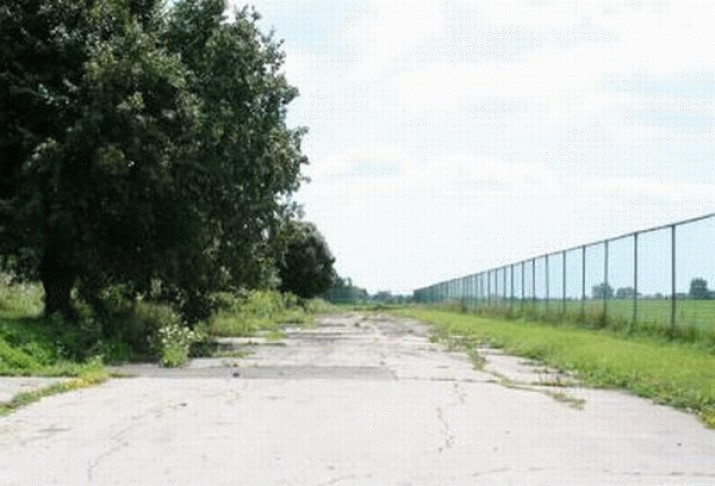
What can Love Canal tell us today? August 7 marks the 35th anniversary of the declaration of a state of emergency over Love Canal by US President Jimmy Carter. Anniversaries are an appropriate time for reflecting on lessons from the past, or for recognising lessons that time brings to the surface. Ten years ago, on the 25th anniversary, a modest stone monument was erected on the disaster site at Ninety-three Street, with an engraved chronology of the history of Love Canal. Yet if you visit the site of the disaster today, there are few explicit clues in the landscape to mark its devastating history. A tall wire fence encloses the vast evacuated site, and the periphery remains eerily abandoned, with weeds sprouting through uneven concrete sidewalks, crumbling skeletons of houses, overgrown lawns, and roads that end abruptly in open fields. You would have to look carefully to find the monument. The Love Canal evacuated site was declared “safe” by the Environmental Protection Agency in 2004 and officially removed from the list of Superfund waste sites. A new “bargain” housing development soon emerged beside it, named Black Creek Village.
But the toxic legacies of Love Canal still linger: toxins were discovered in the area in 2011, and new residents have reported unusual health problems. Is history repeating itself?
Love Canal was not an accident. It was a case of gross corporate and municipal negligence. Originally a “dream” power canal project of the entrepreneur William Love at the turn of the 20th century, the Love Canal was abandoned before completion in 1910. Between 1942 and 1952, the canal was used as a toxic dump for chemical waste by Hooker Electrochemical Company, one of the first heavy industrial companies that grew up around the great natural resource of Niagara Falls. In 1953, Hooker Chemicals filled the canal and sold it to the Niagara Falls School Board for $1, which soon became the site of a new elementary school in the residential working class neighbourhood of LaSalle. The residents of this quiet residential suburb had no idea that it was built on top of a toxic chemical dump. For decades, residents noticed chemical smells and substances emerging in their yards, but they didn’t take action until 1978, when people started getting seriously ill.
Read the full article, with full links, OpenDemocracy here
Pic: Love Canal today. Credit: Mike Kalasnik, Flickr