Economy
Learning nothing and forgetting everything … the Liberals crash into reality again


Senator Richard Colbeck, in defending Abbott’s radical fringe policies on the environment, made the claim that the Tasmanian economy couldn’t withstand having 52% of its land mass reserved.
Here we have an island that is 1 hour’s flying time from a city of 4 million serviced by an overnight sea voyage by passengers and freight. It is also part of a Federation so can get support from a country of 22 million.
Is there another island we could compare with?
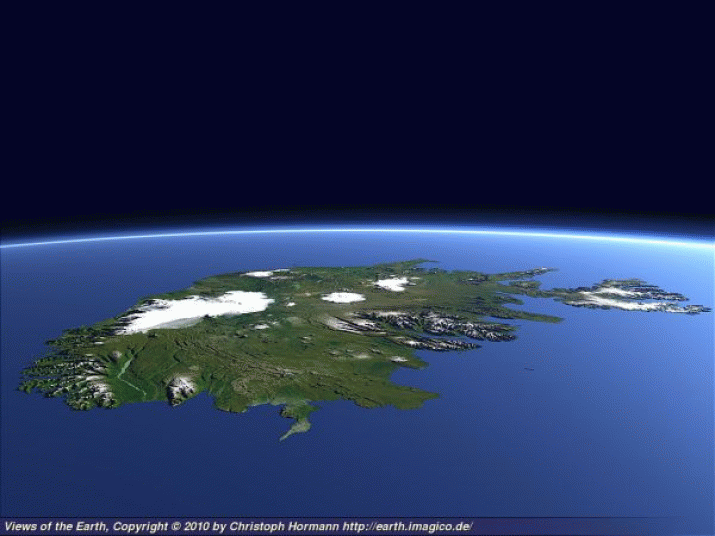
I thought of looking at the opposite pode and came up with Iceland, 2 hours flying time from the Scottish lowlands and another 30 minutes from Oslo. Yes there is a ferry but it takes longer than the Spirit.
Similar in Total Area, we find that 62.7% of Iceland is tundra, reduced from contributing to the Icelandic forestry and mining industries by the climate.
Of course some of that area may contribute to the economy as a tourist attraction but so do those areas Colbeck sees as not contributing to the Tasmanian economy. Does he only understand cut down or dug up economics.
That’s right, let’s forget the 22,000 employed by Tourism that contributes $1.83 billion to the Tasmanian economy.
And what of the per capita incomes of these disparate places.
In 2012 the Gross Domestic Product per capita in Tasmania was estimated as $41,739.
Iceland’s economy was badly affected by the greed driven Global Financial Crisis but still it’s Gross State Product was $44,011 per capita.
Iceland is comparable in another way.
The tourism sector is expanding, especially in ecotourism and whale-watching. On average, Iceland receives around 1.1 million visitors annually, which is more than three times the native population whilst Tasmania has a little less than double its population coming as visitors.
One difference is that Iceland’s economy has been diversifying into manufacturing and service industries in the last decade, including software production, biotechnology, and finance. Industry accounts for around a quarter of economic activity, while services comprise close to 70%.
Colebeck, in promoting his party’s radical fringe policies that are dated and antipathetic to the brand image Tasmania has been attempting to promote, is depending on no one asking what about other places.
I am sure he will have an impact with those who are cognitively challenged but it would seem from a superficial look a country with almost no timber resources does a little better than one that has spent 4 decades giving away its valuable forests.
Included in Colbecks attack was the reasoning of a need for special timbers, his example to supply the trinket market at Salamanca. One asks what happened to all those specialty timbers that were bulldozed and burnt in the mad rush to make Tasmanian forests into a pale shadow of the North American West Coast, a completely unsuitable model for forestry management in Tasmania.
This is the same party that is risking environment dependent industries all over Australia. Coal exports and the assoicated climate change putting the Great Barrier Reeef and the Wet Tropics Rainforests under threat besides bringing more intense storms t other industries all along the eastern seaboard.
They may claim the Greens are a radical fringe but the reality is the Liberals are crazed by short term greed for the Treasury benches and looking after their mates at the stock excahnge, not caring what the long term outcome for young Australians.
This is the mob who released their key policy to address the climate emergency, the Direct Action Plan, a supposedly fully costed policy, to be discovered that they are $4 billion short of funds to meet their completely inadequate 5% target. If the world moves to a 25% target their failure they describe as a policy will be in tatters.
If they retain the Renewable Energy Target but close the Clean Energy Finance Corporation more coal seam gas and wind farms will come the country electorates, polluting water and feeding the unsubstantiated health fears of many Liberal supporters.
Unable to understand the climate reality, to craft policies to deal with the real problems of Carbon emissions or to add up what their policies mean they don’t deserve government.