Economy
Call for an apology for Bass Strait schemes that isolate Tasmania

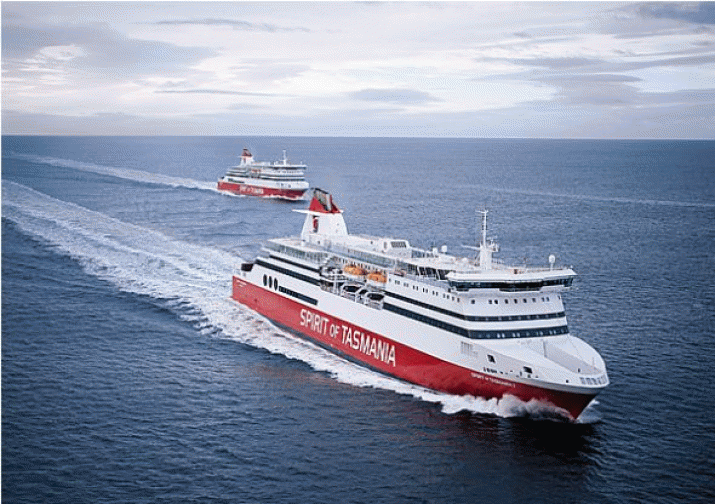

Peter Brohier, Chairman of the former National Sea Highway and Bass Strait Transport Equality Committee’s, in Hobart today called on the Prime Minister and Leader of the Opposition to, on attaining government, investigate and then if appropriate apologise, for Canberra not meeting its responsibility to deliver equal transport links for Tasmania.
Also, for allowing “equalisation” to be skewed and substantially redirected after an election resulting in a mandate for transport equality for the affordable movement of people across Bass Strait being largely ignored.
Mr Brohier said, “These omissions had curtailed the public use of Tasmania’s only surface artery, caused under-utilisation of Tasmania’s natural and developed strengths and required our nation to give greater welfare support to Tasmania than was necessary.
He also called on the nation’s leaders to deliver a comprehensive and effective National Sea Highway crossing Bass Strait, using shipping. This would equalise the cost of movement of all people, vehicles and freight to the cost of highway travel. The Tasmanian Freight Equalisation Scheme covers less than half the freight and excludes southbound consumables. These omissions adversely impacted on exports, the cost of living and jobs. Tasmanians should be allowed the advantages of competition policy, fair trade and freedom of mobility as others interstate.
The National Sea Highway campaign started in Burnie, Tasmania in the early 1990s. Tasmanians sought transport equality for people crossing Bass Strait based on a national highway link. The campaign was supported by major industry groups across South Eastern Australia, as it is today. In the end, Prime Minister’s Paul Keating and John Howard, twice, both tried to meet the wishes of the people.
Offers to make Bass Strait part of the national highway and maintain transport equity for both people and vehicles followed. But the scheme, obtained through people power, has now become just an “accompanied vehicle scheme”. It has cost federal taxpayers about half a billion dollars, so far. The highway equalisation formula has been removed leaving no mechanism to put downward pressure on total passenger or vehicles fares, or any hope of equalising them. A focus on travel experiences, facilitating driving holidays for tourists and the Tasmanian leisure market seems to now have taken its place. Our four year campaign was aimed at moving people from A to B at highway equivalence. It was not just about moving the shell of vehicles. Who would have supported that?
This is the third time that our campaign has been at the top of national politics. This only occurs when an issue is compelling. Failure to meet core Bass Strait promises and mandates, despite the provision of federal uncapped equalisation funding, brings our democratic process into question. While meeting the obligations and pressures that form part of a working democracy, Canberra has a responsibility to keep vital public interstate transport arteries open to all, equally.
An effective Bass Strait link is a critical part of our nation’s birthright. It is entirely appropriate for a sovereign state which lost transport equality when road and rail took over from the sea lanes connecting the other colonies. An equalised link will restore Tasmania’s connection to the integrated transport grid that covers the rest of our nation. This is a basic access and transport issue on the shortest interstate inter-capital route in Australia. Tasmania’s participation in the “common-wealth” of our nation is limited by failure to effectively link Tasmania – not by its geography. As with all other inter-capital routes, air travel should not be the only option.
A full National Sea Highway is consistent with the aims of federation – to allow the colonies to integrate their economies into a national economy through the movement of both people and freight. Given the state of the Tasmanian economy, it makes sound, economically dry, financial sense to connect our nation, right now.
We welcome the Federal Leader of the Opposition’s offer of a prompt review to examine equitable improvements to the Bass Strait equalisation schemes and the promise by the Palmer United Party to inject $400 million into Tasmania’s sea freight and passenger services. We await the Prime Minister’s response. No amount of GST revenue paid to the Government of Tasmania can take the place of delivering fair access for all Australians to all parts of our nation, including our island state.”
Written and authorised by Peter Brohier, 143 Kooyong Road, North Caulfield. Victoria.
*Peter Brohier was born in Devonport, Tasmania. He now lives in Nth Caulfield, Victoria. He is retired lawyer and Chairman of the former National Sea Highway Committee. Peter started his campaign at a public meeting at the Burnie Civic Centre about 20 years ago and has continued to fight for Bass Strait transport equity since 1992. Peter was described by Paul Lennon as the person most responsible for the introduction of the Bass Strait Passenger Vehicle Equalisation scheme. He is the recipient of the Australian Hotels Association -Tasmania award for outstanding services to tourism.