Economy
It will be the fault of MLCs, not us, say activists. Fear of ‘Terrorism’

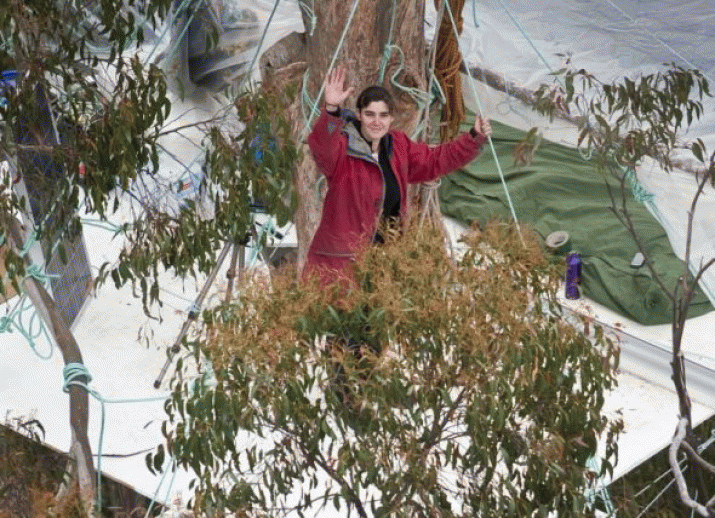

Huon Valley Environment Centre and Still Wild Still Threatened respond to the opinion of the Tasmanian Greens Leader that a moratorium on protests will save the flawed Tasmanian Forest Agreement (TFA) bill. Nick McKim:Give forest peace a chance, Mercury here
Huon Valley Environment Centre’s Jenny Weber said, “If the Tasmanian Legislative Councillors kill the TFA, it will be their doing, not a result of ongoing forest advocacy campaigns by grassroots environment groups. If secure legislated protection is not granted to forests, it will be the fault of those legislative councillors who designed the bill to fail, the politicians who supported that mutated bill, where in protection to forests is granted if campaigns are silenced, among other ‘greenmail’ clauses, and the signatories to this agreement, who designed for the loggers to be delivered upfront more than they wanted.”
“Tasmanian Greens leader Nick McKim has taken the questionable approach, like The Wilderness Society’s Vica Bayley, to offer forest activists as convenient scapegoats to the Tasmanian Legislative Councillors. They are willing to accept the shameful ‘greenmail’ clauses placed in the TFA Bill by the Legislative Councillors; we are not,” Jenny Weber said.
“While conservation reserves are not guaranteed, Tasmania’s forest agreement has already provided millions of dollars to prop up a collapsing logging industry. A fundamental problem we have with this TFA is the support and financing of the very controversial Sarawak timber company Ta Ann, and it comes at a high price, a deepening split in the environment movement,” Jenny Weber said.
Still Wild Still Threatened’s spokesperson Miranda Gibson stated, “For years Tasmania waited for a promised moratorium on our forests and in the meantime lost significant tracts of irreplaceable world heritage and high conservation value forests. We question why Nick McKim is calling now for a moratorium on protests, instead of calling for an end to the destruction Tasmania’s native forests for Malaysian company Ta Ann”
“The real risk is that if we allow this legislation to silence us, if we stop campaigning for the forests, Tasmania is poised to lose vast tracts of native forests while the tax-payer funded industry is given free-reign. Community campaigns have always provided checks and balances, holding the industry to account for destructive practices. If we take away the voice of our community then we are essentially giving a green light to the industry to continue the destruction” said Ms Gibson.
“Protests at Ta Ann mills and in the forest have a critical role to play right now in exposing the fact that industrial scale logging is set to continue under the TFA. Our protests have alerted the international community and customers of Ta Ann to the fact that, regardless of the company receiving endorsement from a few Environmental NGOs, their practices remain unchanged and the destruction of Tasmania’s forests remain unacceptable” said Ms Gibson.
“In this time of ongoing native forest logging, green-wash for corrupt companies like Ta Ann and the threat of biomass plants, it is more important than ever that someone is willing to stand up and tell the truth about what is going on in Tasmania. We will continue to do so as long as Tasmania’s forests are under threat from industrial scale destruction” said Ms Gibson.
• Mongabay.com: Norway’s wealth fund dumps 23 palm oil companies under new deforestation policy
• Sarawak Report: Concern Over Australia’s Mega-Pay Outs To Taib Family Firm
…
In short are Australians are willing to accept yet more destructive investment of the Taib family’s dirty money, stolen from the people of Sarawak, for no discernible tax benefit just to placate the logging lobby ?
At the centre of the dispute are the questionable commitments entered into by the then Director of Forestry Tasmania when Ta Ann negotiated its heavily subsidised investment in Tasmania back in 2006.
Revolving door – Rolley has now gone to work for the very company Ta Ann, which is receiving millions in compensation because of Forestry Tasmania’s inability to now fulfil the commitments he entered into on its behalf.
‘Captain’ Evan Rolley, as he was dubbed by Hamed Sepawi at the time was thanked for working night and day and doing all he could to broker the deal, which saw two mills built in the constituencies of two leading pro-logging MPs, then Premier Paul Lennon and Bryan Green (currently Minister of Energy).
“Mr Sepawi .. singled out for praise Foresty Tasmania head Evan Rolley, whom he dubbed Captain Evan Rolley for the way he drove his staff to efficiency. “No matter the hour of the night, there was not a time that we could not contact him,” Mr Sepawi said. “Thank you, to make us feel so welcome.” He said that Foresty Tasmania staff had done “a lot of work and forgone a lot of weekends” to clinch the deal”.[Tasmanian Examiner 17th Jan 2006]
Publicly, Ta Ann implied it would use plantation and “new growth’ wood. But, it has turned out that Rolley includes the clear felling of wild native forests in this definition and had committed huge areas to be cut down to feed into Ta Ann’s mills.
Thanks to the contract Ta Ann became the single biggest driver of deforestation in the state.
The company has subsequently been exposed for marketing this product as “eco-wood” to customers in Japan and there are further concerns that its processing plant in Australia has also given the company the opportunity to market notoriously unsustainable Sarawak hard wood as ‘eco’ plywood as well.
Yet, despite the millions of dollars of Australian subsidies, company accounts show that Ta Ann claims to have lost $26.8million on its Tasmanian operation. It is hardly a record that appears to justify Kevin Rudd’s latest move, handing the company just over $7million to open a new mill in order to placate loggers who say they feel threatened by the move to protect the future of Tasmania’s forests.
And what of Evan Rolley? Shortly after concluding the deal with Ta Ann back in 2006 he ‘retired’ as head of Forestry Tasmania. Yet within months he took up a $356,838 a year job working for Paul Lennon as the Secretary for his department.
Then it was back to the logging industry, working as the current Chief Executive for Ta Ann.
Read the full article, with full links, Sarawak Report here
• Miranda Gibson: The fear of ‘Terrorism’
Miranda Gibson fears peaceful protests such as her own 15-month tree-sit could be labelled ‘terrorism’.
Could peaceful protest ever be labelled terrorism? New laws in the states are heading in that direction and Australia’s big corporations are eyeing their progress.
WHAT DO THE Tasmanian Forest Agreement and the ‘War on Terror’ have in common? They are both being used to silence political dissent.
Journalist and author Will Potter, who is on a speaking tour of Australia this week( TT here and TT What’s On, here ), says since 9/11, the focus of the War on Terror in the United States has widened from those who murder human beings to include environmentalists and animal rights activists, who are now considered to be the FBI’s number one domestic ‘terrorism’ threat. Why? Potter has been investigating thie very question for more than a decade.
Potter’s book Green is the New Red draws a comparison between these widened terrorism powers and the Macarthy era. “It is using one word — this time, it’s ‘terrorist’ — to push a political agenda, instill fear, and chill dissent.” says Potter.
According to the US Department of Homeland Security and the FBI ‘terrorism’ includes complaints about water quality, film screenings of Gasland, non-violent protests, and activities by mainstream non-government organisations including PETA and the Humane Society.
Through his research, Potter continually encountered the influence of corporate interests. “Corporations have been behind this every step of the way.”
While environmentalists have felt the force of the FBI and new laws such as the Animal Enterprise Terrorism Act, it is the more insidious scare-mongering tactics involved in media and PR campaigns, that Potter considers most dangerous. “Corporations know the power of that language. And they have been exploiting it for decades against anyone who stands in their way” said Potter. In the US, Potter said language has been manipulated to portray activists as a greater threat to communities than the destruction of the planet that they oppose.
Here in Australia the rhetoric presents a scary reflection of that in the United States. I myself have been labelled as an ‘eco-terrorist’ for peacefully tree-sitting. The more effective our campaigns became at bringing attention to timber company Ta Ann’s forest destruction, the more words like ‘terrorist’ were thrown around. In February 2012 Terry Edwards, of the Forest Industries Association of Tasmania said Ta Ann’s loss of customers was “caused by eco-terrorism in Japan and Britain”. Jan Davis of Tasmanian Farmers and Graziers reiterated that it was “at the hands of these eco-terrorists”.
After reading such quotes, you might be forgiven for wondering if someone had flown planes into buildings. What actually happened was Jenny Weber and Peg Putt, representing a collaboration of environment groups, met with Ta Ann’s customer companies. They submitted reports documenting the source of timber and values of the forest. Not exactly what most people would call ‘terrorism’, right?
It wasn’t just the forestry industry pushing this line. Paul Harris, member of Tasmania’s Legislative Council said “Unless this eco-terrorism stops overseas… we are deadly serious about not entertaining the prospect of locking up more of our forests into reserves.”
Terry Edwards agreed, urging that “the extreme actions of these terrorists are not rewarded by the Government and that no additional reservation will be passed into law.”
This concept that ‘terrorists should not be rewarded’ developed into an unprecedented and undemocratic clause in the Tasmanian Forest Agreement. The so-called ‘durabilty clause’ threatens to punish anyone who dares exercise their right to free speech to criticise the forestry industry. While in the US activists are punished by lengthy prison sentences and ‘terrorism enhancement’ penalties, environmentalists here are instead threatened with the loss of what is most important to us: forest protection.
The durability clause holds the forest to ransom and is akin to blackmail. Richard Dennis of the Australia Institute noted, “The creation of this legislative poison pill is equivalent to telling a union that if it strikes for better conditions then the minimum wage will be cut, or telling human rights groups that if they protest for improved treatment of asylum seekers the annual intake of refugees will be cut.”
While the tactics may differ between US anti-terrorism legislation and the Tasmanian Forest Agreement, the end goal is the same: to discourage dissent. As Potter explains, it is “not outlawing free speech, but it is making people afraid to speak up and use their rights”.
“Silence and silencing are the death of democracy,” said author Richard Flanagan in his criticism of the TFA. However, just as draconian laws have failed to silence activists, so has the Tasmanian durability clause. In the last few weeks peaceful protests took place at logging areas and Ta Ann mills across Tasmania. In the face of a fire of backlash and rhetoric about “destroying the peace”, people continue to take a stand. Those of us who continue to speak up do so not simply to maintain our right to free speech, but because it’s absolutely necessary to hold the forestry industry accountable and bring an end to industrial scale destruction of our native forests.
At the same time as actions took place in Tasmania, people in the United States are also taking a stand. Last week a law suit was filed by academics, activists and journalists, including Will Potter, to challenge the ‘Ag-Gag’ laws that criminalise anyone who takes or distributes images of animal industry facilities.
The fact is, people all around the world will continue to stand up for our beliefs regardless of the personal consequences or how we are labelled. We have far more to lose if we stay silent and allow big business to go unchecked. Our very future depends on refusing to stay silent.
Miranda Gibson is a qualified high school teacher who is best known for her record-breaking 14-month tree-sit defending threatened forests in the Tyenna Valley.
First published as Discouraging dissent, ABC Environment, here
Pic: of Amanda Gibson in The Observer Tree