Coroner & Legal
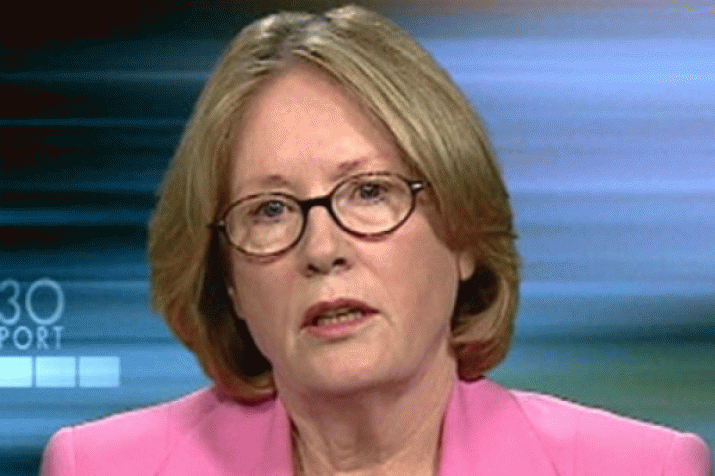
When will the mythologies stop? The Final Speech of Judy Moylan


…
I should like to close this farewell speech on an interrogative note. As one leaves the stage of active intervention, there is inevitably heartache, mostly stemming from issues in our body politic that persistently resist amelioration. Poverty is one: 600,000 children are living below the poverty line in Australia today. In some parts of the electorate of Pearce, the impact is devastating. Why have we not been able to do better? Was it not a body blow to the capacity of sole parents and their families to shift them on to Newstart while cutting Job Network funds? Are we not denying them a chance to forge a better future? The ‘Fair Incentives to Work Bill’? When will the mythologies stop?
Another mythology is privatisation. Is it always the answer to efficient delivery of services? Let us ask those on a fixed or low income about their essential services bills. In general terms, though, the answer is yes. Privatisation can be beneficial providing due diligence is applied. However, as chair of the Public Works Committee for nine years, let me assure the House that the rush to sell off assets is almost never submitted to impartial cost-benefit analysis. And what is new about that?
And what of the level playing field, another mantra? Trade inequities abound, with combined subsidies paid to farmers in the European Union and the United States totalling around $350 billion per annum. Our near neighbours of Japan, Taiwan and South Korea continue to have among the highest subsidies for farmers. Is it a welter of self-hatred that causes us to endanger some of our proudest and most efficient producers? The Australian people have forged by dint of prodigious labour, innovation and stubborn self-belief a peaceful and prosperous civilisation in the most arid continent on the planet. It ought to be a personal agony for everyone here when our economic savants sanction admission of goods from nations that continue to pay subsidies, do not pay decent wages, do not impose occupation health and safety regulations, have no superannuation schemes and do not apply standards of food hygiene and strict controls over additives.
Unsurprisingly, these goods enter this country at a cheaper price than we can produce them. But at what cost to our future, social and economic? Day in, day out we dream of being a future food bowl for Asia while simultaneously destroying our existing industries. Meanwhile, frank and shameless subsidies and protections proceed unremarked whilst our own administration has withdrawn subsidies and continues to heap the burden of more and more ‘red tape’ on the breaking backs of our producers and our manufacturers. Is this pragmatism or an amiable madness on our part?
While the House ponders this conundrum, I turn to my six years as Chair of the Australia-China Parliamentary Group. It proved to be miraculously serendipitous. I led several delegations to Beijing, Shanghai and some of the remote regions of the Middle Kingdom. Thus, I was a personal witness to a unique event in human history as China emerged and, to the astonishment of the world, forged for itself the iron mantle of a great economic and military power.
With each successive visit, I was led to study a little more of Chinese political history. My impression is that China, with the arguable exception of Tibet, has been averse to pursuing territorial expansion and focuses above all else on improving the living standards of its people through trade. Certainly, in terms of the current economic downturn and with the prospect of alternative suppliers massing on the horizon, our trading relationship with China will need to be culturally sophisticated, intelligent and sensitive.
There are also other significant nations sharing with us the great Indian Ocean — a region whose time has come. Our ability to navigate amongst these competing interests will be a test of our political maturity and the efficacy of our educational institutions.
Two years ago, I was fortunate to secure a gifted intern from ANU to research a paper on the case for an Australian Centre for Indian Ocean Affairs. It makes compelling reading. Commerce and cultural exchange are the enemies of poverty and the great facilitators to peace and growth along the Indian Ocean littoral . Why have we waited so long? But the signs are we may not have to wait much longer. The recent announcement by the shadow minister for foreign affairs, the member for Curtin, of a prospective re-incarnation of the original Colombo Plan is profoundly welcome.
If we are to learn anything , though, from the political and social problems of the region it must surely be the necessity to engage with our neighbours t o manage the flow of refugees in the Indian Ocean region. This is not a situation Australia can manage in isolation. It is not.
If we are committed to stopping the deaths at sea, in this most intransigent of political arenas, our parliament must find a way to forge a national consensus before we can possibly entertain any hope of achieving a regional consensus. This is the only way we will find a lasting and humane resolution to one of the enduring human horrors of war and civil strife in our midst, and my feelings on this matter have been expressed frequently both within this chamber and without. I remain stridently opposed to indefinite mandatory detention and the continued detention of children, 2,000 of whom are currently in detention under our management. These practices have gone on in our name and will stand as a matter of great shame.
In conclusion, I cannot help reflecting that as legislators, the members of this House exercise a glorious responsibility. It is no small thing to contrive, consider and ultimately create new law for a great nation. It is no small thing to rigorously uphold the separation of powers that tempers the potential excesses of executive government. Equally it is no small thing to defend the sanctity of free speech, especially in that essential organ of democracy, the fourth estate.
• The full speech:
http://parlinfo.aph.gov.au/parlInfo/search/display/display.w3p;query=Id%3A%22chamber%2Fhansardr%2F5b6d8876-4831-481f-8b5b-85bb0fbe651f%2F0068%22
• Judy Moylan webpages:
http://www.judimoylan.com.au/ and http://www.aph.gov.au/Senators_and_Members/Parliamentarian?MPID=4V5