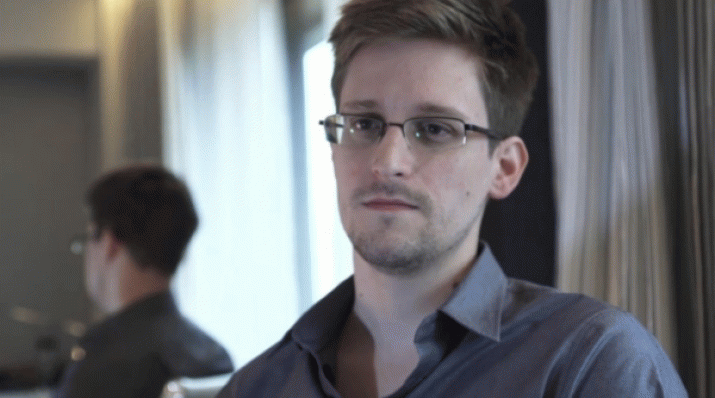
The individual responsible for one of the most significant leaks in US political history is Edward Snowden, a 29-year-old former technical assistant for the CIA and current employee of the defence contractor Booz Allen Hamilton. Snowden has been working at the National Security Agency for the last four years as an employee of various outside contractors, including Booz Allen and Dell.
The Guardian, after several days of interviews, is revealing his identity at his request. From the moment he decided to disclose numerous top-secret documents to the public, he was determined not to opt for the protection of anonymity. “I have no intention of hiding who I am because I know I have done nothing wrong,” he said.
Snowden will go down in history as one of America’s most consequential whistleblowers, alongside Daniel Ellsberg and Bradley Manning. He is responsible for handing over material from one of the world’s most secretive organisations – the NSA.
In a note accompanying the first set of documents he provided, he wrote: “I understand that I will be made to suffer for my actions,” but “I will be satisfied if the federation of secret law, unequal pardon and irresistible executive powers that rule the world that I love are revealed even for an instant.”
Despite his determination to be publicly unveiled, he repeatedly insisted that he wants to avoid the media spotlight. “I don’t want public attention because I don’t want the story to be about me. I want it to be about what the US government is doing.”
He does not fear the consequences of going public, he said, only that doing so will distract attention from the issues raised by his disclosures. “I know the media likes to personalise political debates, and I know the government will demonise me.”
• Q&A: ‘I do not expect to see home again’
• Wikileaks Party: Data retention and access
• Wikileaks Party: Giving Australians Greater Security
• Elizabeth O’Shea, Fairfax: Dangers of blowing the whistle in the digital age Whistleblowers are vital to our press and our democracy. They provide some of the best information about the workings of closed environments such as corporations and government. Interestingly, what is demonstrated by Snowden’s story, and Glenn Greenwald’s fearless journalism, is that intimidation is a weak defence against the human instinct to expose injustice. While governments continue to misuse power under the cover of darkness, good people will invariably let the sunshine in. We must protect them. As Matt Taibbi wrote: ”If you can be punished for making public a crime, then the government doing the punishing is itself criminal.” Both Manning and Snowden, like all whistleblowers, have a defence: the public interest. That is currently not available to Manning because of a ruling that sees his motivations as only relevant for sentencing purposes. It must be reversed and be taken into account in all such similar legal contexts. Without this, Manning’s actions make no sense and his treatment looks like a show trial. When we start to criminalise dissent and the exposure of injustice in this way, it has very serious consequences for our society. As Ben Wizner from the American Civil Liberties Union noted: ”Sometimes what may be helpful to the enemy is also indispensable to the public in a functioning democracy”. If you think Manning’s trial has nothing to do with your privacy or democratic rights, think again.