Coroner & Legal
A health issue, not a criminal one. MLCs delay bill

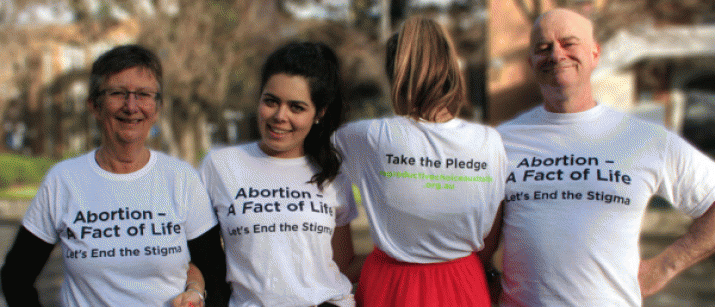

Who you gonna trust? Mythbusters!
Tasmania’s eighty-nine year old Criminal Code Act currently contains sanctions of up to 21 years’ jail for any woman who terminates an unwanted pregnancy. Consider that around one third of all women will have at least one abortion in their reproductive lifetime.
Further consider that well-designed, unbiased surveys of the Tasmanian and Australian communities consistently show that over 80% of people consider pregnancy termination to be a health issue, not a criminal one. The anti-abortion provisions within the Criminal Code Act are clearly obsolete.
This chasm between the law, community attitudes, clinical practice and the lived experience of Tasmanian women is fundamentally what the Reproductive Health (Access to Terminations) Bill is attempting to fix. Not that you’d know it from the propaganda war that has been waged in recent months.
Those of us who have been through more than one law reform campaign are used to the tactics of the anti-choice groups, but for state based services and politicians who have not been through such a process before, it can be difficult to sort through the truth from the lies. Most media outlets jump on anything sensationalist and so public debate, usually a sign of a robust and functioning democracy, becomes poisonous, skewed and counterproductive because the “debate” is centred on misinformation and myths.
Misinformation and myths do damage. They obscure, blur and skew the conversation at the peril of women’s legal and bodily autonomy, and health. They make doctors fearful of persecution. They make for a confused electorate. They muddle parliamentarians, who then feel overwhelmed and under-prepared and less likely to support legal change – which of course is the ultimate goal of the myth-mongers.
In the current Tasmanian debate, as always, the anti-choicers are out in force with their anti-choice, anti-woman, anti-evidence agenda to myth you over. I am here to myth bust.
MYTH: Abortion harms women.
FACTS: Legally regulated, accessible abortion is medically safe – in fact, one of the safest medical procedures, including statistically safer than childbirth, according to the World Health Organisation (WHO). Making abortion illegal and inaccessible harms women because they resort to desperate means; in 2008, approximately 47000 women worldwide died from unsafe abortion (WHO 2011). So, we have WHO’s evidence-based data, or we have anti-choice myths. There shouldn’t even be a question mark over whom we trust.
MYTH: That removing the threat of criminal sanction from abortion will result in women suddenly terminating pregnancies en mass just because they can.
FACTS: The lack of trust, respect and empathy for women illustrated here is extraordinarily patronising. I feel patronised just rewriting such rubbish. Women will decide to continue to terminate pregnancies for the same reasons they always have – reasons personal to them, which are not our business. If the reasons remain the same, it follows that the numbers will too. International experience supports this, with Canada legalising abortion back in 1988 yet having a lower estimated abortion rate than Australia [ http://rabble.ca/columnists/2013/01/benefits-decriminalizing-abortion ]. The sky has not fallen in on any jurisdiction since legalising abortion.
MYTH: Discontent with just one numerical lie, we’re also told that late-term abortions are evil and will rise dramatically after legalisation. Panic!
FACTS: Don’t panic! I have a couple of myth busting pieces of evidence up my sleeve for this one. Firstly, less than 1% of terminations occur post 20 weeks. Secondly, late-term abortions are mostly a group of women who have ‘problem pregnancies’, wherein the pregnancy is wanted but severe foetal abnormalities or dramatic psychosocial circumstances (such as the death of a partner) make the pregnancy not viable (Victorian Law Reform Commission 2008). Most genetic abnormalities can only be detected post 18 weeks, and some tests require follow up that take yet more weeks. So, a woman with inconclusive results and the legal cut-off looming may terminate her wanted pregnancy out of fear rather than waiting it out, only to lose the legal option to terminate if the pregnancy is deemed non-viable. No one should push for legislation that sees women terminate wanted pregnancies because of uncertainty and fear.
[ http://whv.org.au/static/files/assets/bc92aacd/WhatMPsNeedtoKnowAboutLateTerminations.pdf]
MYTH: The gestational limit should be less than 16 weeks.
FACTS: Oddly, there is also misinformed push from anti-choicers to decrease the gestational limit on legal abortions. It takes only a wee bit of causational thought to realise lowering the gestational limit will increase terminations categorised as ‘late-term’ because these abortions are largely medically necessary. It also likely risks more frightened women ending wanted pregnancies if that looming legal cut-off pushes its way closer to their uteruses. The misinformers claim that foetuses are commonly viable earlier than the standard 24 weeks. They omit to mention that 24 weeks is the result of academic research on over 10 years worth of UK neonatal data on viability [ http://www.bmj.com/content/336/7655/1221.full. ] What will do the most to prevent late-term abortions are medical advances and increased healthcare access that enables earlier screening of foetus non-viability. Can those desperately concerned with late-term foetuses give this a little more attention, perhaps?
MYTH: women need abortion counselling and therefore this should be compulsory in any new legislation.
FACTS: This myth says that counselling will undeniably help women. This is false. It has been considered and subsequently thrown out by parliaments before, including in Victoria and the UK. The Victorian Law Reform Commission, an independent inquiry body working for the Attorney General’s office, found that most women who sought terminations were already informed and had already thoughtfully considered their decision (p 120 – 8.80). Perhaps most importantly, the Commission found that that not only is mandatory counselling unlikely to do good but actually has the potential to do harm (p 125 – 8.125), particularly insofar as implying to women that they are incompetent at making their own reasoned decisions (p 123 – 8.106). Women are proactive beings, capable of making their own ethical decisions without the butting in of government or strangers? And women don’t like a minority of propagandists and government telling them (and everyone) otherwise? Go figure.
MYTH: Compulsory viewing of ultrasounds is needed for informed consent and would lead women to change their minds.
FACTS: This myth runs on the premise that abortion is inherently bad, and that women are stupid and reckless. The majority of women decide on abortion because they feel unable to be a good parent at this time and/or are economically unable to support a child (Guttmacher Institute 2005). They do not decide because they do not comprehend what a pregnancy is, nor because they do not know what is best for their own bodies and lives. Compulsory ultrasounds may cause women to change their minds about what State they seek abortion in, perhaps, but not about their pregnancy
MYTH: The Bill’s proposed access zones impedes on protesters’ freedom of speech.
FACTS: The Bill does not demand protesters cease completely, but simply asks that they stand 100 meters away from the clinic entrance. This is to allow easy access to healthcare centres and respect the personal space of women. Again, to Canada, who has had exclusion zones for decades and, again, the sky hasn’t fallen in. Well golly, who woulda thunkit? In addition to propaganda peddling, some anti-choicers think it their right to scream at women outside healthcare clinics. If abortion is so terrible, as they claim, how dare they worsen the experience by waving placards in women’s faces? We see the logical fallacy in their actions. We see that their (mis)information has an agenda.
MYTH: The Bill forces doctors to refer for abortion against their conscience.
FACTS: The Bill does NOT force doctors to refer for abortion. It requires that a doctor tell the woman he/she objects to abortion, and refer the woman to a medical practitioner who does not object to abortion, so that the woman can be advised on all her options in an unbiased manner. So, really, we’re looking at a Bill that asks doctors to be professional, professionally secular, honest, non-judgemental and respectful to patients … kind of like what medical councils and general medical practice laws already ask for, no? In fact, for GPs to prevent having to say no in the first place, perhaps they can simply place a sign at their reception saying, “This doctor/practice does not support requests for abortions.” Sorted.
So, Tasmanian MLCs – don’t fall victim to the strategy of deliberate misinformation and emotional manipulation. Question everything you read, check the reputation and expertise of the source, and weigh up the facts. Then do the right thing by Tasmanian women; vote the good (read: honest, accurate, evidence-based) vote.
• CL urges Tasmania’s Legislative Council to reject radical abortion legislation
• Kate’s story, in Comments: If every woman who has had an abortion spoke up publicly there would be no question that the law would change, services would improve and the secrecy would be unnecessary. But while we keep silent we keep being treated like criminals. We don’t deserve that.
• Thursday: ABC: Abortion bill delayed by Upper House … Independents Ruth Forrest and Michael Gaffney voted against the delay, while Government MP Craig Farrell supported it, saying he would like to know more about some matters raised during discussions. Ms Forrest is the committee’s chairwoman, and says she is worried some MPs will misuse the process. “I think it needs to be a very targetted inquiry, the focus on the bill, and not on the broader issue of whether termination should be legal or not. “That debate was had in 2001,” she said. The Huon Independent, Paul Hariss, says MPs need more information before they can cast a vote. • ABC here