Economy
The Mining Boom is over. Is farming the next boom … ?

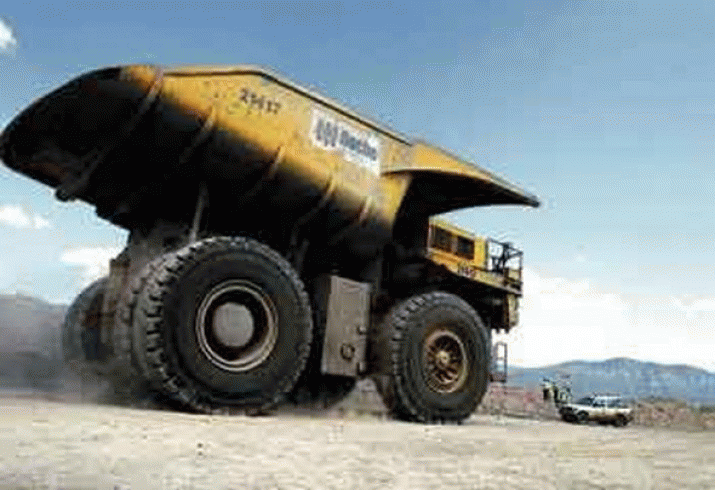

The resources boom is over, sooner than anyone expected. Capital expenditure in mining essentially peaked in mid-2012, flatlined over the following six months, then plunged steeply in the March quarter, wiping almost $1.5 billion off Australia’s quarterly output.
The Bureau of Statistics capex survey dramatically changes the roadmap for Australia’s economy. The debate over whether the boom would peak in 2013, 2014 or 2015 is over. We now know it actually peaked in 2012.
And while the Reserve Bank has been hoping that non-resource investment would rebound to take the baton from mining, the Bureau figures show that, too, continued to slide in the March quarter, sinking to its lowest level as a share of GDP for almost 60 years.
The Reserve has little choice now but to follow up its May rate-cut with another one in June. As Professor Ross Garnaut has warned, it is urgent that it lower rates to help bring down the dollar rapidly, to give other industries the incentive to invest and expand in mining’s place.
That’s not to say it will necessarily do so. Under Glenn Stevens, the Reserve has erred repeatedly on the side of being too cautious: in five years dominated by the mining boom, our GDP per head has risen just 4 per cent.
The one ray of optimism the Bureau reports is that the miners are still predicting higher investment. Their forecasts imply an implausible 16 per cent surge in spending in the June quarter, followed by a further 4 per cent rise to $102 billion in 2013-14.
Take that with a heap of salt. This time last year the miners forecast they would invest $119 billion in 2012-13. They now predict that will be just $98 billion, and on past form, the figure will actually be less than $95 billion.
After that, why should we give any credibility to the industry’s forecasts? Its forecast for 2013-14 is as trustworthy as a politician’s promise.
What matters here is the actual data. Capital expenditure in mining plunged by $1.47 billion or 6.2 per cent in the March quarter, after seasonal adjustment. The Bureau revised down its estimate of capex in the previous six months by $872 million or 1.8 per cent.
Western Australia was the epicentre of the fall.
…
This is a turning point: for the mining industry and the economy. Its implications need to be absorbed fully by the Reserve, and by the austerity faction in the federal Coalition, which is likely to inherit an economy slowing sharply.
Read more: http://www.theage.com.au/business/the-mining-boom-is-over-20130530-2ndu9.html#ixzz2UoFSzH6d
• Examiner May 22: Fears for mining activity in Tasmania
• Jan Davis, TFGA CEO: Farmers could be the next boom, if …
Agriculture is about playing poker with God
A forecast $2 trillion bonanza in Australian farm exports to middle class Asians is being lauded by some as the next mining boom. The National Food Plan released earlier this week is underpinned by this approach.
There is certainly scope for agriculture to build on the myriad of opportunities identified in this massive marketplace; and the recently announced suite of commitments to investment by both the state and federal governments is long overdue.
However, there is a risk that there is too much focus on the bright shiny bits of this possibility; and not enough on the underlying issues that will prevent farmers from capturing these opportunities. These issues may not be able to be packaged up into ‘sexy’ announcements; but if we don’t address them, we’re not going to be able to catch this rising wave.
In comparison to emerging competitors like Brazil and India, Australian farmers are hampered by increasing input costs, sagging productivity and heavy regulatory burdens. The industry is also squeezed by supermarket chains that are forcing down prices; and boycotted by a $1.5 trillion domestic superannuation funds industry that could provide it with much-needed capital.
The nub of the problem is that, to be successful, the industry needs a long-term view; but it is hobbled by the Australian preference for the short-term grab.
Farming consultant David McKinna has referred to agriculture as ‘playing poker with God’ – and he’s right.
Farming underwrote our emergence as an affluent country, with the nation famously seen as ‘riding on the sheep’s back’. However, over the past 50 years, Australian agriculture has been eclipsed by the resources boom, ravaged by plunging prices and let down by falling investment in vital research and development resources.
Doug Shears, Australia’s most successful producer of value-added agricultural goods, cautions that the perceived opportunities might not even exist to the extent often imagined.
The founder of Uncle Toby’s Oats, developer of the Berri fruit juice brand and exporter of processed herbs, dairy and beef products is sceptical about demand from Asia transforming Australian farming.
“Is Asia suffering from a likelihood of a shortage of food? Where is all this food demand going to come from?” Shears asks. “Thailand is a food exporter, Malaysia is a food exporter, The Philippines is a food exporter, China is a major exporter of food products.
“Probably the most relevant are Japan and Korea. Their production areas are limited but they’re very fussy about where they’ll import from. They have a long history of imports from Australia but also globally.”
Despite this scepticism, farm boom talk is thick on the ground.
World food demand is expected to rise by 77 per cent by 2050 and “most of this growth will occur in Asia where demand will double,” according to the federal government’s white paper on the Asian Century. Australia’s food sector “has strong prospects over the long term, given our proximity to Asia, and our strengths in key growth commodities like beef, wheat, dairy products, sheep meat and sugar,” the paper says.
However, there’s no sign of that happening yet.
The Australian Farm Institute warns drastic improvements in productivity are needed both on the farm and in food processing plants for Australia to remain competitive. This is because of the emergence of “major new agricultural exporting nations that have a much richer natural resource base and much lower cost structures than Australian agricultural businesses”.
“A need for higher productivity in food processing may be recognised but what is less clear is how that productivity growth might be achieved,” says Mick Keogh, of the AFI.
The federal government’s Bureau of Agricultural and Resource Economics and Sciences (ABARES) has also warned that Australian farmers will fail to cash in on growing Asian demand unless productivity improves and there is a significant shift in how Australian produce is marketed overseas.
Longer term, the outlook is equally uncertain as Australian farmers are unable to compete on price with low-cost producers in countries such as Brazil and India.
“The key point that has been overlooked,” according to Shears, “is that agri-trade has been globalised over the past 25 years. All the major corporations participating in the food industry are global: they source their products from all over the world and they’ll go to the cheapest source.”
The National Farmers Federation has identified that there has been little growth in investment in agricultural research and development (R&D) since the mid-1970s. This has hit productivity and the capacity of Australian farmers to compete on global markets. Most major farm produce exporting nations have a higher rate of investment in R&D in agriculture than Australia and this is fuelling their rapidly growing agriculture sectors.
Unless we lift our game, it is clear that Australian farmers will fall further and further behind emerging competitors and we will find that the forecast ‘Asian century’ is more sizzle than sausage. – Tasmanian Country column today
• Richard Colbeck: Research paper shows Chinese market puzzle is challenging, not impossible