Economy
The first duty of every government: namely, to preserve the nation’s finances


The first duty of every government: namely, to preserve the nation’s finances.
So said Tony Abbott in his 2013 Address in Reply to the Government’s Budget when referring to keeping all of Labor’s proposed cuts to spending contained in the 2013 Budget.
Of course preserving the nation’s finances also rests on good long term policies, investing in the future such as ensuring your country has adequate defences and is socially cohesive;
What has begun to impact on national finances?.
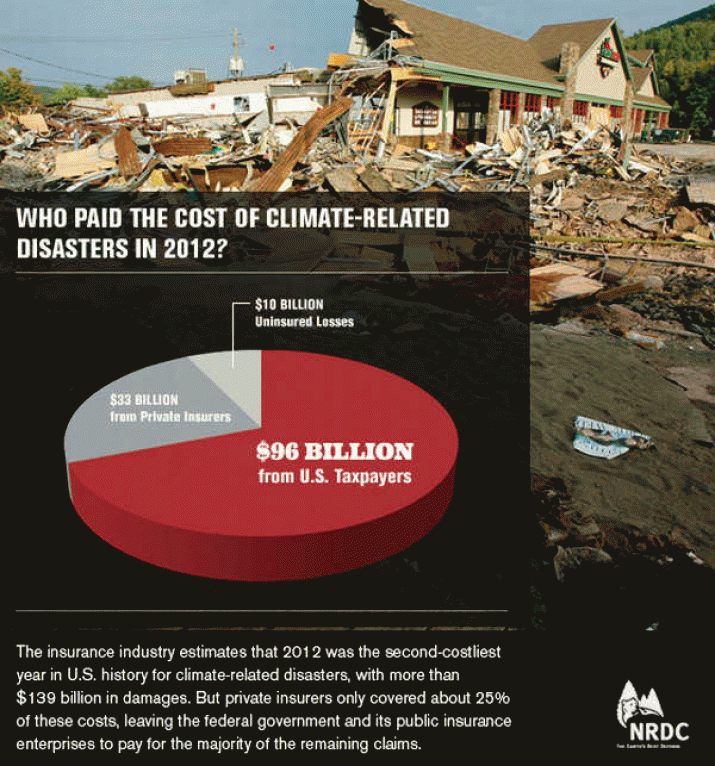
In the US in 2012 the Federal Government spent more from its Discretionary Budget on climate related diasters than on education or transportation.


And that is not the full costs to the economy with Insurers paying out $33 Billion and $10 Billion in uninsured losses.


Below is the sort of result we can expect from following Abbott’s policy of waiting for the US to act first. First is atmospheric Carbon.

Second is temperature following the sort of trend indicated below.

Whilst these outcomes may not be exactly what results, the ongoing Australian policies of fossil fuel burning and coal exports can only ensure that this is the trend for temperature and thus for increasing climate instability.
Australia has been somewhat fortunate that disasters have not hit highly built up areas like the North Eastern US, including New York. In the case of Cyclone Sandy we should remember there were also costs to countries in the Caribbean, including Haiti, a country impacted by a devastating earthquake only a few years before.
Of course this is no consolation for those impacted in Australia as extreme temperatures cause death and injury, as well loss of property from catastrophic fires, a new fire danger rating category created this decade.
Those in Queensland know what rainfall events are as they recover from a third event in as many years. In North Queensland the recovery from Cyclone Yasi is still to be completed.
In the major capitals heat waves have increased costs as the nation has to take measures to secure water supplies against declining rainfall.
These additional investments defer or reduce expenditure on other needs.
Indirect costs are often not counted or attributed. Along with that discount is the complete foolery of accounting still applies where disaster recovery adds to the GDP.
A rising trend of temperature increases causing greater climate instability will see the costs of recovery and adaptation bite further and further into the nation’s finances.
All Abbott has to offer is less investment in a transition to sustainable renewable energy and an offer to business to take what now amount to meaningless actions such as tree planting.
Programs based solely on tree planting have become next to meaningless because the trees need to remain in the ground for a century to be effective offsets for emissions when the predictions are for a much hotter and drier climate then and all Abbott proposes is a 5% reduction when all the advice tells us it should be about 20% by 2020 if we have a change of avoiding such an outcome.
If Abbott is elected for a second term to meet the advice of the experts an Abbott government will have to make a 15% reduction in 3 years.
Whilst it is true that Australia has found reductions of almost 9% in one year under the Emissions Trading Schemes fixed price period, if Abbott abolishes the scheme who can be sure of the emissions outcome, gains may be lost requiring even more severe cuts as we slip into a dangerous climate scenario.
One suspects the gains to date may have been the easy ones and the rate of reduction will fall as more costly changes to energy production have to be addressed making it harder for an Abbott government to make meaningful reductions in emissions.
Then there is placement of these tree plantations. For commercial growth rates areas of rainfall over 600mm are needed. Increasing climate instability brings such non-food uses into conflict with food production as droughts and floods impact on such production both nationally and globally.
Are the nations finances better served by higher food prices due to global scarcity?.
An outstanding example of the Liberals incapacity to understand the nation’s finances in a climate emergency comes from the budget.
The Clean Energy Finance Corporation is a statutory authority bound to act as a commercial lender currently up to $10 Billion to fund energy projects. Each of the projects is expected to make a commercial return.
Repayments including interest from the loans will see this a Nil cost over the life of the first round of funding as well as an increased supply of clean energy.
As these are commercial arrangements not only will all the laws will apply but the projects will have to show in a business plan based on energy demand and prices that they are viable.
Abbott wants to close this down and so he believed he could take its funds from the 2013 budget and redirect them to cover the tax cuts that were compensation for the Emissions Trading Scheme.
Besides the funds not being budget items the fact that his agenda is more of the same fossil fuel emissions that have resulted in the cost impact from the current level of climate instability show clearly he has no understanding of the climate emergency and how its impact on the nation’s finances will grow as frequency and degree of disasters increases.
It is the classical third stop on Diamond’s road map of societal failure where “rational behaviour” overrides the clashes of interest between the few highly motivated individuals trying to reap the big rewards from destroying climate stability and the many who because of the disinformation campaigns cannot recognize their long term interests in a stable climate.
Abbott’s failure to understand this and put in place comprehensive, adequate and timely action to reduce carbon pollution and transit the Australian economy will leave his daughter children and grandchildren wondering what were his motivations. They certainly are unlikely to be saying thanks.
From Canberra, The Eyre Peninsular, Melbourne, Sydney, Brisbane and Hobart’s fringes and in many rural and regional areas the impact of hot dry summers and fires is well known.
Fewer may have been impacted by floods but Logan Valley and Ipswich will remain vulnerable, unprotected by Brisbane’s flood defense, the Wivenhoe Dam. Coastal Queensland and NSW should keep in mind its recent experience as should northern Tasmania. Those in the Darling system may be thankful for the flood that ended the long drought but they should not forget that is their future.
Much of southern Australia has to consider that the heatwaves of last summer will be longer and more frequent.
Then they have to judge what is the best way to protect the nation’s finances in a climate emergency. Back to the past practices that have brought us into this pickle or continuing with emissions trading to transit energy production and the economy into the future?.
The conservative dream will not become reality. Nothing will bring back the climate older Australians grew up with, all we can hope for is it won’t get too much worse and take action to try to stop it becoming disastrous.