Coroner & Legal
The ‘blackmail provisions’ in the TFA Act

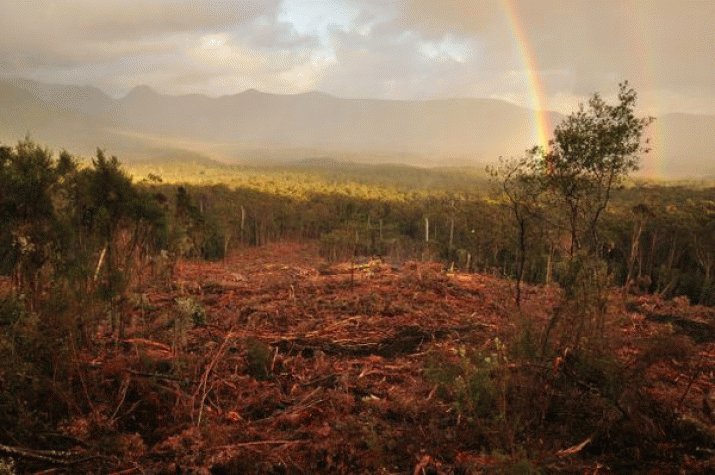

Tasmanian Forests Agreement
How it burdens the freedom of political communication
1. Details of the legislative process
The Tasmanian Forests Agreement Act 2013 (TFA Act) contains a process for the declaration of approximately 504,000 hectares of reserves. Aspects of the process arguably ‘burden freedom of communication about government and political matters’. The following is a step-by-step description of the legislative process and those aspects of it that seek to curtail dissent and protest against the Tasmanian forestry sector.
2. The reserve declaration process
Step 1: A ‘Special Council’ consisting of representatives from the forestry sector and the anointed environmental non-government organisations (Australian Conservation Foundation, The Wilderness Society and Environment Tasmania) must be appointed by the Tasmanian Minister.
Step 2: Upon the commencement of the Act, the specified reserve areas (i.e. approximately 504,000 ha) become ‘future reserve land’, which allows them to be proposed as reserves. Harvesting in most of the future reserve land is prohibited, although there are exceptions. In particular:
• harvesting on future reserve land can occur if it is associated with providing ‘access roading’ to harvestable coups, or installing cable harvesting infrastructure for harvesting in harvestable coups (i.e. to facilitate harvesting on steep slopes);
• harvesting can occur in any of the identified harvest reserve coups specified in Schedules A and D of the Act (there are 42 coups in Schedule D alone and many more in Schedule A);
• special species timber harvesting can occur in the Special Species Contingency Areas (24 coups) if it is recommended by the Special Council (noting that either House of Parliament can veto the harvesting); and
• special species timber harvesting can occur anywhere in the state if it is recommended by the Special Council and regulations are made to this effect (this is only meant to occur if the Special Council deems there is insufficient special species timber in the Special Species Contingency Areas) (again, either House of Parliament can veto the harvesting).
•
Step 3: After the TFA Act has commenced and the reserve areas have become ‘future reserve land’, the Minister has the discretion (i.e. he/she ‘may’) to make an order that identifies the future reserve lands that are to be ‘proposed reserves’ (known as the ‘proposed reserve order’). While the Minister is not compelled to make a proposed reserve order, he/she can only make it within a defined period. For these purposes, the reserves are broken into three groups:
• the ‘initial proposed reserve order’ areas — the order must be made within 30 days of the commencement of the Act;
• the ‘second proposed reserve order’ areas — the order must be made no later than March 2015; and
• the ‘third proposed reserve order’ areas — the order must be made in 2022.
If the Minister does not make either of the second or third reserve orders, the reserves that have not already been made are terminated (i.e. Schedule A is repealed and the reserves cannot be made via the TFA Act process). Further, if the Minister does not make the initial proposed reserve order, the TFA Act is immediately and automatically repealed. Importantly, if either the Act or Schedule A are repealed, the minimum high quality sawlog quota goes back to 300,000 m3 per year (from the TFA agreed 137,000 m3 per year). This would effectively require the recreation of the Tasmanian forestry sector and recommencement of sawmilling in sawmills that have been, or are intended to be, bought out through the exit program.
Before making a proposed reserve order, the Minister must ask for and receive:
• a ‘durability report’ from the Special Council; and
• for the second and third tranche of reserves, advice from Forestry Tasmania that Forest Stewardship Council (FSC) certification has been obtained for harvesting operations in the harvestable forests (known as the ‘permanent timber production zone’).
The proposed reserve order, durability report and Forestry Tasmania advice (where relevant) must be laid before both Houses of Parliament, and the order must be accepted by both Houses. If either House does not accept the initial proposed reserve order, the TFA Act is immediately and automatically repealed. For the second and third proposed reserve orders, the Minister gets one chance. If either House fails to accept a proposed reserve order twice (other than the initial proposed reserve order), the remaining undeclared reserves cannot be made under the TFA Act (i.e. Schedule A is immediately and automatically repealed and the minimum sawlog quota returns to 300,000 m3 per year).
Step 4: If a proposed reserve order is accepted by both Houses, the Minister must notify the Nature Conservation Minister, who must then make a determination on the final boundaries, values and purpose of the reserves. However:
• a determination for certain lots specified in Schedule AB of the Act cannot be made before 1 October 2014 and until Forestry Tasmania has received FSC certification; and
• a determination for certain lots specified in Schedule AC of the Act cannot be made until Forestry Tasmania has received FSC certification and the lots have been included in the World Heritage List.
If the boundaries, values and purpose of the reserves in the Nature Conservation Minister’s determination do not ‘substantially accord’ with those in the proposed reserve order, the determination must be tabled in both Houses, and accepted by both Houses. If either House does not accept the determination, the land cannot be made a reserve through the TFA Act (i.e. it is no longer future reserve land or a proposed reserve).
Step 5: After the Nature Conservation Minister has made a determination and it either substantially accords with the proposed reserve order or has been accepted by both Houses, the reserves are supposed to be declared by the Governor.
Note, however, that none of the Special Species Contingency Areas or special species harvesting areas specified under regulations can be included in a ‘Nature Conservation Act’ class reserve unless it has been approved by the Special Council.
3. Durability determinations
The TFA Act allows either House of Parliament to make a determination that:
… there has been a failure of durability, including, but not limited to, substantial active protests or substantial market disruption since the previous durability report, or if there is no previous durability report, since the commencement of the Act.
‘Substantial active protest’ is defined for these purposes as:
… an activity that has a negative material impact on forest operations legally carried out or on any processing of timber legally carried out.
‘Substantial market disruption’ is defined as:
… an activity that has a negative material impact on the sale of legally harvested Tasmanian timber.
If a reserve determination has been made by the Nature Conservation Minister and it substantially accords with the relevant proposed reserve order, and a durability determination has been made by either House of Parliament, details of the boundaries, values and purposes of the reserves, and a durability report, must be laid before both Houses of Parliament before the reserves are made. If the reserves and their boundaries, values and purposes are not accepted by both Houses, the land cannot be made a reserve through the TFA Act (i.e. it is no longer future reserve land or a proposed reserve).
4. Durability reports
The TFA Act requires the Special Council to prepare a durability report at least once every year and also in specific circumstances (e.g. prior to the making of a proposed reserve order and before the making of reserves if a durability determination has been made).
The TFA Act explicitly provides that, in preparing durability reports, the Special Council must:
• take into account the matters specified in clause 42 of the TFA, which include ‘ongoing public and proactive support for the outcomes of this agreement, including in markets for Tasmanian forest products’; and
• ‘contain advice as to whether there has been substantial active protests or substantial market disruption since the previous durability report or, if there is no previous durability report, since the commencement of the Act’.
5. Constitutional issues and freedom of political communication
The relevant test that is applied when considering whether a law infringes the freedom of political communication has three limbs.
• Does the law effectively burden freedom of communication about government or political matters in its terms, operation or effect?
• If so, does the law serve a legitimate end?
• If it does, does it serve that end in a manner compatible with the maintenance of the constitutionally prescribed system of representative and responsible government (i.e. is it proportionate)?
If a law does not satisfy these requirements, it will be struck down or the offending provisions will be severed from the Act or regulations. Courts will also seek to read down legislation so as to avoid infringing the implied freedom. If this option is available, it will curtail the matters that can be considered when making decisions under the legislation.
Arguably, the TFA Act imposes a burden on the freedom of political communication for an illegitimate purpose or in a manner that is disproportionate and not compatible with representative and responsible government. This is because of the ‘blackmail provisions’ contained in the TFA Act, which seek to ensure that, if there are significant protests or opposition to the forestry sector, the Tasmanian environment (to say nothing of the national economy) will be punished by not declaring the reserves and returning the sector to its previous harvest levels. Even if the Act or specific provisions are not struck down, the TFA and the TFA Act violate the intent and spirit of the freedom of political communication.
• Christine Milne: Forest Exit questions unanswered
• *Andrew Macintosh is Associate Professor, ANU College of Law
• Ben Quin, in Comments: It appears that the majority of the Tasmanian public, the ENGO’s, the Forestry Industry and the Parliament have simply shrugged off the loss of billions of dollars of public funds provided over years to the Tasmanian Forestry industry as being of no concern. They have shrugged off the collapse of Gunns together with the collateral damage to the Tasmanian economy. More compensation for forestry is acceptable within the TFA compromise. (I don’t agree. We should have a commission of enquiry as a pre-condition of the TFA). The real test of the TFA will come with the announcement of the re-start of negotiations for the pulp mill permits. Let’s see how the durability clauses stand up then. With the history of these affairs, those who argue that this is not political blackmail of the most insidious type are fooling themselves. We are destroying trust in our fundamental social institutions. Henning, Flanagan and others understand this.