Economy
Forestry Tasmania will clearfall vital swift parrot habitat on Bruny Island

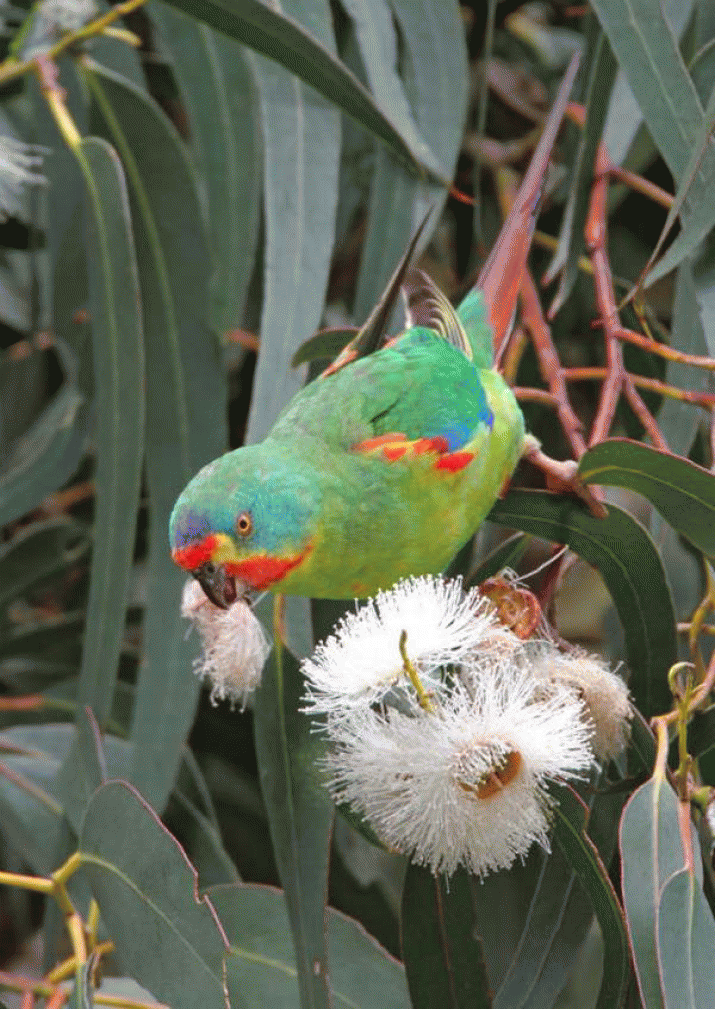

Forestry Tasmania has told the Bruny Island community that it will commence logging three coupes within the Bruny Island national park extension reserve in June.
The decision means that a significant area of forest, which provides essential breeding habitat to Australia’s 2500 remaining swift parrots, will be destroyed.
Dr Louise Crossley, Chair of Spirit of Bruny said, “The Bruny national park extension is one of only two proposed reserves in Tasmania that received National Park status under the Forest Agreement verification processes.”
This assessment is the highest possible level of protection under conservation legislation and it recognizes the outstanding biodiversity, cultural heritage, and threatened species habitat values of the proposed reserve.
“It is absurd that after all the negotiations leading up to the Forest Agreement, Forestry Tasmania want to clearfell in this reserve area. Their action will place at further risk the swift parrot and 38 other threatened species that have found a refuge here.
Forestry Tasmania have told Spirit of Bruny it recognizes the conservation value of these coupes, but is obliged to clearfell them to meet contractual obligations. However, Spirit of Bruny believes that alternative timber is available outside the reserve on Bruny Island, or elsewhere on the Tasmanian mainland.
“We are calling on the Minister for Forestry, Mr Brian Green MLA, and the Chair of Forestry Tasmania, Mr Bob Annells, to direct Forestry Tasmania not to damage the Bruny Island national park extension reserve,” said Dr Crossley, “Forestry Tasmania must seek timber from coupes outside reserve areas.”
The Tasmania Forest Agreement has given several hundred million dollars of funding to the forest industry, but it has failed to deliver certainty to the swift parrot and other threatened species on Bruny Island.
• David Obendorf Transcript: Interpreting the Spirit of the TFA
[ABC1-TV [i]7.30 Tasmania[/i] – 10 May 2013]
[b]Bob Annells[/b] – Chairman of FT [29 April 2013]: ‘Apart from a couple of coupes that will be finished in a matter of weeks, we will be out of those areas and we will stay out.’
[b]Bob Annells[/b] [early May 2013]: ‘The ink isn’t even dry on the Agreement and now we are being asked to make exceptions.
The broader transition arrangements under the TFA envisage in non-World Heritage nominated areas that we will continue logging for quite some time. So, no, I’m to being tricky with words; people chose to put an interpretation on it that wasn’t there.
We had a saw miller last week that just ran out of logs because we are just not able to supply them. That has both legal and operational impacts for us.’
[b]Phill Pullinger[/b], Environment Tasmania negotiator [on the 42 coupes scheduled to be logged within the 504,000 ha reserve area]: ‘That was one of the unfortunate, ahh… that was one of the compromises that was made during the negotiations.’
[b]Airlie Ward[/b]: ‘Publicly pro-peace deal environmental negotiation leaders [ENGOs] have been saying no proposed reserves will be logged.’
[b]Nick McKim[/b], leader of the Tasmanian Greens: ‘Well, the legislation that was passed yesterday [30 April] actually delivered immediate legislated protection for over half a million hectares.’
[b]Phill Pullinger[/b] [on 30 April before the TFA Bill passed]: ‘Well, this ahhh…. legislation if it passes today – through the House of Assembly – will protect, ahhh… half a million hectares of native forest of outstanding natural values.’
[b]Airlie Ward[/b]: ‘Are you being tricky with words then to say that 504,000 ha is being protected from logging when within that there’s around 600 ha that is potentially going to be logged?’
[b]Phill Pullinger[/b] [in early May after the TFA Bill passed]: ‘No, ahhhm… basically what this agreement does is bring… bring an end to, ahh… the logging in these forests and there is a period of transition for the … for the actual, ahhm… practical, structural work of the moving of the logging operations out of the agreed reserves.
I certainly hope that with the additional funding, with the support from Governments and a, ahhm… a constructive approach from Forestry Tasmania there’s a way that they can f… f… find a way to shift those logging coupes, ahhm… out and off that list.’
[b]Bob Annells[/b]: ‘The spirit of the Agreement that I referred to is the very genuine attempt that we are making to try, in fact, and not use transition coupes wherever possible. That’s the spirit of what we are trying to do.’
[b]Airlie Ward[/b]: ‘But you can give no guarantees?’
[b]Bob Annells[/b]: ‘I can give no guarantees.’
• Gordon Bradbury, http://blackwoodgrowers.com.au/ :
All this talk about Forestry Tasmania and certification, sawlogs, regrowth management, sustainability, etc, etc. is a clear indication to me of one of the main reasons why the forest industry is such a basket case.
I keep saying it, but very few people seem to understand. Growing trees for wood production is a business, and the first and most important objective in any business is profitability. Everything else comes later. Doesn’t matter whether it is a GBE or a private grower. Same rule applies. Even the manager at my local corner store knows this rule!
If the new GM at FT does not improve the financial performance (and reporting) of the GBE, all the sustainability in the world wont save it.
So how about some discussion about the profitability of FT (and the rest of the industry) and how it can be improved. For example I suspect that growing more sawlogs wont improve FTs profitability, not unless sawlog prices increase dramatically.
Any other ideas?
• Richard Colbeck: Labor needs a plan to stand up to green protests, not platitudes and naivety
• Gunna, in Comments: The Rainforest Alliance announces its intention to conduct an audit of Gunns Ltd forestry operations from 13th to 20th June 2013, as required under the Forest Stewardship Council (FSC) FM Controlled Wood Standard. Download public briefing paper:
• Senator Christine Milne: Senate motion: logging in world heritage areas
Senator Milne will move a motion tomorrow calling on the Senate to uphold the principle that World Heritage Areas should never be logged.
WHO: Senator Christine Milne
WHERE: Senate Chamber
WHEN: Wednesday 15 May, after 3.30pm
WEB: http://www.aph.gov.au/News_and_Events/Watch_Parliament
NOTICE OF MOTION
I give notice that on the next day of sitting I shall move that –
The Senate:
1. Notes:
a. The April 2013 letter from the Minister for the Environment Tony Burke MP to the signatories in the Tasmanian forestry talks affirming that he would not allow logging within the Tasmanian Wilderness World Heritage Area or other areas listed in the Environment Protection Biodiversity and Conservation Act 1999.
2. Upholds:
a. The principle that areas listed as world heritage should never be logged.