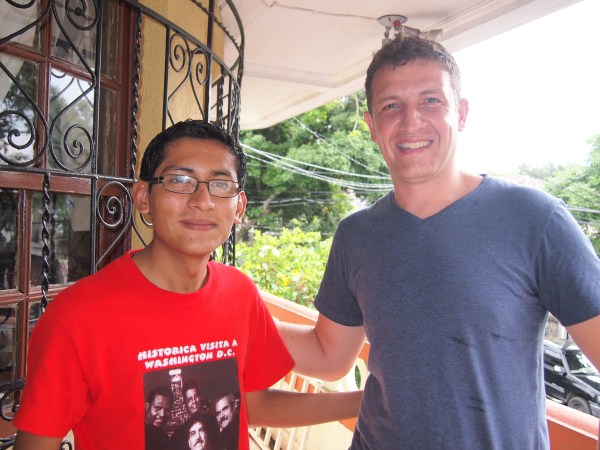
Picture: Mauricio and James in San Salvador
After getting somewhat lost in the run-down outskirts of El Salvador´s capital, San Salvador, we finally meet Mauricio Maravilla Chavez outside radio station Cadena Mi Gente. He greets us with a hug and takes us inside past the studio and upstairs on to a small balcony mostly sheltered from the afternoon rain. Mauricio has just turned nineteen. Many Salvadoran men his age provide the hands that harvest the huge sugar cane and coffee plantations or have fallen into the gang life that so brutally plagues Central America, but Mauricio is no average teenager. He talks on the radio for 20 hours a week, studies and vociferously writes blogs and poetry. When I began researching Mauricio online from Australia, one of his statements leapt from the screen and captured me: ´´If I read and don´t write I am in debt to the world.´´
Mauricio grew up in the village of San Juan Opico, which is separated from the capital by a half hour drive and the imposing San Salvador Volcano. The eldest of four children, he recalls a traumatic childhood when he witnessed regular beatings of his mother at the hands of his drunken father. The family often had to move, until at the age of 12, Mauricio was forced into early adulthood when his father was killed by local gang members. From that point on Mauricio´s mother had to move her young family into her mother´s home and work extremely hard to support her children.
Despite this difficult childhood, Mauricio believes the thing that shaped him most in his youth was his motivation to read, ´´Not just by reading books, but within them, the discovery of reality, the reality that our country is very troubled and needs to change,´´ he explains. Books are expensive in El Salvador, most people can´t afford them, but access to the internet and a generous teacher who gives him a book every birthday has helped Mauricio quench his thirst for words. According to Mauricio, it´s reading that has allowed a different pathway to form ahead of him.
Mauricio is slightly built and wears glasses. He is wearing jeans and a red t-shirt with the Venezuelan band Los Guaraguao on the chest. I have interviewed others where it is necessary to add questions to questions in order to obtain a full answer, but with Mauricio it is necessary to cut him off in order to get to other important questions, yet with remorse, because every word he speaks feels relevant and important. Like most good speakers, he speaks not only with his mouth, but with his body and with strategically placed silence. We pause for a moment while a dying motorbike chokes up the street below us before continuing our conversation.
Mauricio argues that because Latin America is one of the least developed parts of the world it is fundamental that a consciousness of the need for change be built within her ´everyday people´. He admits to being on the left side of politics, explaining that in his view the key difference between left and right is that the Left believe poverty can be reduced, even eliminated, whereas the Right view poverty as something natural that will always be. ´´But´´, he says, ´´there is no point saying I am Left you are Right when we both live in poverty. If we both face the same problems we need to find solutions together.´´
Mauricio believes there are subtle ideologies underlying Salvadoran society caused by centuries of imperialism, slavery, racism and oligarchic rule, which conspire to diminish hope by propagating the resignation that change is impossible. He scorns individualism, believing that family leads to community which leads to society and that true greatness is found in struggling for others in need. His heroes are Jesus, ´´the person, not the religious identity´´, and Gandhi because they were both courageous yet non-violent and empowered people to create a better future.
In early 2012, a new political party was launched in El Salvador called Movimiento Nuevo Pais (New Country Movement) lead by Dagoberto Gutiérrez. Mauricio is heavily involved with the party, particularly with the role of trying to engage and activate the country´s youth. He believes that the other parties, both left and right, are run too much like businesses and for their own sake, when their primary purpose should be improving lives and enacting the Constitution. Despite being a political party, Mauricio argues that the main ´´struggle´´ for Movimiento Nuevo Pais is not electoral, but rather it is social – a struggle to invigorate people politically, to show them issues and possibilities and to motivate them to create change.
I ask Mauricio why poetry and writing is important to him. His answer is simple – ´´So people understand.´´ It doesn´t matter if it is nature, love, injustice or anything else you write about, the hope is that your words will create understanding.
He tells me of an interview he once heard with El Salvador´s most famous writer Roque Dalton, who was asked how he could love El Salvador at the same time as writing of such tragedy and sadness. Dalton replied, ´´This is what we are. Let´s change.´´
Next to Mauricio sits a small laptop. He won the laptop for an essay he wrote about a campaign to stop violence against women. I glance at the laptop, almost pitying its lack of rest, having observed how often new posts from Mauricio appear on social media. His prolific writing, the laptop and the internet have enabled him to repay his self-imposed debt to the world with interest.
His ´´ultimate dream´´ is to one day become President of El Salvador to ´´help build a more just country.´´ From most people this notion would seem far-fetched and fanciful, but there´s just something about Mauricio that makes his dream seem reasoned and attainable.