Economy
Roundtable for Two Please

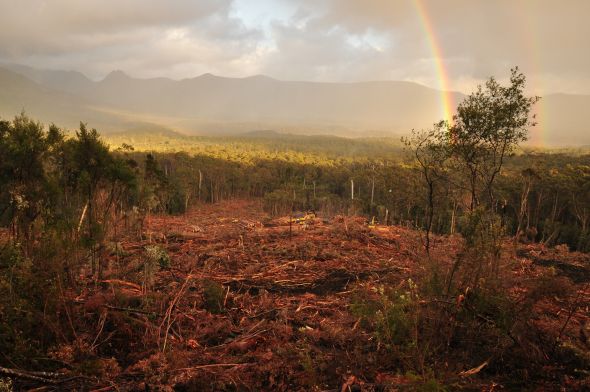
Pic: Emma Capp

“Table for two?Just two?”
“Yes, of course. It will be a permanent booking.”
“Same as usual then? Put it on the public tab?”
“Of course. Money’s no issue. It’s not ours”.
“So, clearfell for you and a bit of the old growth for you then?”
“We’ll need to send a meal to the corporate boyos, usual transport, on the public tab, don’t forget. With gravy”.
“Anything else for you both?”
“We’re interested in a large helping of residues with extra plantation garnish.”
“Large?”
“As always, of course.And done the same way.”
“So just the two of you then?”
“We like to be exclusive, so there will be nobody else, unless the Man rings…”
“We have a new FSC dessert. Like to try it?”
“New? What’s in it? How will it go on top of clearfell?”
“Umm… I’ll check with the chef. Something to do with free, prior and informed consent.”
“Sounds a bit unhealthy to me. Just like those carbon credits with coffee.”
“Oh well, it might be what the other tables want.”
“What other tables?”
“The rest of them. You know, the public tables.”
“Never heard of them. Must be outside the tent. By the way, we might try the FSC dessert, but the social chamber sauce looks a bit rich. Any way to replace it…?”
The real winners from the 30 month negotiations are the ENGOs. The real losers are the timber industry itself and the Tasmanian public. If ever a chance to really restructure the timber industry onto an economically and socially sustainable footing was lost it was blown to pieces during this disastrous period.
At no stage throughout the whole process were the substantive issues of management satisfactorily addressed. The main outcomes were all about trade-offs between the industry dinosaurs on one side and the one-issue conservationists on the other. It was essentially a roundtable for two, with a hide-bound focus on the local turf war, all about carving out territory and then using heaps of public funds for all sorts of buy-backs, buy-outs, and special purposes, such as a “plantation management fund” and a “plantation manufacturing innovation fund”.
There is no evidence of any attempt to remodel the industry away from past and present clearfelling practices in the catchments, or of intensive logging, or of bulk woodchipping.
“Residues” are to continue being created as they have ever since woodchips became the mainstay of the industry. In relation to that, the agreement calls for “urgent” access to “the Triabunna processing and export facility and Burnie wharf facility”, to be publicly funded by a “value-adding facilitation fund”, whatever that means.
Ambiguity surrounds the volumes of everything, from high quality sawlogs, to the size and purpose of the plantation estate and the quantity of “low-quality sawlogs” and “residues”.
According to the agreement “at least 137,000 cu.m of high quality sawlogs” will be a “minimum supply requirement”. This is later contradicted by another clause which says that “sawlog volumes are to be reallocated up to 137,000 cu m per annum”, and that “high quality native forest sawlog above this minimum agreed figure will be permanently retired”.
Which part of the agreement are we to believe? Presumably the ambiguity is deliberate, because these people have spent months together working out the wording.
There is no detail about peeler wood supply for Ta Ann, except for the need for renegotiated contracts. What the deal will be between Ta Ann and Forestry Tasmania will be buried from public scrutiny, as is normal, as will the ways and means that Ta Ann will be featherbedded through various subsidies.
Special timbers have their access areas reduced, and lipservice is given in the agreement to train the clearfellers to identify different species, presumably to prevent at least some of the more valuable timber being “residued” or burnt. That exposes its own story, especially about the obdurate and incomprehensible support given to clearfelling and woodchipping for years on end by some of the more publicly known users of special timbers. Everyone who has worked in the “residued” industry can tell stories of special timbers being chipped, as well as stories of workers trying to save the timber from such a useless fate.
So it looks like business as usual in a smaller paddock. Nobody was allowed to participate in the process who was known to have questions about current management practices, or questions about monocultural plantations, or who wasn’t willing to trade on the pulp mill. There is nothing in the agreement which poses any problems for any consortium willing to buy Gunns’ permits if they are put up for sale. There is no doubt that the government will use this argument to get MLCs to back legislative implementation, in much the same way that they tried to help get Gunns a joint venture partner after the 2010 statement of principles was signed off. The argument back then was that the statement of principles had created a “social licence” for the mill. We’re in for a repeat of all that.
In this sense, it is interesting that a whole host of environmental groups which had initially opposed ENGO involvement in the forestry roundtable process, and even publicly distanced themselves from their peak organisation, Environment Tasmania, have now endorsed the forestry agreement. No doubt most of them have fallen into line because they believe that their local interests have been addressed, if we are to believe that representatives of the Blue Tiers, Western Tiers and many others who were previously very critical of the whole process which began in May 2010, have now swung behind the ENGO signatories, TWS, ET and ACF.
Looking at the map, there is good reason to understand why parochialism has won the day for so many who have been ignored for so long. The prevailing consideration is that any agreement which locks out forestry operations in areas identified as having high conservation values, irrespective of the trade- offs, is an indisputable winner as far as they are concerned. In fact that is exactly what one of their representatives said in the joint press release of 16 environmental groups. They seek to rest easy after seeing their landscape trashed for years on end.
Perhaps they should have had a closer look at the map. Parochialism has its virtues, but it also has its self-destructive limits. It’s a great map. What it shows is that the catchment areas which have been mercilessly trashed over the last generation or so of clearfelling can expect more of the same. This is where the general Tasmanian public is the real loser from this whole two-sided deal. It means that in the end the final costs – in money, water and land degradation – will be higher for the whole Tasmanian community. It’s truly a lopsided deal for a sector of the economy which represents such a small proportion of the workforce and which relies heavily on the public purse anyway. It is also likely that the concern expressed by Jonathan West that the “wood zone” will be more heavily trashed than ever, will come to pass.
The MLCs aren’t known for the length and breadth of their vision beyond short-term self-interest, so they’ll consult their navels very closely on this, with loud announcements of personal angst. That anxiety will have been ramped up by the fact that Ta Ann has given its imprimatur to the agreement, especially among those who rely heavily on a political image as forest industry stalwarts. We have already seen Paul Harriss fly the energy flag as a salve to conservative opposition to the agreement in his electoral heartland, but we also know that key elements of TCA – particularly in the Huon, but elsewhere as well – have always been confident of their ability to influence the votes of some MLCs on this issue. Ta Ann versus TCA is about as unlikely a scenario as you could get. But since about 2006 the splinters of division within the Tasmanian community have sprouted like ecological diversity in a well-managed forest – how ironical is that! –so whether we now see a rapid evaporation of any deep-seated concerns of any sort among MLCs on the back of their kow-towing to the predominant corporate interest, as in 2007, will be a sight to behold, or at least entertaining.

Evan Rolley

Whatever the case Ta Ann is now much better placed than any forestry corporate interest in Tasmania’s history, apart from the now defunct Gunns, to rip-off the Tasmanian taxpayer and future generations of Tasmanians in short-term profits for off shore investors for about 100 local jobs. They’ve learnt a bit from Gunns, but the signs are good that they’ve learnt the wrong lessons. A couple of weeks ago Ta Ann said it was poised to leave Tasmania if it didn’t get what it wanted from the IGA. This was pure theatre, equivalent to John Gay’s histrionic blabber about leaving Tasmania for China unless he got his way.
As soon as a company starts to sprout that sort of propaganda they lose public credibility, and it’s a bit too soon to copy Gunns’ methods of public relations. Their corpse still stinks too much. But we shouldn’t be surprised by the tactics. Evan Rolley has brought a new dimension to Ta Ann. He is similar to Robin Gray at Gunns, but with important differences.
Rolley has got himself in a key position with an offshore company which has a horrendous international reputation for its practices in its own country, Malaysia, and he is also a former key executive of Forestry Tasmania. Great combination.
It’s taken 30 months to produce this strangely ambiguous document, shot through with all kinds of loose ends, dichotomous phraseology and junk clauses. One of the reasons it has taken so long – if not the most important reason – is that it failed in its purpose of getting a joint-venture partner for Gunns. Throughout 2011 the process floundered as Gunns unravelled, and really only came to a more speedy conclusion after Gunns final exited stage rear a couple of months ago. Perhaps that also helps to explain why the agreement is such a shoddy document, but such an explanation makes it no less shoddy.
One thing is most disturbing. The composition of this roundtable guaranteed – tragically for the future of the industry – that key issues were not on the agenda, especially to ensure a full canvassing of a range of alternative models for the future, in a rapidly changing world. Those alternatives were deliberately excluded by the complete politicisation of the whole process, narrowing everything down to the balkanised interests of old-style industry stalwarts and blinkered environmentalists.
This whole process has actually further weakened the capacity of the forestry industry to drive reform from within. Nowhere is this made clearer than in the bland statement that “the signatories will actively support FSC certification”. That will be an interesting challenge if the current management practices are not changed. If, as seems likely, the industry attempts to stack the social chamber or rort the updated FSC certification process requiring “free, prior and informed consent”, FSC International will seek to protect itself.
The Tasmanian industry is in a real bind in relation to certification. After scorning FSC accreditation for nearly 20 years, they now find that it’s the global marketing benchmark which they can’t ignore. But how can they reform the industry to meet those standards?
Then we come to plantations.
This is where things really go off the rails into the realm of deep illusion. Everything written about the plantation “solution” is mired in fallacy. There can be no transition into a sustainable forestry industry in Tasmania based on monocultural plantations planted for pulp. This goes to the heart of the lack of honesty and transparency at the centre of the negotiations which began in May 2010.
Whatever the fate of this weird and anachronistic shambles, based as it is on siloed thinking of the worst kind, it’s hard to know how the old forestry industry, with its cargo cult mentality still predominating, can learn to change.
Siloed thinking never works. It always fails to accommodate important relevant information because it is so often confused with incremental reform. Those who say we will “fix” this issue before we move to the next issue are doomed to failure. There has to be an integrated approach to policy development which is based on careful and ongoing assessment, not an approach which focuses on the interests of narrowly-based groups which inherently excludes valuable information for political reasons.
Many of those who have supported the establishment of the roundtable in May 2010 and everything which has taken place since then until now, have made their decisions on a hope and a prayer that a two-sided roundtable had the capacity to deal with issues in an environment of compromise for them alone, and nobody else.A table for two which enshrined their power to influence how public funds would continue to flow into a bottomless pit for the indefinite future, under all sorts of funding programs.
The reality is that…
“Table for two next week then?”
“Must say that side dish of special species was not up to much. Haven’t you got something more appetising? Didn’t like that new FSC stuff either. Needs watering down”
“The chef’s working on it, but don’t forget most of it has already gone into the main course”.
“Bit like caviar, eh? Another one for the public tab, don’t you reckon?”
“The good old public tab. Where would you guys be without it? No more dining out…”
“Must run. Man’s on the phone. Commercial in confidence. By the way, what did happen to that sturgeon you used to sell, you know, the caviar stuff? Used to be part of the clearfell course. Remember?”